
Web SocialSense: Bridging Physical and Social Sensing via the Mobile Browser
Sensor fusion of physical and social data using Web SocialSense on smartphone mobile browsers
This paper introduces Web SocialSense, a JavaScript-based framework designed for smartphone mobile browsers (specifically Tizen) that enables near-real-time sensor fusion. It utilizes a graph-based topology to integrate time-series data from physical hardware sensors with "social software sensors" to create context-aware applications.
TL;DR
Web SocialSense is a JavaScript framework that allows developers to build sophisticated, context-aware mobile apps entirely in the web browser. By using a graph-based architecture, it fuses data from physical sensors (accelerometers, GPS) with "social sensors" (Facebook, calendars) to drive real-time features like activity-targeted advertising and social mapping.
Background & Motivation: The Native Barrier
Historically, building a context-aware app—one that knows if you are running, driving, or near a friend—meant wrestling with native SDKs. Developers had to write Java for Android and Objective-C for iOS, leading to fragmented codebases.
The authors of Web SocialSense identify a shifting paradigm: as Web Runtimes (WRT) like Tizen and Firefox OS treat web apps as first-class citizens, can we move the heavy lifting of sensor processing and fusion into JavaScript? The challenge lies in performance, power efficiency, and handling asynchronous data streams from diverse sources.
Methodology: The Graph Topology Paradigm
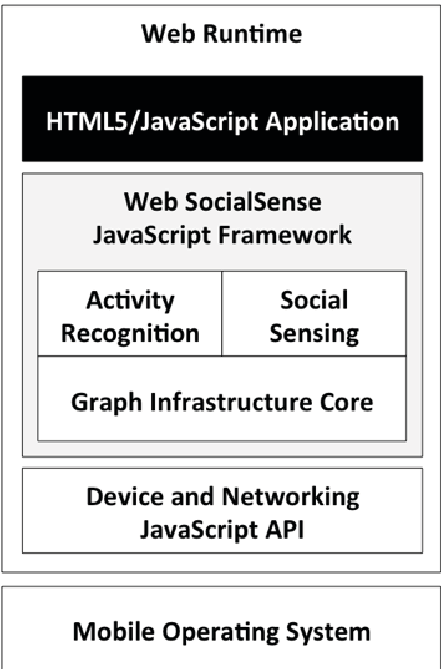
The core innovation of Web SocialSense is its modular graph-based architecture. Instead of a monolithic script, processing is broken down into discrete nodes:
- Source Nodes: Wrap hardware APIs (Accelerometer, Geolocation) or Web APIs (Facebook SNS).
- Processor Nodes: Handle signal processing (e.g., Fast Fourier Transform - FFT) or data filtering.
- Fusion Nodes: The "brains" where physical and social data meet.
Decoding the Activity Recognition Window
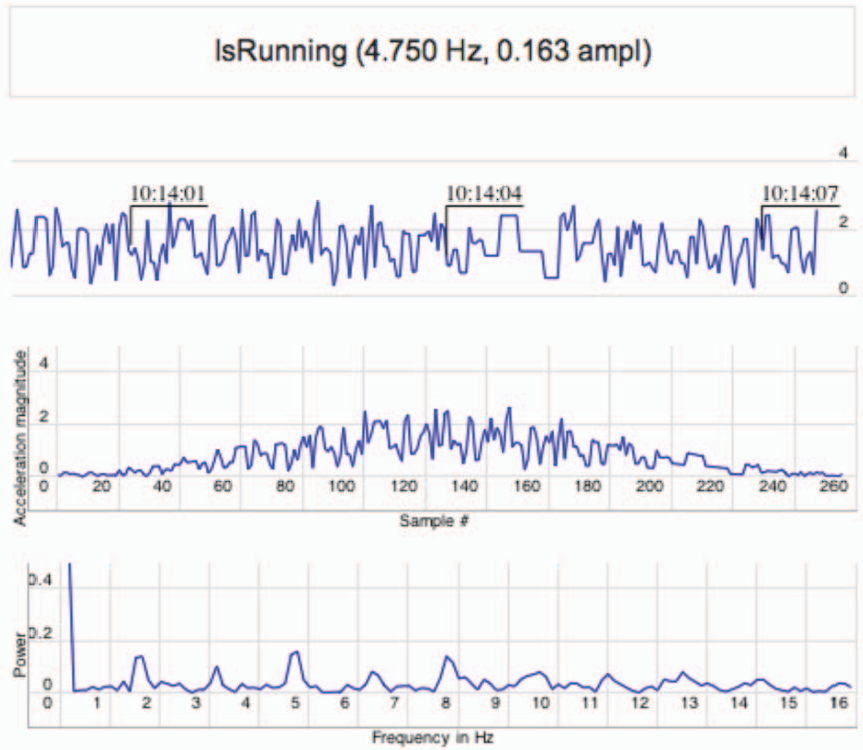
To identify movement, the framework performs real-time digital signal processing (DSP). It captures 32Hz accelerometer data, applies a Hamming window to reduce artifacts, and uses a C4.5 decision tree to classify the activity. This process, traditionally reserved for native code, is executed here in a high-level JS environment.
Real-World Applications: Social Map & ActVertisements
To prove the framework's utility, the authors built:
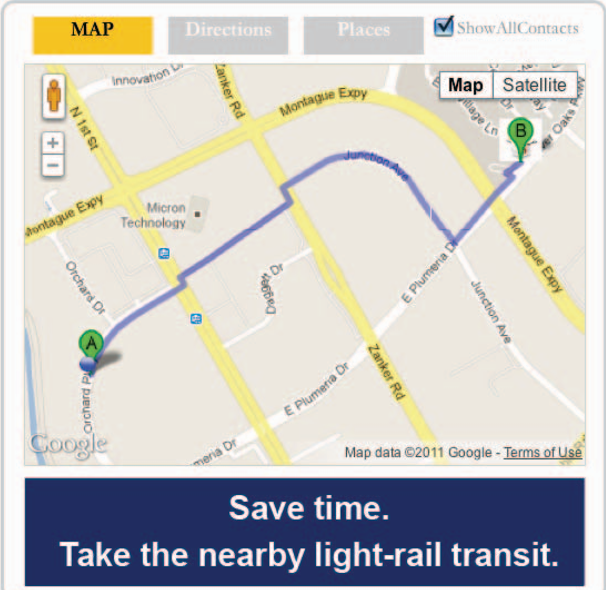
- Social Map: A dynamic map that suggests routes to friends based on your current activity. If you're walking, it shows a trail; if you're driving, it switches to a road route—all fused from real-time social check-ins.
- ActVertisements: An automated ad-engine that serves banners based on physical state. Imagine receiving a discount for running shoes exactly when the accelerometer confirms you've finished a 5km run.
Performance & Efficiency
Many dismiss Web-based sensing as too slow or power-hungry. The results argue otherwise:
- Accuracy: 95% in activity classification, rivaling native solutions.
- Latency: Fusion nodes take ~1-2ms, while the heavy FFT/Classification takes ~34ms—well within the window for real-time interaction.
- Power: While native Android sensing used ~185mW, Web SocialSense used ~317mW. While higher, it remains within a viable range for modern smartphone batteries.
Critical Insight: Why This Matters
The true value of Web SocialSense isn't just "JS on mobile." It's the structural abstraction. By treating social data (API calls) and physical data (hardware interrupts) as similar time-series nodes in a graph, it simplifies the logic of "fusing" them.
However, the reliance on polling for social sensors (e.g., checking Facebook every 30s) is a clear bottleneck for battery life. Future iterations moving toward Push Notifications and offloading heavy classification to Web Workers (multi-threading) or the cloud could further bridge the gap between web and native performance.
Conclusion
Web SocialSense demonstrates that the mobile browser has evolved from a simple document viewer into a powerful sensing hub. For developers, this means the "write once, run anywhere" dream is extending into the complex world of context-aware, multi-modal sensing.