
Beyond Cognition: How Sensory Profiles Shape Robot-Mediated Autism Therapy
9341_Do Sensory Preferences of Children with Autism Impact an Imitation Task with a Robot
This paper investigates how the sensory profiles of children with Autism Spectrum Disorder (ASD) affect their performance in imitation tasks with a Nao robot. The researchers used a customized Socially Assistive Robotics (SAR) protocol to evaluate imitation skills across seven sessions, finding that sensory preferences significantly influence human-robot interaction outcomes.
TL;DR
Researchers have discovered that a child's "sensory fingerprint"—specifically whether they rely more on internal body cues (proprioception) or external visual cues—drastically changes how they interact with social robots. While all children in the study showed social improvements after working with the Nao robot, those with an overreliance on proprioception struggled significantly more with imitation tasks, suggesting that future AI-driven therapy must be "sensory-aware" to be truly effective.
Contextualizing the Study
Socially Assistive Robotics (SAR) is no longer a futuristic concept in autism therapy; robots like Nao are frequently used to bridge the gap in social communication. However, most studies treat ASD as a monolithic group or categorize children by cognitive levels. This paper shifts the focus to the sensory-motor coordinate system, arguing that motor impairments and visual processing deficits are the real gatekeepers of social success in human-robot interaction (HRI).
The "Why": Why Sensory Profiles Matter
The research team operated on a fascinating technical intuition: children with ASD who have hyporeactivity to visual motion but overreliance on proprioceptive information (body sense) are essentially "locked out" of the visual feedback loop required for successful imitation. If you can't process the robot's visual motion effectively because you are focused on your own limb's internal position, the social "mirroring" required for imitation breaks down.
Methodology: The Imitation Loop
To test this, the authors designed a dual-phase interaction:
- Imitation by the Child: The robot "danced" to a song, and the child had to replicate arm positions. The system was adaptive, increasing speed and complexity as the child improved.
- Imitation by the Robot: Using an RGB-D camera (Asus Xtion), the robot tracked the child's movements and mirrored them in real-time, testing the child's "initiation" skills.
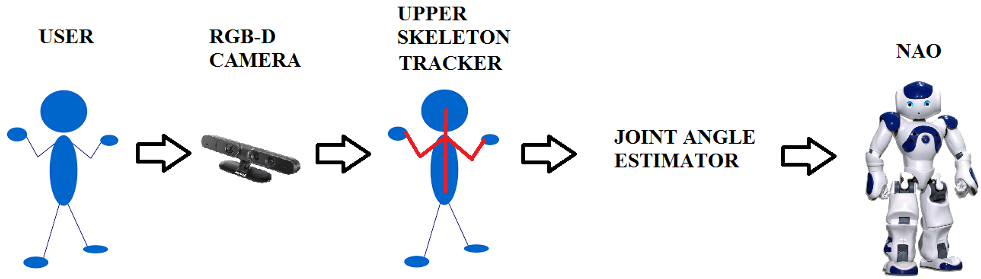
Figure 1: The technical pipeline using ROS and OpenNI to create a closed-loop imitation system between the child and the Nao robot.
Experimental Results: The Proprioceptive Gap
The results confirmed a stark divide between the two sensory groups (G1 and G2):
- Imitation Performance: Group G2 (visual-reliant) achieved significantly higher imitation scores (~80%) compared to Group G1 (~23%).
- Social Engagement: Gaze behavior was consistently higher in those who were more reactive to visual cues.
- The "Generalization" Effect: Crucially, the skills learned with the robot transferred to humans. For instance, participant CH11 saw a massive jump in gaze towards a human partner (from 14% to 60%) after the robotic training sessions.
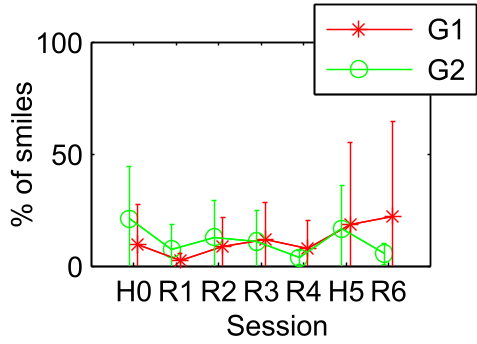
Figure 2: Longitudinal tracking of gaze and imitation scores showing the diverging performance based on sensory profiles.
Critical Insight & Future Outlook
The core takeaway is that standardized therapy is suboptimal. A robot that performs complex, fast visual movements might be perfect for a "visual-reliant" child but overwhelming or invisible to a "proprioceptive-reliant" child.
Limitations & Future Work
- Robot Embodiment: Nao's small size and non-biological motion limit its effectiveness for those who struggle with movement processing.
- Automation: The study suggests that robots should eventually include a "sensory profiling" module that automatically detects a child's profile via their initial movements and adjusts the interaction's visual complexity accordingly.
Conclusion
This work provides a roadmap for the next generation of Socially Assistive Robots. By moving beyond IQ-based assessments and looking at how children physically perceive the world, we can design AI partners that don't just "act social" but "interact optimally" with the diverse sensory realities of the autism spectrum.