
SentiBank: Decoding the Emotional Language of Images through Adjective-Noun Pairs
19002_SentiBank large-scale ontology and classifiers for detecting sentiment and emotions in visual content.
SentiBank is a large-scale visual sentiment ontology and a library of 1,200 classifiers designed to detect emotions in social multimedia. It introduces the concept of Adjective-Noun Pairs (ANPs), such as "beautiful flowers" or "sad eyes," to bridge the gap between low-level visual features and high-level affective meanings.
TL;DR
SentiBank is a pioneering framework that moves beyond simple "happy/sad" labels for images. By creating a massive ontology of 1,200 Adjective-Noun Pairs (ANPs)—like "gloomy sky" or "wonderful sunset"—it provides a mid-level semantic layer that allows computers to "feel" the sentiment of visual content with unprecedented precision.
Academic Positioning: This work is a seminal contribution to Affective Computing and Multimedia Analysis, successfully bridging the "Semantic Gap" between raw pixels and human emotion using a hybrid approach of psychology and big data mining.
1. The Semantic Gap in Visual Sentiment
Traditional sentiment analysis has a "missing middle." On one hand, we have low-level features (colors, textures, shapes); on the other, we have high-level emotions (joy, anger, serenity). Mapping pixels directly to "Joy" is incredibly difficult because "Joy" is abstract.
The authors argue that images on social media (Flickr, Twitter) contain rich affective information that text-only models miss. Their insight was to find a mid-level representation that is both emotionally descriptive and computationally detectable.
2. Methodology: The Power of the ANP (Adjective-Noun Pair)
The core innovation of SentiBank is the use of Adjective-Noun Pairs (ANPs) as the fundamental unit of sentiment.
Why ANPs?
- Adjectives carry the emotion (e.g., "Beautiful," "Tragic").
- Nouns provide the context/anchor for detection (e.g., "Landscape," "Accident").
By pairing them, the system creates a concept that a machine can actually "see." It’s much easier for a computer to detect a "beautiful flower" than just "beauty."
Construction Process
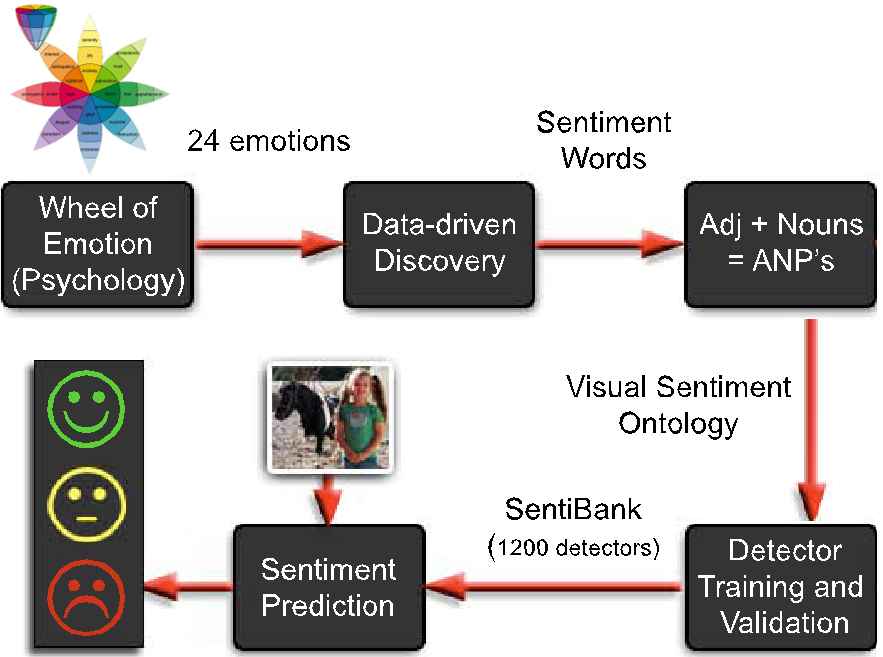
- Psychological Foundation: Start with Plutchik’s Wheel of Emotions.
- Data Mining: Scrape tags from Flickr/YouTube to find words that co-occur with these emotions.
- NLP Filtering: Use lexical tools to find "polarized" adjectives and pair them with frequent nouns.
- Training: Train 1,200 individual detectors using crawled social media images.
3. Results and Visual Interaction
The SentiBank library doesn't just exist as code; it enables new ways to browse the emotional "landscape" of the internet.
Performance
The classifiers are surprisingly robust for their time (2013). With most F-scores exceeding 0.6, the system proved that breaking emotion into 1,200 specific ANP concepts makes the "subjective" task of sentiment analysis much more "objective" and measurable.
Exploration Tools
The authors demonstrated three primary interfaces:
- The Emotion Wheel: An interactive map based on Plutchik’s theory where users can explore ANPs linked to specific intensities of emotion.
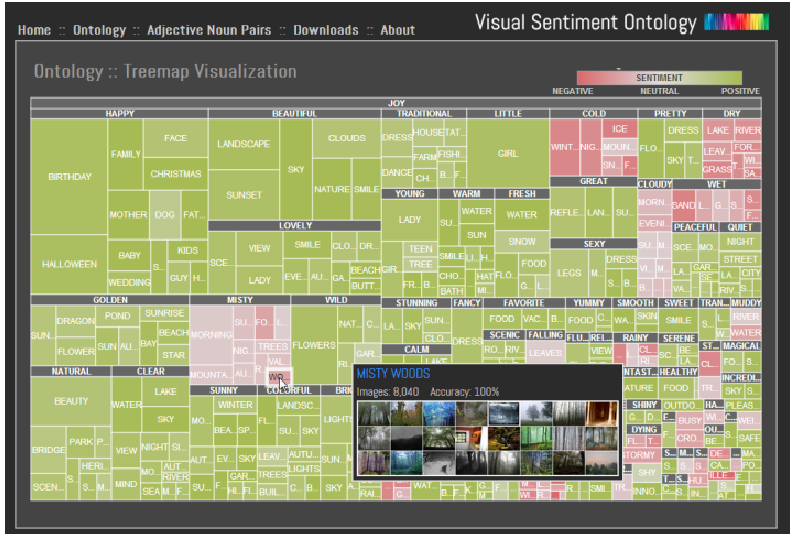
- The Treemap: A hierarchical view (Emotion Group -> Adjective -> ANP) that uses color (green for positive, red for negative) and size to visualize the sentiment distribution of massive datasets.
4. Critical Insight: Live Sentiment Monitoring
One of the most forward-thinking aspects of this research was Live Monitoring. The authors mapped incoming social media streams to multimodal cues. For instance, a positive image detection would trigger a high-pitched music note, while a negative one played a low pitch. This early exploration of "sonification" of sentiment data points toward the future of immersive data dashboards.
5. Conclusion & Future Impact
SentiBank was a landmark shift from "Affective features" (pixels) to "Affective concepts" (semantics).
Takeaway: The legacy of SentiBank lives on in how we prompt modern AI. Today’s CLIP-based models and Generative AI essentially utilize the same "Adjective-Noun" logic to understand the nuances of style and mood.
Limitations: Being a 2013 paper, the classifiers were pre-Deep Learning (likely SVM-based). Modern iterations using Vision Transformers (ViT) would likely see a massive jump in accuracy, yet the Ontology itself remains a gold standard for digital humanities and sentiment research.