
Beyond the Star Rating: Leveraging Aspect-Level Sentiment for Strategic Marketing
A Step Further in Sentiment Analysis Application in Marketing Decision-Making
The paper introduces a multi-stage framework for Marketing Decision-Making that integrates Sentiment Analysis (SA) with Product Feature Selection from User-Generated Content (UGC). Utilizing tools like Stanford CoreNLP and the AFINN lexicon on Amazon datasets, it goes beyond global star ratings to map specific product attributes to consumer sentiment.
TL;DR
While star ratings provide a quick snapshot of consumer satisfaction, they fail to explain why a customer is happy or frustrated. This paper proposes a systematic framework to bridge this gap by extracting specific product features (like "battery," "screen," or "price") and calculating individual sentiment scores for each. By combining these with traditional metrics, the authors offer a high-granularity dashboard for marketing managers to optimize product design and brand positioning.
The "Hidden Signal" Problem in Big Data
In the era of Big Data, Marketing Managers are drowning in User-Generated Content (UGC). A product might maintain a 4.2-star average, yet be losing market share because a newly launched competitor excels in a specific feature the majority of users care about—such as "noise cancellation."
The authors argue that Global Sentiment is a blunt instrument. A review is often a "mixed bag" where a user praises the aesthetics but lambasts the ergonomics. Prior works often treated reviews as single-polarity documents; this paper shifts the focus to the Sentence and Aspect level, treated as the primary unit of marketing intelligence.
Methodology: The Four-Stage Pipeline
The authors don't just ask "is this review positive?"; they ask "what specific thing is this person talking about, and how do they feel about it?"
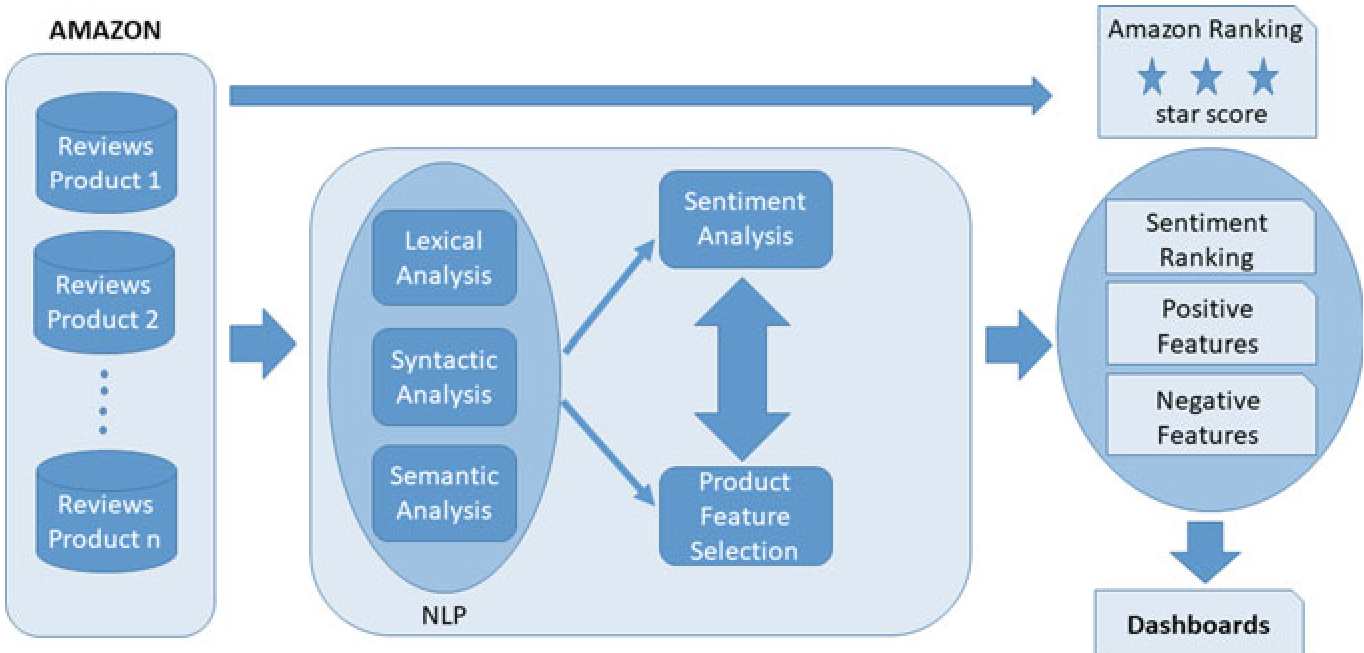
1. The Architecture
The proposed system follows a logical flow from raw text to executive visualization:
2. Feature-Sentiment Mapping
The core innovation is the link between Part-of-Speech (POS) Tagging and Local Sentiment.
- Feature Extraction: The system identifies nouns and noun phrases (e.g., "headset," "volume") that appear frequently across the dataset.
- Sentiment Attribution: Instead of averaging the whole review, the system looks at the specific sentence where the feature appears.
- Example: "The sound is great (+3) but the wire is flimsy (-2)."
- The feature "sound" gets a positive increment, while "wire" gets a negative one.
3. Mathematical Normalization
To make these insights comparable, the authors developed a normalization formula to map various sentiment scales (like AFINN's -5 to 5) into a standardized 1-5 score, compatible with Amazon’s star ratings.
Case Study: Amazon Cell Phone Accessories
The researchers applied this to a massive dataset of Amazon reviews. A standout example in the paper involves a headset review that would traditionally be labeled "Neutral."
| Feature | Sentiment Score | Contextual Phrase |
|---|---|---|
| Noise Cancellation | High Positive | "Noise cancellation is also pretty good." |
| Price | Positive | "Great headset for the price." |
| Rubber Piece | Negative | "...really stiff and hurts my ear." |
By decomposing the review, the manufacturer learns exactly what to keep (the noise cancellation tech) and what to fix (the material of the ear hook).
Visualizing Feedback: Word Clouds for Decisions
To make this data digestible for executives, the authors propose split-polarity word clouds. This allows a manager to see the "DNA" of their product's reputation at a glance.
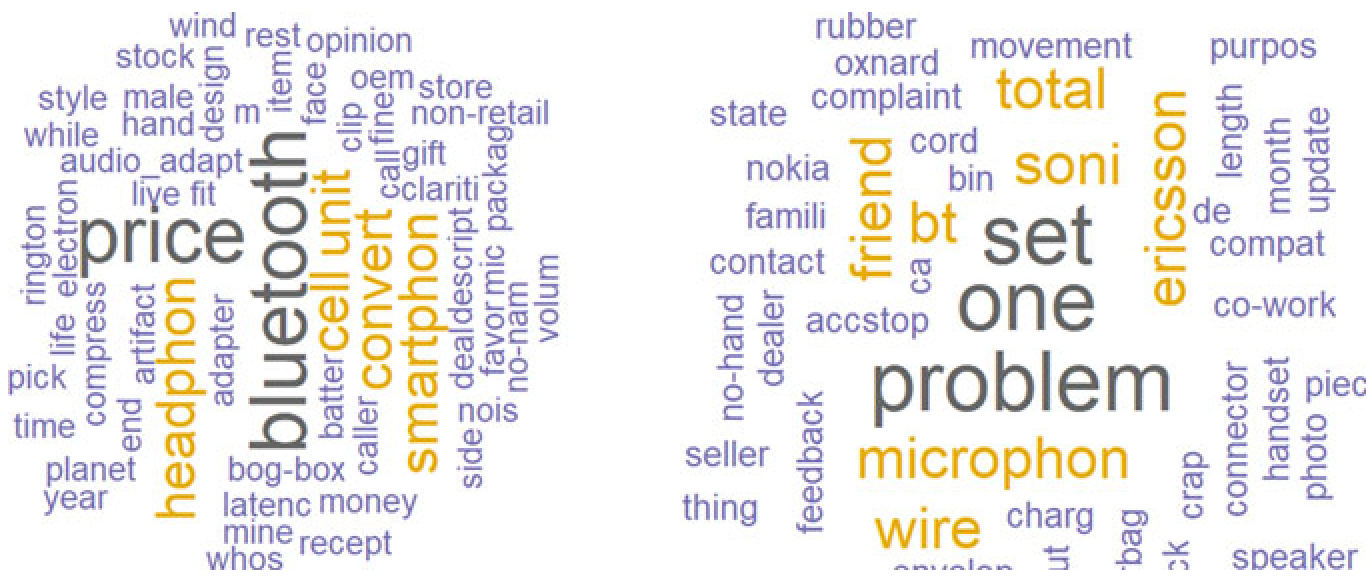 The visualization clearly separates what customers love (larger text = higher frequency) from what they dislike.
Critical Insight & Conclusion
The true value of this work is its Integrative Ranking. By combining the price, the global star rating, and the specific feature scores, companies can create a "Competitive Intelligence Matrix."
Limitations: The current method relies heavily on frequent noun extraction. As the authors note, future work needs to handle more complex linguistic structures like n-grams (e.g., "battery life" vs just "battery") and sarcasm, which can flip the sentiment of a feature entirely.
Takeaway: For the modern marketer, the goal is no longer just to "increase the star rating," but to "win the sentiment on the features that matter most to the target segment." This paper provides the mathematical and structural scaffolding to do exactly that.