
Beyond Keywords: Semantic-Driven Sentiment Analysis on Social Media
Sentiment Analysis on Social Media
2025-04-15
Summary
Problem
Method
Results
Takeaways
Abstract
This paper presents a sentiment analysis study of over 1,000 Facebook posts comparing the Italian public broadcaster RAI with the private news outlet La7. It utilizes the "iSyn Semantic Center," a proprietary platform combining deep linguistic analysis with semantic roles to achieve high-precision sentiment scoring.
## Executive Summary
**TL;DR**: This study moves beyond simple "bag-of-words" sentiment analysis by processing 1,000+ Facebook posts through a deep semantic engine. By analyzing the syntactical structure and semantic roles of Italian commentary, the researchers successfully mapped social media "vibe" to the actual audience decline of Italy's public broadcaster, RAI, and the rise of its rival, La7.
**Background**: Positioned between academic research and commercial OSINT (Open Source Intelligence), this work validates how deep linguistic analysis can transform unstructured social media noise into measurable marketing and sociological insights.
## The Motivation: Why Rules Beat Keyword Counting
Most sentiment analysis tools treat text as a simple collection of positive or negative words. However, the authors argue that this is insufficient for a language as complex as Italian—especially on social media where irony, negation, and political nuance are prevalent.
The core problem identified is **ambiguity**: a word like "unpredictable" is positive for a movie plot but negative for a car's steering. Without understanding the *subject* and the *role* of a word within a sentence, automated systems remain shallow.
## Methodology: The iSyn Semantic Engine
The researchers utilized a proprietary system, the **iSyn Semantic Center**, which consists of a sophisticated six-part pipeline.
### 1. Syntactic Parsing via Slot Grammar
Instead of just looking for keywords, the system uses **McCord’s Slot Grammar**. It attempts to build a full syntactical tree for every sentence. This allows the model to understand:
* **Negations**: Correcting the polarity of "not good."
* **Intensifiers**: Measuring the weight of "incredibly popular."
* **Semantic Roles**: Identifying who is doing what to whom (Subject-Action-Object).
### 2. The Logic of Sentiment
The engine identifies "sentiment factors" by looking at the interaction between verbs and their objects. For instance, in the phrase *"Enrico Mentana's newsbreak is becoming increasingly popular,"* the system doesn't just see "popular"; it identifies the action `HOW[become, popular]` and applies it to the `OBJ[newsbreak]`.
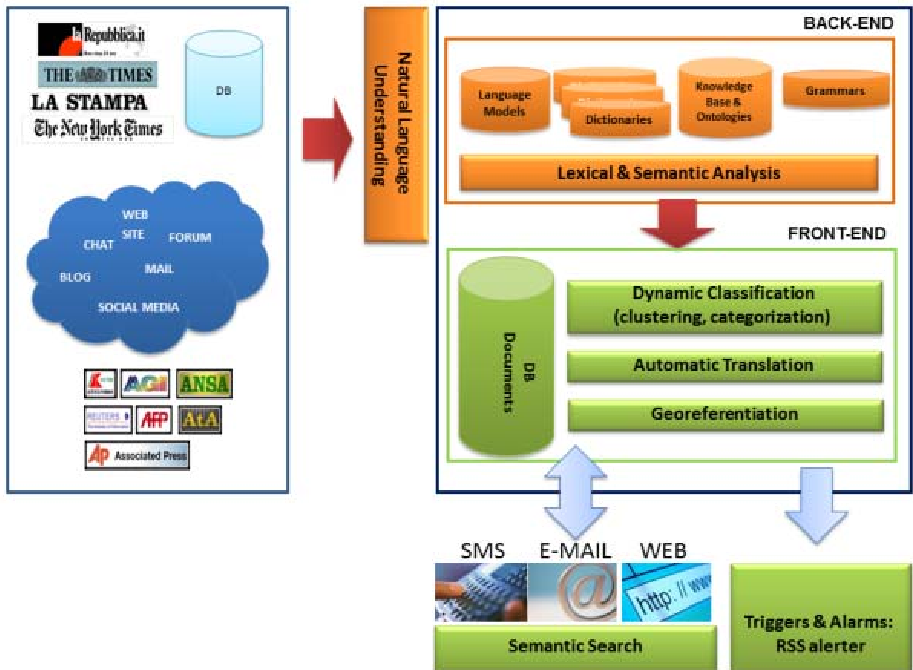
*Figure 1: The system architecture showing the flow from Crawler to Semantic Engine.*
## Experiments: RAI vs. La7
The study focused on a critical period in Italian media when the public broadcaster RAI (and its news program Tg1) was accused of political bias, while the private channel La7 was emerging as a "balanced" alternative.
### Key Findings:
* **Social Reality vs. Audience Data**: The sentiment extracted from Facebook posts perfectly mirrored the **Auditel** audience data. When sentiment for RAI plummeted on social media, its actual viewership dropped by 11.3%.
* **Cluster Mapping**: Using unsupervised K-Means clustering, the system automatically grouped negative RAI posts around terms like "factious" and "gagging information," while La7 clusters focused on "sobriety" and "professionalism."
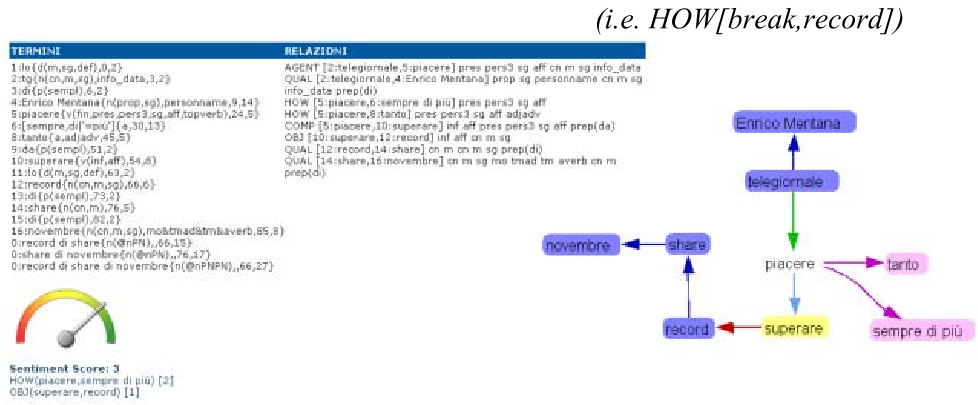
*Figure 2: Example of the system's ability to extract specific sentiment roles from Italian text.*
## Performance and Insights
The technical prowess of the system is evident in its metrics:
* **Precision**: 93%
* **Recall**: 87%
* **Processing Speed**: 300 words per second.

*Figure 3: Time distribution showing the shift in public consensus.*
## Critical Analysis & Conclusion
This research proves that **Semantic Role Labeling (SRL)** is a bridge between qualitative media analysis and quantitative data science. By moving past "positive/negative" labels and into "who-said-what-about-whom," we can predict real-world shifts in consumer behavior (like switching TV channels) before they appear in final quarterly reports.
**Limitations**: The study is limited to a dataset of 1,000 posts—relatively small by modern Big Data standards. Additionally, while the system handles Italian exceptionally well, the unsupervised clustering component (K-Means) remains limited to 10 clusters, which might oversimplify very diverse public debates.
**Future Prospect**: Integrating this semantic depth with modern Large Language Models (LLMs) could provide the "best of both worlds": the deep linguistic accuracy of Slot Grammar with the generative reasoning of GPT-style architectures.