
Sentimental Influence: Beyond the Numbers in Social Media Engagement
Analyzing sentimental influence of posts on social networks
This paper introduces a framework for analyzing the "sentimental influence" of social media posts by categorizing interactions into compliance or opposition. It proposes a hybrid methodology combining emotional word dictionaries and emoticon-based detection to measure sentiment across multiple social platforms like Twitter, Sina Weibo, and Yahoo News.
TL;DR
Quantifying social media influence has long been a game of "how many replies?" However, this paper argues that sentiment polarity is the true decider of impact. By introducing a graph-based model and a multi-dimensional emotion dictionary, the researchers distinguish between "Compliance" (supporters) and "Opposition" (adversaries). Their findings reveal a striking reality: on public issues, negative posts are far more effective at building a compliant audience than positive ones.
The "Loudness" Trap: Why Engagement Metrics Lie
In the current social media landscape, a post with 1,000 replies is considered more "influential" than one with 100. But what if those 1,000 replies are all hateful rebuttals? Prior works have largely ignored the valence of influence.
The authors identify a critical missing link: the Sentimental Influence. They posit that influence isn't just a scalar (magnitude) but a vector (direction). Furthermore, they highlight the "External Noise" problem—people might react to a football score or a disaster (Public Topics) rather than the post itself, whereas (Personal Topics) like life advice reflect true interpersonal influence.
Methodology: Mapping Emotions and Graphs
To solve the ambiguity of short-form social text, the paper employs two core strategies:
1. Dual-Path Emotion Detection
The system doesn't just look for "good" or "bad." It categorizes text into five dimensions based on the Profile of Mood States (POMS): Happy, Tense, Angry, Sad, and Fatigue. It uses a custom-built dictionary of bilingual words and, crucially, emoticons—which serve as high-signal proxies for intent in microblogs.
2. The Influence Graph & Balance Theory
By treating posts as nodes and replies as directed edges, the authors apply Heider’s Balance Theory. The logic follows: "My friend’s enemy is my enemy." This allows the model to estimate influence even between users who aren't directly connected.
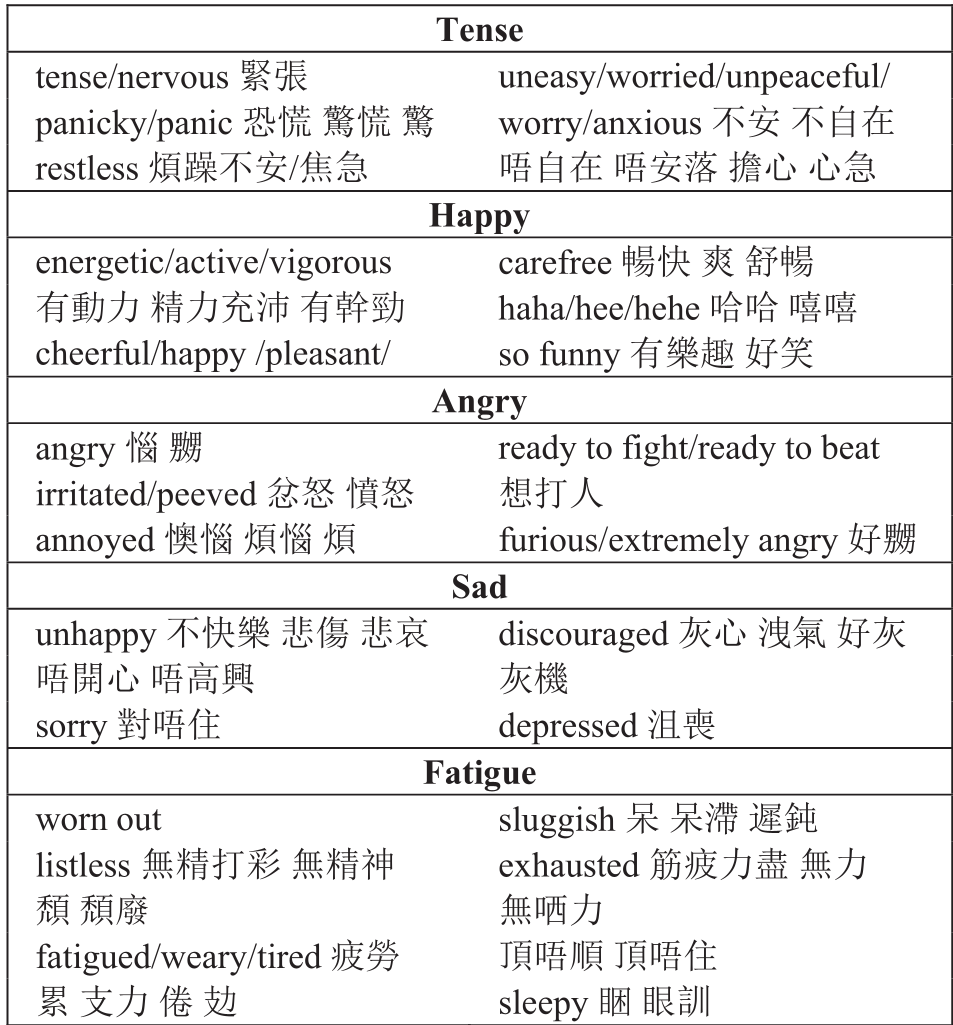 Table: Categorization of emotional words and emoticons used to determine post polarity.
Experimental Insights: The Power of Negativity
The team analyzed data from Twitter, HK Discuss, and Yahoo News across 10 distinct topics.
Key Findings:
- Public vs. Personal Variance: Controversy breeds diversity. Public topics (like government restrictions) showed much higher sentiment fluctuation than personal life updates.
- The Compliance Paradox: On public topics, influencers expressing Negative sentiment achieved a 71.1% compliance rate. This suggests that in public discourse, "outrage" or "criticism" is more contagious and easier for receptors to align with.
- The "Comfort" Effect: On personal topics, even if a user posts something sad (negative), the receptors or repliers often post positive, supportive messages to "comfort" the author—leading to an "Opposition" of sentiment but a "Compliance" of social bond.
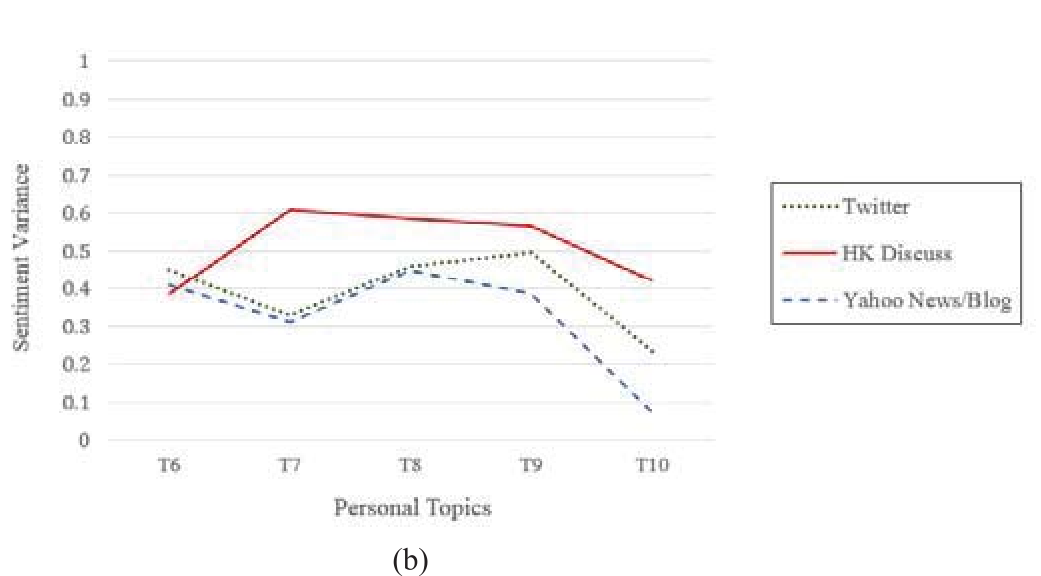 Figure: Variance comparison showing that public topics (a) possess a wider emotional spectrum than personal topics (b).
Critical Analysis & Takeaways
The paper’s greatest strength lies in its contextual awareness. By separating Public and Personal topics, it avoids the common pitfall of attributing "influence" to a user when the "influence" actually came from a world event (like a football match).
Limitations: The reliance on dictionary-based counts is somewhat dated compared to modern LLM-based embeddings (like BERT or GPT), which can capture sarcasm and nuance more effectively. However, the Graph Model logic remains a robust framework for any sentiment engine.
Future Outlook: This research paves the way for "Brand Sentiment Safety." Marketers shouldn't just look for influencers with high reach; they must look for those with high Positive Compliance Rates to ensure their message isn't met with an "Opposition" backlash.
Conclusion
Social influence is a social-emotional contract. By measuring whether audiences follow (Compliance) or fight (Opposition) the emotional lead of a post, we can better understand the mechanics of viral trends and the spread of public opinion.