
Sentiment Classification of Drug Reviews: A Rule-Based Linguistic Deep Dive
Sentiment Classification of Drug Reviews Using a Rule-Based Linguistic Approach
The paper introduces a clause-level sentiment classification algorithm for drug reviews using a rule-based linguistic approach. By leveraging Stanford typed dependencies and medical domain knowledge via MetaMap, the system calculates sentiment polarities (positive, negative, neutral) based on grammatical structures, outperforming standard machine learning baselines.
TL;DR
Researchers from Nanyang Technological University have developed a specialized clause-level sentiment classification system for medical drug reviews. Moving away from "black box" machine learning of the era, they utilized a pure linguistic approach that combines grammatical dependency parsing with medical domain knowledge (MetaMap). The result? An accuracy of 78%, consistently beating traditional SVM-based benchmarks by up to 9%.
Background: Why Generic NLP Fails Medical Reviews
Most sentiment analysis focuses on "easy" domains like movies or electronics. In medical contexts, the language is far more complex. A sentence like "The drug reduced my pain" contains two negative concepts ("reduced" and "pain"), but their combination is positive.
Traditional Machine Learning (ML) models, particularly Support Vector Machines (SVM) using Bag-of-Words, often miss these nuances because they lack a structural understanding of how words modify one another. This paper argues that for clinical digital libraries, we must look at the clause level rather than the document level to separate overall satisfaction from side effects.
Methodology: The Power of Grammatical Dependency
The core of this work is the bottom-up traversal of a dependency tree. Instead of treating a sentence as a flat list of words, the system analyzes the "Governor-Dependent" relationships defined by the Stanford NLP library.
1. Lexicon Construction
The system uses a general lexicon of ~9,600 terms (from SentiWordNet and Subjectivity Lexicon) and a specialized domain lexicon. Crucially, it uses MetaMap to identify "Disorders" (e.g., hair loss, fatigue) and automatically assigns them a negative prior score.
2. Rule-Based Sentiment Calculus
The team defined several layers of rules to handle how sentiment flows through a sentence:
- Phrase Rules: Handle intensifiers (e.g., "enormously good").
- Polarity Shifters: Handle words like "hardly" or "rarely" that flip the meaning of adjectives.
- Decrease Disorder Rule: A domain-specific logic where a negative verb + a negative medical term (disorder) = a positive outcome.
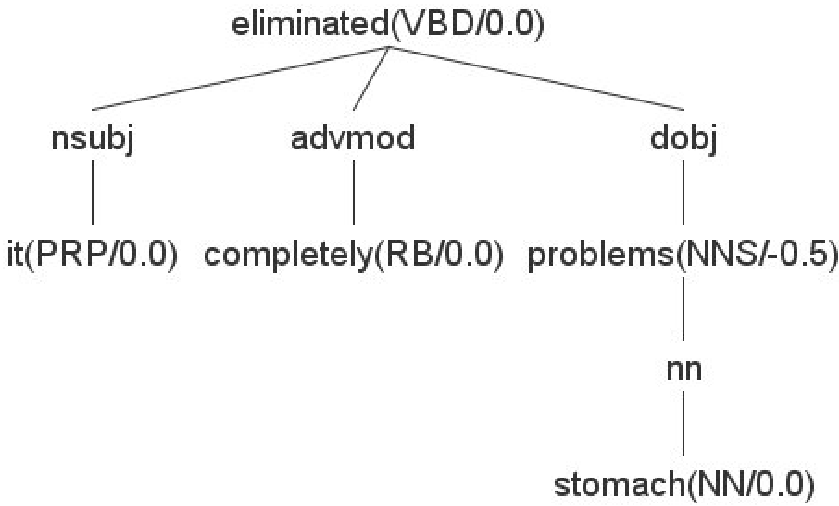 Figure 1: Dependency tree for "it completely eliminated stomach problems," showing how scores propagate from "problems" (-0.5) to a final positive clause score (+0.5).
Experiments & Results
The researchers tested their approach against two SVM baselines on a dataset of 1,000 clauses from DrugLib.com.
- SVM-1: Standard Bag-of-Words + Negation handling.
- SVM-2: Added "Typed Dependencies" as features.
- Linguistic Approach: The proposed rule-based system.
Performance Comparison
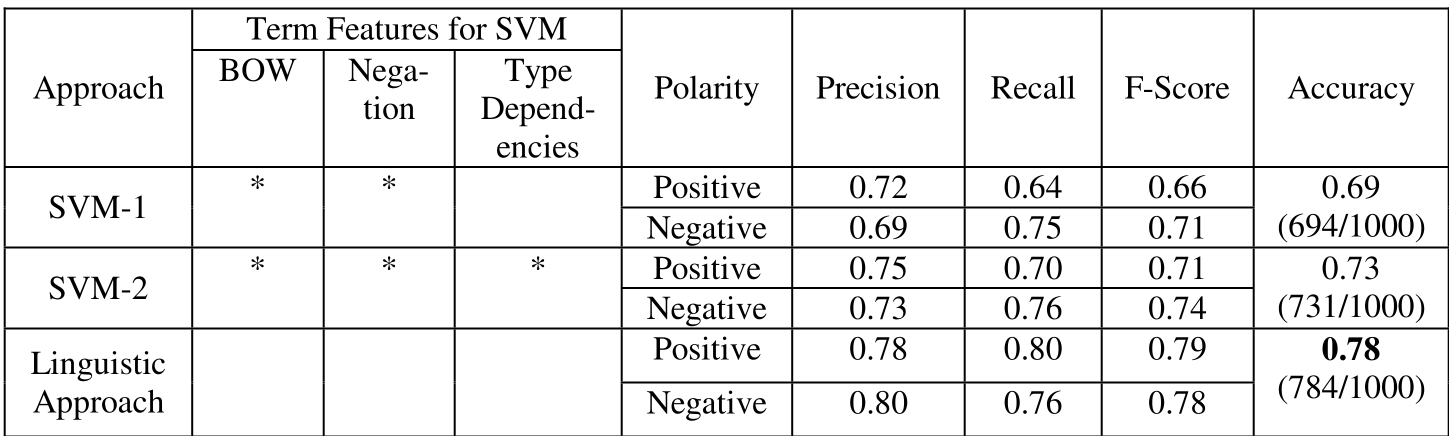
The linguistic approach achieved a 78.4% accuracy, outperforming the best ML baseline (73.1%). Interestingly, the system performed exceptionally well on "Overall" drug opinions (83% accuracy) and "Condition" (80%) but struggled with "Dosage" (64%), where the sentiment is often implied rather than stated.
Critical Analysis: What's Missing?
While the rule-based approach is robust, the authors identified several "frontier" problems:
- Inference Problems (35% of errors): Users often describe experiences without subjective words (e.g., "it felt like I was wearing a hat"). Rules cannot "reason" through these metaphors.
- Context Sensitivity: "I lost 3 lbs" is positive for a weight-loss drug but terrifying for a cancer patient. The system currently lacks the clinical context to differentiate these.
- Systemic Dependencies: If the Stanford Parser fails to identify the correct grammatical link, the entire rule chain breaks.
Conclusion
This research highlights the importance of structural linguistics in specialized domains. Before the era of Large Language Models (LLMs), this work provided a vital blueprint for how to bake human-like reasoning and domain-specific medical knowledge into AI systems. For modern practitioners, it serves as a reminder that understanding how a sentence is built is just as important as knowing what words it contains.