
Sentiment or Structure? Decoding the DNA of Social Network Emergence
Dissemination Patterns and Associated Network Effects of Sentiments in Social Networks
The paper investigates the dissemination patterns of sentiments in online social networks using a novel Dynamic Network Motif Analysis. By analyzing over 12,000 networks across five diverse datasets, the study identifies a sequential emergence of social network effects: reciprocity first, followed by hierarchy, and finally triadic closure/transitivity.
TL;DR
Does "angry" communication spread differently than "happy" communication? According to this large-scale study of 12,000 networks, the answer is surprisingly: No. While social networks evolve through a distinct hierarchy of effects—starting with Reciprocity, moving to Hierarchy, and ending in Clustering—the emotional tone of the messages is merely a passenger, not the driver, of the network's structural growth.
The Core Conflict: Human Emotion vs. Network Topology
For decades, social scientists have debated how emotions shape our connections. Heider’s Social Balance Theory suggests that "the enemy of my enemy is my friend," implying that negative and positive relationships should form fundamentally different structural patterns. However, most existing research has been static, looking at the "final" state of a network rather than how it was built, interaction by interaction.
Hillmann and Trier set out to bridge this gap. Their intuition was simple but powerful: If we treat every message as a "link event" with a timestamp and a sentiment (Positive/Negative), we can watch the network's "skeleton" grow in real-time.
Methodology: Dynamic Network Motif Analysis
The researchers moved beyond simple node-counting to Triad Analysis. A triad (three actors) can exist in 16 different states based on the direction and existence of ties.
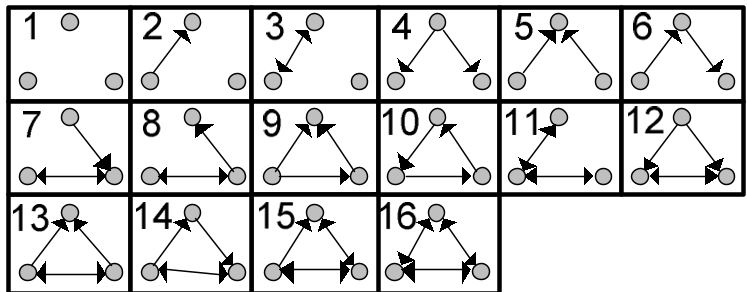
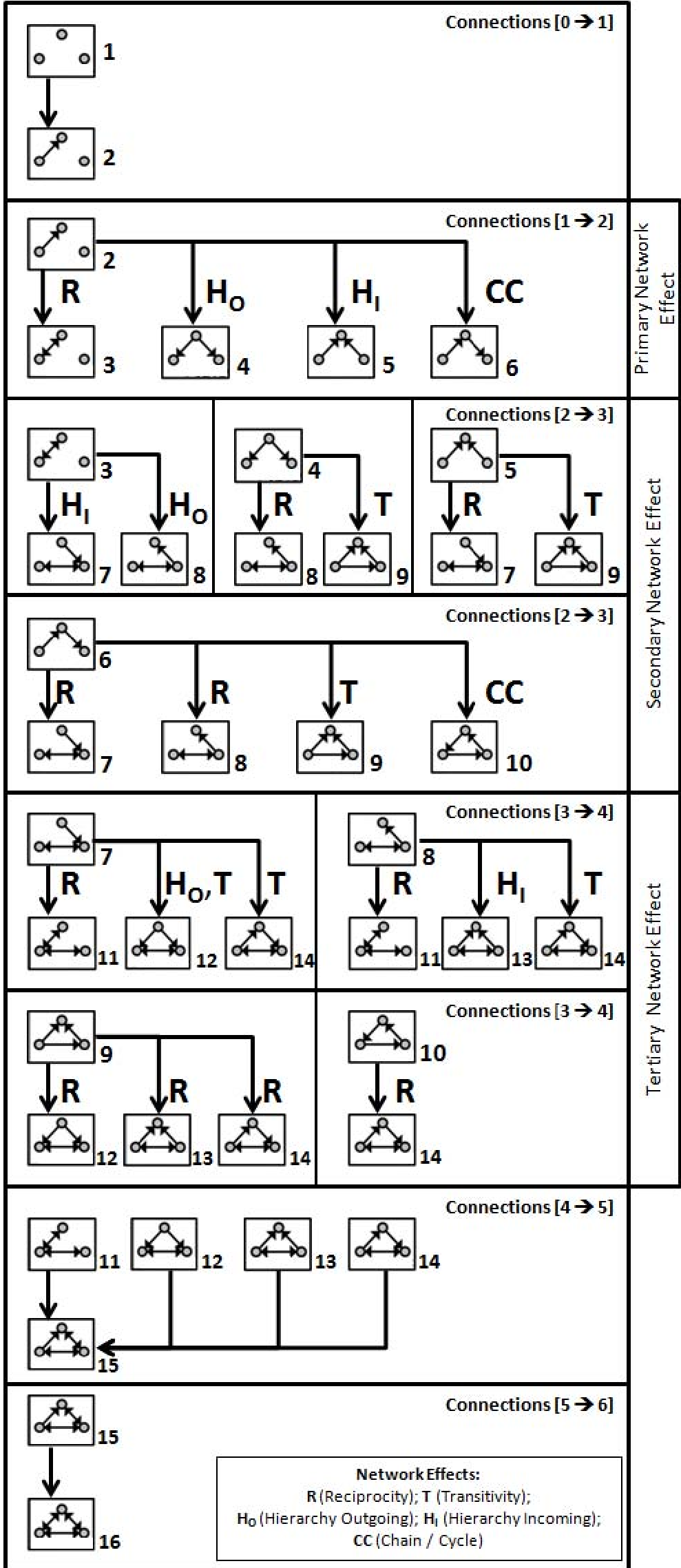
The innovation here is the Transition Path. Every time a user sends a message, a triad moves from one state to another (e.g., from an unconnected state to a directed pair, then to a reciprocal pair). By calculating the mathematical probability of these transitions occurring by "chance," the authors could identify which "Social Network Effects" were actually at play:
- Reciprocity: The drive to respond back.
- Hierarchy: The emergence of "hubs" or popular actors.
- Transitivity: The "triadic closure" where friends of friends become friends.
The Hierarchical Evolution of a Network
The study analyzed five diverse datasets, including BBC forums, Digg, IRC chats, Twitter, and Usenet newsgroups. Despite the technical differences between these platforms, a clear evolutionary pattern emerged (Supporting Hypothesis 1):
- Phase 1: Reciprocity (The Dominant Force): In almost every dataset, the transition from a single link to a reciprocal pair (State 2 > State 3) was the most significant deviation from randomness.
- Phase 2: Incoming Hierarchy: Once reciprocity is established, the next trend is "Incoming Hierarchy"—central actors being addressed by others, rather than them reaching out.
- Phase 3: Social Clustering: Transitivity (triadic closure) appears as a later-stage effect, but it is highly context-dependent and less universal than reciprocity.
The Sentiment Shocker: Data over Emotion
The most provocative finding of this paper is the rejection of Hypothesis 2. The researchers split the networks into "Positive-only" and "Negative-only" sub-networks.
The Result? The structural growth patterns were nearly identical.
Statistical T-tests showed that whether a sub-network was built entirely on "Negative" interactions or "Positive" ones, the tendencies toward reciprocity and hierarchy remained the same. This suggests that the mechanism of digital social interaction (the "reply" button, the "mention") is a much stronger determinant of network shape than the content of the message itself.
Critical Analysis & Conclusion
Takeaways
- Architecture Wins: Network emergence is a property of the platform's affordances and general human social behavior patterns, not the emotional valence of the content.
- Revisiting Balance Theory: Heider’s theory might be too abstract for modern CMC (Computer-Mediated Communication). In online settings, a "negative" message doesn't necessarily create a "negative tie" in the way a physical enemy does.
Limitations
The study treats sentiment as a binary (Positive/Negative) and projects it directly onto edges. However, as the authors admit, an "exchange of negative sentiment" (like an argument) might actually increase reciprocity and strengthen a structural tie, even if the emotional value is low.
Future Outlook
This work paves the way for "Sentiment-Aware Topology" research. Future models might need to distinguish between affective ties (friend/enemy) and interaction events (argument/praise) to fully reconcile Social Balance Theory with digital reality.