
Beyond Links: Decoding Social Communities Through the Lens of Sentiment
Sentiment-driven Community Profiling and Detection on Social Media
This paper introduces GSNMF (Graph regularized Semi-Nonnegative Matrix Factorization), a framework for sentiment-driven community detection and profiling on social media. It moves beyond traditional structural analysis by integrating users' positive and negative attitudes toward specific "key expressions" to uncover the motives behind community formation.
TL;DR
Understanding online communities is no longer just about "who follows whom." This paper presents GSNMF, a framework that detects communities by analyzing both social interactions (retweets) and users' internal sentiments. Unlike previous methods that just list keywords, GSNMF creates dual profiles that show what a community loves versus what it loathes, providing a much sharper picture of social polarization.
The "Keyword Paradox" in Social Media
Traditional community profiling assumes that if people talk about the same things, they belong together. This is the Keyword Paradox. During the 2016 US Election, both Republicans and Democrats posted incessantly about "Hillary Clinton" and "Donald Trump." If you only look at word frequency, these two groups look identical.
The authors argue that the position (sentiment) matters more than the topic. To solve this, they treat community detection as a joint optimization problem: finding groups that interact frequently and share a collective stance on controversial issues.
Methodology: GSNMF Explained
The core innovation is the Graph regularized Semi-Nonnegative Matrix Factorization (GSNMF).
- Issue Extraction: Using POS-tagging and metadata (hashtags/mentions) to identify "Key Expressions."
- Sentiment Mapping: Using a window-based approach with SentiStrength to determine if a user feels positive or negative about a specific expression.
- The Matrix Math: They decompose a User-Opinion matrix () into a Community Membership matrix () and a Profile matrix ().
- Because it’s Semi-NMF, the profile matrix can have negative values.
- Positive values in V = Issues the community supports.
- Negative values in V = Issues the community opposes or is concerned about.
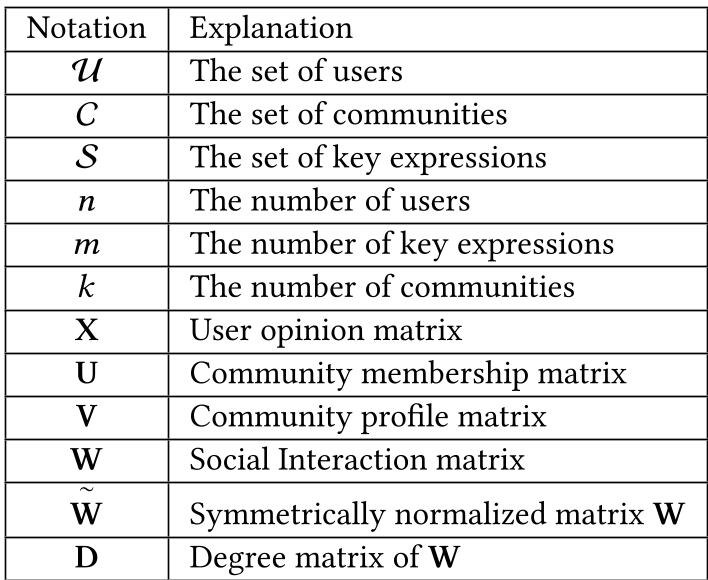
Table 1: Key notations showing the bridge between User-Opinion (X) and Social Interaction (W).
Experimental Battleground: Politics
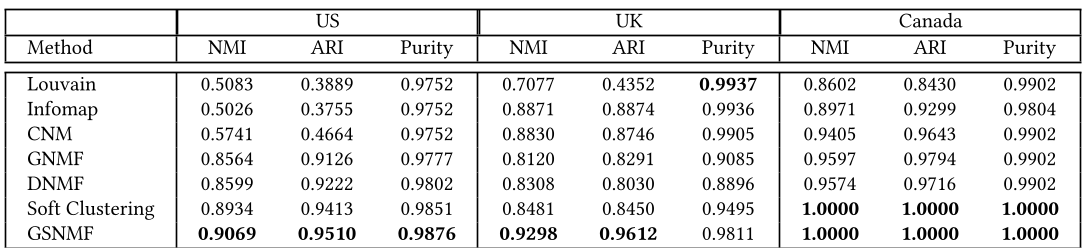
The researchers tested GSNMF against heavyweights like the Louvain method and Infomap across three political datasets (US, UK, Canada).
Quantitative Edge
GSNMF consistently led the pack. In the Canada dataset, it achieved a perfect score across NMI, ARI, and Purity metrics. Even in the highly complex UK dataset (involving 5 parties), it maintained an NMI of 0.9298, significantly higher than standard GNMF (0.8120).
Qualitative Insights: What does a community actually look like?
The real "Aha!" moment comes from the community profiles. In the US dataset, GSNMF didn't just find "Republicans"; it found a group that was Positive toward @realDonaldTrump and @SpeakerRyan, but Negative toward Obamacare and Iran.
Comparatively, previous SOTA methods (GNMF/DNMF) produced "mushy" profiles where Trump and Clinton appeared in the same list without any indication of who liked whom—making them nearly useless for real-world sociological analysis.
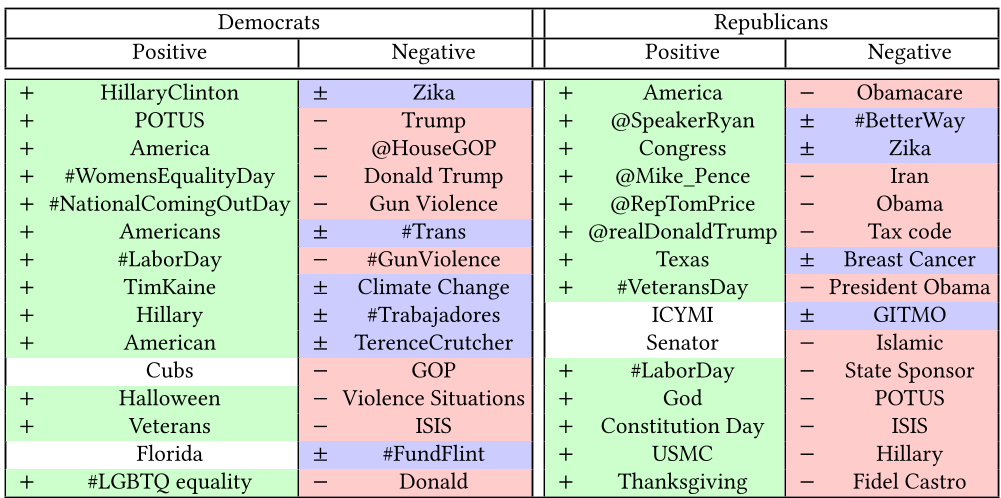
Table 4: GSNMF successfully separates Democrats and Republicans by their stance on issues like 'Gun Violence' and 'POTUS'.
Critical Analysis & Conclusion
The beauty of this work lies in its interpretability. By allowing the profile matrix to take negative values, the math reflects human reality: we are defined as much by what we oppose as by what we support.
Limitations:
- The current sentiment extraction is "window-based," which might struggle with complex sarcasm or nuanced political rhetoric.
- It currently treats "Opposition" and "Concern" (e.g., hating a candidate vs. being worried about a disease) similarly because both carry negative sentiment weight.
Future Outlook: The authors suggest that the next frontier is Dynamic Profiling—tracking how a community's collective opinion shifts over time. For marketers and political scientists, GSNMF offers a blueprint for moving from simple "social listening" to "social understanding."