
Beyond the Swarm: Inferring Hidden Leadership via Bayesian Monte Carlo Methods
Sequential Dynamic Leadership Inference Using Bayesian Monte Carlo Methods QING LI , Student Member, IEEE
Summary
Problem
Method
Results
Takeaways
Abstract
The paper proposes a novel Bayesian framework for sequential inference of dynamic leadership in multi-agent groups. It introduces a leader-follower model based on a multivariate Ornstein-Uhlenbeck process, implemented via Sequential Markov Chain Monte Carlo (SMCMC) and Rao-Blackwellised Kalman filtering to track group structure and kinematic states from noisy observations.
## TL;DR
Understanding who is leading a group—be it a flock of birds, a school of fish, or a convoy of vehicles—is critical for predicting intent and improving tracking precision. This paper introduces a robust Bayesian framework using **Sequential Markov Chain Monte Carlo (SMCMC)** to identify leaders and followers in real-time. By modeling group motion as an **Ornstein–Uhlenbeck (OU) process**, the system doesn't just track "dots" on a screen; it deciphers the underlying social hierarchy and destination-driven intent.
## The Motivation: Why Latent Hierarchy Matters
Most tracking algorithms treat groups as a collection of independent agents or as a single "blob." However, in nature and engineering, groups are often led by **informed individuals** (e.g., a bird who knows the migration route).
The technical challenge is twofold:
1. **Explosive State Space**: For a group of $N$ objects, there are $2^N-1$ possible leadership structures.
2. **Dynamic Switching**: Leadership isn't static; it rotates as individuals tire or new landmarks are spotted.
Existing SOTA often uses batch processing (looking at the whole video at once), which prevents real-time application in robotics or surveillance.
## Methodology: The Leader-Follower OU Process
The core innovation lies in the **Destination-Reverting Model**. The authors define two distinct forces:
1. **Leader Force**: Drags the leader toward a destination $D$ with strength $\eta$.
2. **Follower Force**: Compels followers to match the position and velocity of the current leaders ($\alpha, \beta$).
### The Mathematical Engine: Rao-Blackwellisation
Tracking both the "Who is leading" (discrete) and "Where are they" (continuous) is computationally expensive. The authors solve this by splitting the problem:
* **The Continuous Part**: Given a leadership structure, the positions/velocities are Linear Gaussian. This is solved optimally using **Kalman Filtering**.
* **The Discrete Part**: The leadership structure ($L_t$) is sampled using **SMCMC**. Specifically, they propose an "Optimal Kernel" that ensures new samples are always accepted, dramatically speeding up convergence.
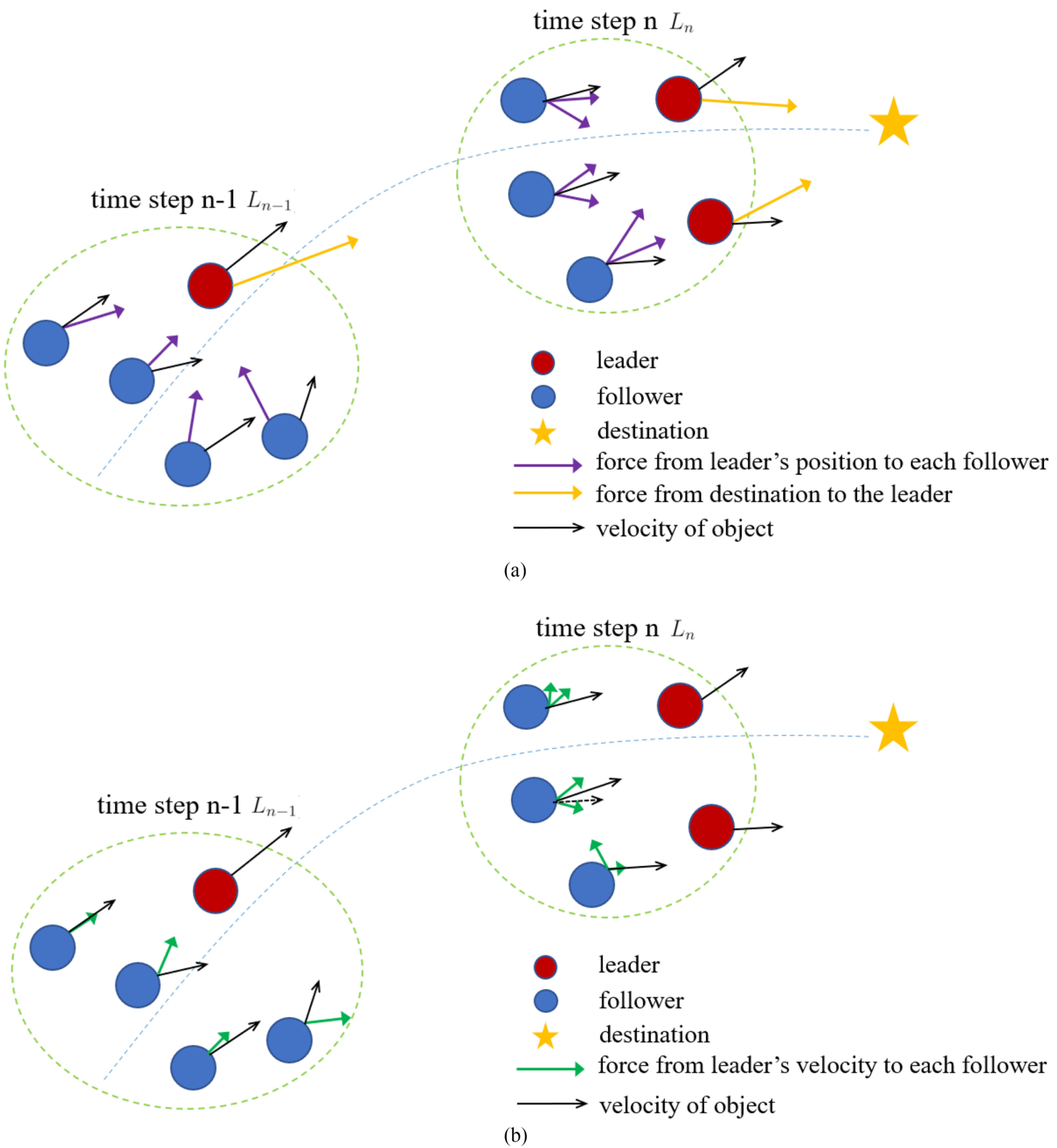
*Fig 1: The dual-force interaction model. (a) Positional attraction to destination/leaders. (b) Velocity matching between followers and leaders.*
## Experiments: Synthetic Rigor & Real-World Validation
The researchers tested five variations of Sequential Monte Carlo (SMC) methods.
### 1. Synthetic Scalability
In simulations of up to 8 objects (254 possible structures), the **SMCMC with Optimal Proposal** consistently outperformed standard Marginal Particle Filters. It maintained a high "Correct Rate" while keeping the Root-Mean-Square Error (RMSE) significantly lower than models that ignored group interactions.
### 2. The Pigeon & the Fish
The real "acid test" involved biological data:
* **Pigeon Flocks**: The model identified "Pigeon 1" as the dominant leader, matching GPS analysis from previous biological studies. When Pigeon 1 reached the home destination, the model successfully captured the transition as "Pigeon 2" took over.
* **Fish Schools**: Tracking golden shiners, the model identified the "informed" fish (those trained to find food) based solely on their movement patterns, even when the algorithm wasn't told which fish were trained.
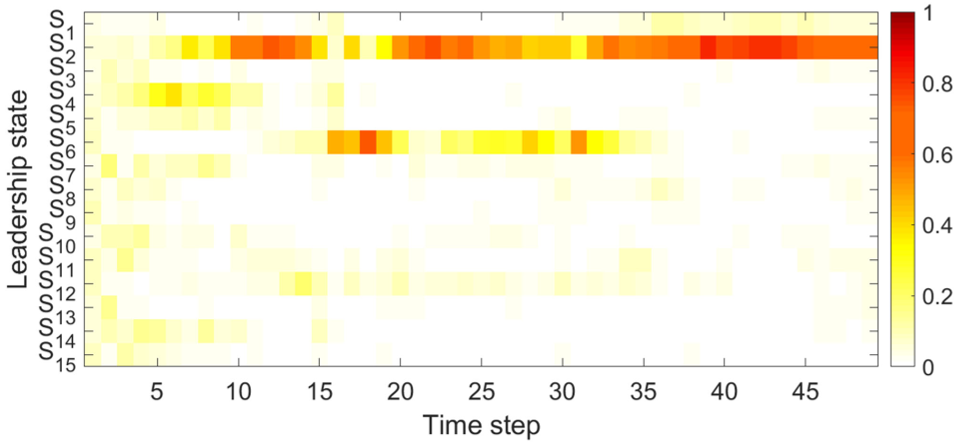
*Fig 2: Heatmap of leadership probability in a fish school. The model clearly identifies the peak influence of trained individuals after a stimulus (Time step 10).*
## Critical Analysis & Conclusion
The beauty of this work is its **physical intuition**. By embedding the Ornstein-Uhlenbeck process into a Bayesian filter, the authors convert a raw data problem into a behavioral inference problem.
**Key Takeaways:**
* **Efficiency**: Rao-Blackwellisation is the "secret sauce" that makes high-dimensional leadership inference tractable.
* **Accuracy**: Incorporating leadership interaction is not just an academic exercise; it directly reduces tracking error (RMSE) because the model "understands" why an object is maneuvering.
**Limitations**: The model currently assumes a known destination and pre-set interaction parameters ($\alpha, \beta, \gamma$). Future iterations that learn these parameters online through Expectation-Maximization or Variational Inference would make this framework truly autonomous.
This research paves the way for smarter autonomous swarms and more predictive surveillance systems that can spot "intent" long before an action is completed.