
SNBE: Optimizing Identity-Based Encryption for the Era of Serial Numbers
Serial number based encryption and its application for mobile social networks
The paper introduces Serial Number Based Encryption (SNBE), a lightweight functional public key encryption primitive specifically tailored for Mobile Social Networks (MSNs). By leveraging the fact that MSN identities are serial numbers (e.g., phone numbers, license plates), the authors construct a scheme that achieves full security in the standard model with constant-size ciphertexts, outperforming traditional Identity-Based Encryption (IBE) in efficiency.
TL;DR
Researchers have proposed Serial Number Based Encryption (SNBE), a specialized form of Identity-Based Encryption (IBE). By recognizing that most mobile and IoT "identities" are actually serial numbers (phone numbers, IDs, timestamps), they developed a scheme that is both fully secure and extremely lightweight. It features constant-size ciphertexts (only 2 group elements) and public parameters, significantly outperforming general-purpose IBE schemes in practical Mobile Social Network (MSN) applications.
The "Arbitrary String" Tax in Cryptography
Since Shamir introduced Identity-Based Cryptography in 1984, the standard assumption has been that an "identity" can be any arbitrary string. While theoretically powerful, this generality comes with a "tax." Achieving adaptive security (where the attacker can choose the target identity at any time) in the standard model (without the "idealized" Random Oracle) usually requires massive public keys or inefficient mathematical reductions.
In the context of Mobile Social Networks (MSNs) and Vehicular Networks (VANETs), this generality is often unnecessary. Users are identified by structured serial numbers:
- Phone Numbers: +86 138...
- License Plates: ABC-1234
- Timestamps: 2026-05-28...
SNBE asks: If we know the identity is a number, can we make encryption faster and safer?
Methodology: The Power of Categorized Reductions
The core of the SNBE scheme lies in its specific construction of the public hash function:
This structure allows the authors to introduce a "New Proof Idea." In the security proof, the simulator guesses whether the adversary will challenge a "large" serial number (Type I) or a "small" one (Type II). This classification allows for a much tighter reduction to the Decisional Bilinear Diffie-Hellman (DBDH) problem.
Architecture Overview
The system consists of five key phases:
- Setup: Central Authority (CA) generates parameters.
- Registration: A global counter
cntis incremented. - Key Generation: CA issues private keys for numbers .
- Encryption: Senders use the recipient's serial number as the public key.
- Decryption: Recipients use their private key to recover the message.
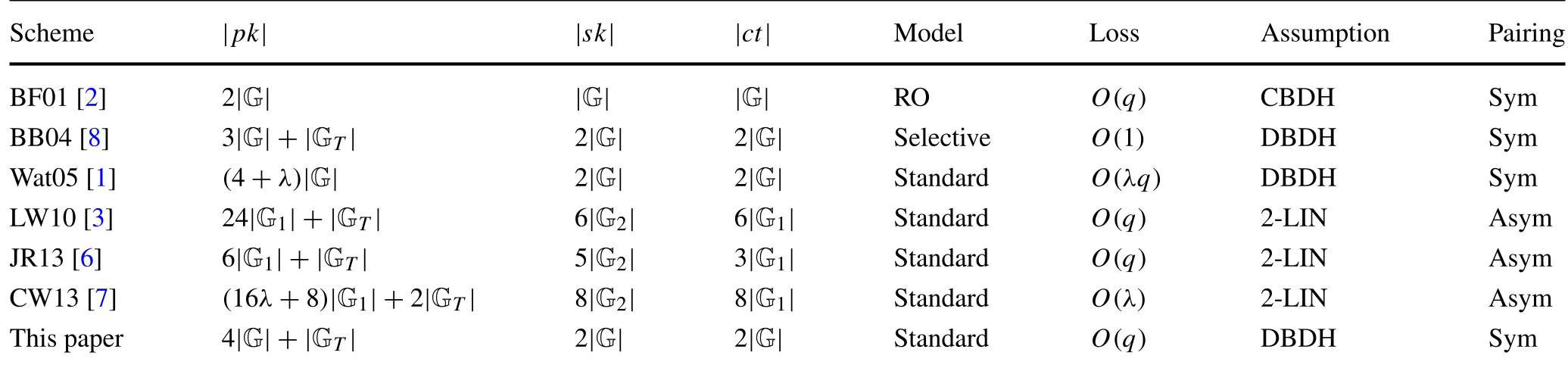 Table 1: SNBE vs. SOTA IBE Schemes. Note that SNBE achieves standard model security with constant-size ciphertext () and minimal public key size.
Experiments and Results: Best of Both Worlds
As shown in the comparison table above, traditional schemes like Wat05 or CW13 require or public parameters, where is a security parameter. SNBE reduces this to a constant 4 elements in group .
More importantly, SNBE achieves:
- Constant Ciphertext Overhead: Only 2 group elements, regardless of identity length.
- Standard Model Security: It does not rely on the "Random Oracle" heuristic, making it more robust against sophisticated attacks.
- Revocation Support: The authors extended the scheme to support efficient revocation using a binary tree structure, reducing the cost of updating keys to a logarithmic scale.
Deep Insights: Why It Matters
The fundamental contribution of this paper is the shift from general-purpose to domain-specific cryptography. In the world of Big Data and IoT, we don't need a "one-size-fits-all" IBE.
Real-world Applications
- Smart Cities: Using license plate numbers for encrypted vehicle-to-vehicle (V2V) alerts.
- E-Commerce: Using mobile numbers for secure payment notifications via Alipay or similar platforms.
- IoT: Using Product IDs for secure management of RFID-tagged goods.
Limitations and Future Work
While SNBE is highly efficient for numbers, it still relies on Bilinear Pairings, which can be computationally expensive for the most basic 8-bit microcontrollers. The authors suggest that a "pairing-free" SNBE would be the next "Holy Grail" for lightweight mobile security.
Conclusion
SNBE proves that "less is more." By limiting the identity space to serial numbers, the authors have created a protocol that is finally practical enough for the high-speed, low-latency requirements of modern mobile networks. It bridges the gap between theoretical provable security and the stark reality of mobile hardware constraints.