
High Confidence Sentiment: An SOA Approach to Pruning the Twitter Noise
Towards a Service-Oriented Architecture for Pre-Processing Crowd-Sourced Sentiment from Twitter
This paper proposes a Service-Oriented Architecture (SOA) framework tailored for the automated pre-processing and filtering of crowd-sourced sentiment from Twitter. By leveraging configurable "social media signals" (origin, originality, and user participation), the system enhances data quality to produce High Confidence Data (HCD) for sentiment analysis tasks.
TL;DR
Twitter is a goldmine for sentiment analysis, but most of what we mine is "fool's gold." This paper introduces an SOA-based framework designed to transform raw, bot-infested, and repetitive tweet streams into High Confidence Data (HCD). By filtering for human origin, originality, and balanced user participation, the authors demonstrate that up to 84% of raw data may be misleading—turning a "positive" sentiment trend into a "negative" one once the noise is removed.
Problem & Motivation: The "Ballooning" Effect
Traditional sentiment analysis often assumes that the volume of tweets correlates directly with public opinion. However, the authors argue this is a dangerous fallacy. Prior works often overlook three critical distortions:
- The Bot Problem: Automated scripts (Bots) can mimic human discourse but follow rigid rules or malicious agendas.
- The Retweet Echo: Retweets are reiterations, not unique thoughts, yet they aggregate to oversample single opinions.
- The "Junkie" Bias: A tiny fraction of users (Junkies) can post hundreds of times per day, drowning out the "silent majority" of passive users.
Without a systematic way to filter these signals, data consumers—government agencies, marketers, and researchers—risk making decisions based on artificial sentiment spikes rather than genuine public consensus.
Methodology: The SOA Filtering Pipeline
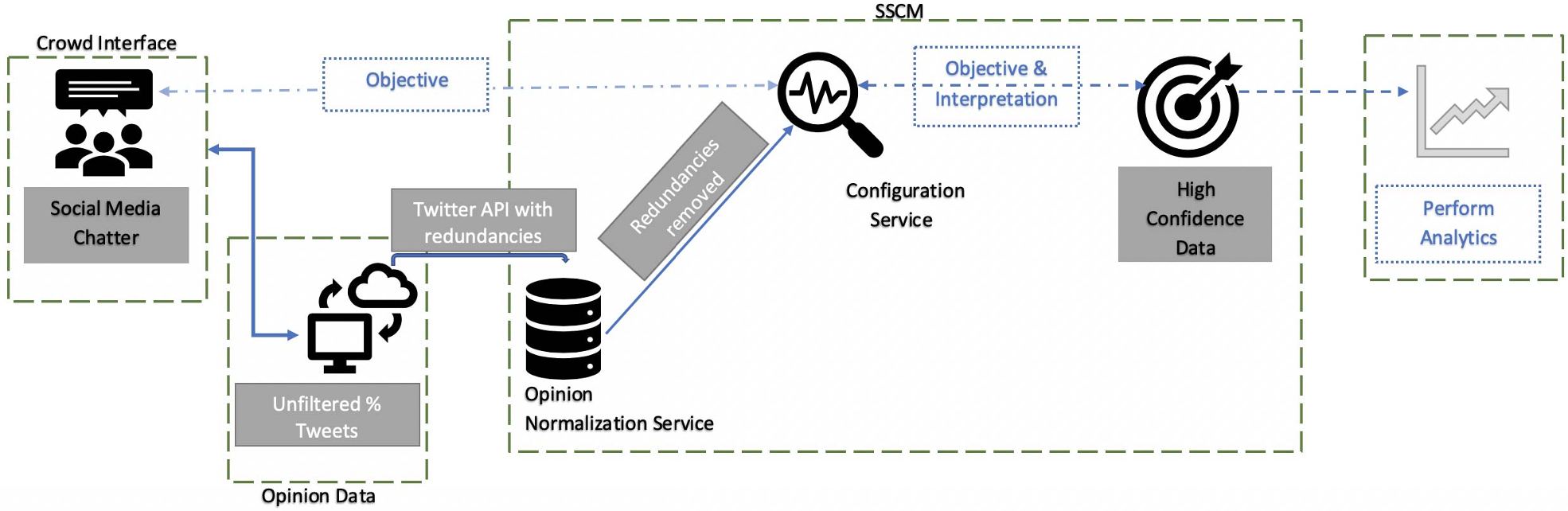
The paper proposes an architecture that sandwiches filtering logic between data ingestion (Twitter API) and final analysis (LIWC/Sentiment tools).
1. Architectural Backbone
The framework utilizes Service Synchronization and Coordination Middleware (SSCM). It models tasks and workers as Abstract Data Types (ADTs), ensuring that opinion requests are handled with the same rigor as traditional crowdsourcing jobs.
2. The Three Pillars of Filtering
The core innovation lies in the Configuration Service, which filters data based on three "Social Media Signals":
- Origin: Distinguishes between "Organic" (Human) and "Inorganic" (Bot) voices using the Bot-O-Meter.
- Originality: Separates "Mentions" (unique thoughts) from "Retweets" (duplicated content).
- User Participation: Segregates users into Passive (1-2 posts), Active, and Junkies (7+ posts).
Experiments & Results: A Reality Check on Political Sentiment
The authors applied their framework to 336,538 tweets from the 2016 US Presidential Election. The results were startling:
- Data Pruning: Only 16% of the original tweets met the criteria for High Confidence Data (original, human, passive users).
- Sentiment Shift: In the "Presidential Debate" subset, the raw data showed a 58% positive sentiment. After the HCD pipeline removed bots and high-frequency "junkies," the sentiment flipped to majority negative.
 Figure: Unfiltered sentiment showing a deceptive positive majority.
 Figure: HCD filtered sentiment revealing a negative reality among unique human voices.
Critical Analysis & Conclusion
Takeaway
The study proves that "Big Data" is not always "Good Data." By using an SOA approach, researchers can build modular, invocable services that prioritize the integrity of the speaker over the quantity of the speech. This is essential for any secondary or tertiary data consumer who needs to rely on crowdsourced insights for policy or strategy.
Limitations & Future Work
While the framework is robust, identifying "intent" in retweets (e.g., sarcastic sharing) remains a challenge. Future iterations intend to expand the "social media signals" library and test the framework's efficacy in commercial product sentiment, where marketing bots are even more prevalent than political ones.
Conclusion: This work provides a necessary "sanity check" for the field of social media analytics, offering a scalable blueprint for extracting truth from the noise of the digital crowd.