
FOAGRNN: Revolutionizing Logistics Satisfaction Prediction via Fruit Fly Intelligence
Analysis of service satisfaction in web auction logistics service using a combination of Fruit fly optimization algorithm and general regression neural network
This paper introduces the Fruit Fly Optimization Algorithm (FOA) to optimize the spread parameter of a General Regression Neural Network (GRNN). The resulting FOAGRNN model achieves SOTA performance in predicting web auction logistics service satisfaction, outperforming traditional PSO-GRNN and PCR methods.
TL;DR
This research presents a novel hybrid model, FOAGRNN, which combines the Fruit Fly Optimization Algorithm (FOA) with General Regression Neural Networks (GRNN). By simulating the biological foraging behavior of fruit flies to tune neural network parameters, the model achieves a remarkable 0.942 AUC in predicting logistics service satisfaction for web auctions, significantly outperforming PSO-optimized and traditional regression models.
Background & Positioning
In the e-commerce ecosystem, logistics is the bridge between digital transactions and physical fulfillment. While most research focuses on "Cash Flow" or "Information Flow," this paper tackles the complexity of "Service Satisfaction" in web auction logistics. From a technical standpoint, it moves away from overused meta-heuristics like Genetic Algorithms (GA) and explores a then-novel Fruit Fly Optimization (FOA) paradigm to solve the parameter-sensitivity issues of GRNN.
The Problem: The "Spread" Bottleneck
General Regression Neural Networks (GRNN) are powerful for non-linear mapping but are extremely sensitive to a single parameter: the Spread Constant.
- Too small: The network loses generalization (overfitting).
- Too large: The network becomes too "smooth" and loses detail (underfitting).
Previous works relied on "trial-and-error" or Particle Swarm Optimization (PSO), which can be computationally expensive or prone to local optima.
Methodology: Biomimicry Meets Regression
The author proposes a three-stage pipeline:
- Feature Engineering: Using Principal Component Regression (PCR) to reduce 41 survey items into 4-6 significant factors.
- Global Search (The Olfactory Phase): FOA initializes a swarm of flies. Each fly estimates a "smell concentration" (fitness) based on the inverse of the distance to a potential food source (the optimal parameter).
- Local Refinement (The Visual Phase): The swarm aggregates toward the fly with the best smell, iteratively refining the GRNN spread constant.
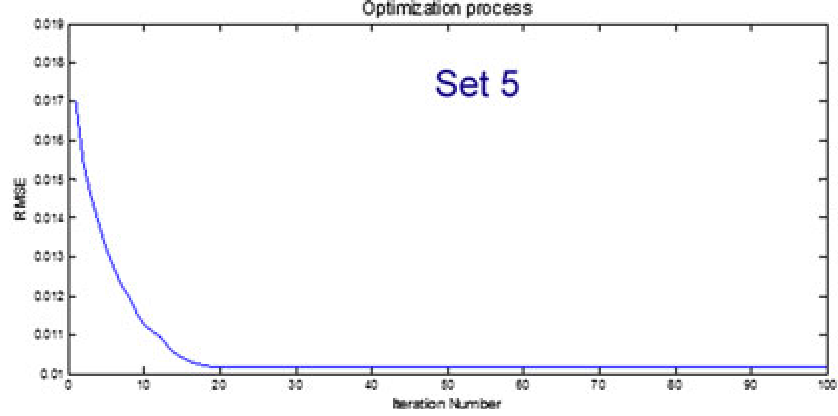 Figure: The convergence charts show how FOA dynamically drags the RMSE down to a minimum within just 20 iterations.
Experimental Results & SOTA Comparison
The study compared FOAGRNN against PSOGRNN, standard GRNN, and PCR across multiple data sets.
Key Performance Metrics:
- Convergence: FOAGRNN reached stability much faster than PSOGRNN.
- Accuracy: As shown in the ROC analysis, FOAGRNN occupies the largest Area Under the Curve (AUC).
| Model | Sensitivity (Sen) | Specificity (Spe) | AUC |
|---|---|---|---|
| FOAGRNN | 0.960 | 0.924 | 0.942 |
| PSOGRNN | 0.911 | 0.892 | 0.901 |
| Standard GRNN | 0.832 | 0.855 | 0.844 |
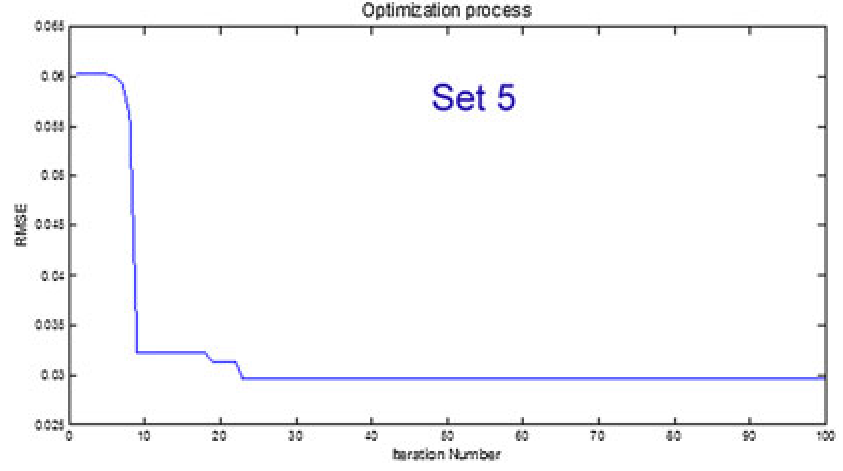 Figure: The ROC curves demonstrate the clear superiority of the FOA-optimized approach in classification robustness.
Critical Insight: Why FOA Works
The success of FOA in this context lies in its stochastic search efficiency. Unlike PSO, which requires tuning multiple velocity and inertia constants, FOA's "smell concentration judgment" simplifies the search space navigation, making it particularly effective for univariate optimization tasks like finding the GRNN spread constant.
Conclusion
The FOAGRNN model provides a robust framework for e-commerce platforms to preemptively identify logistics dissatisfaction. While the paper specifically looks at web auctions, the methodology of using FOA to tune sensitive neural parameters provides a blueprint for optimizing other complex systems like Support Vector Machines (SVM) or Fuzzy Inference Systems.
Takeaway: In the world of hyperparameter tuning, sometimes the simplest biological inspirations—like a fruit fly looking for fruit—yield the most efficient engineering solutions.