
Service Supervision: Ensuring Harmony in Collective Intelligence
Service Supervision for Service-Oriented Collective Intelligence
This paper introduces a multi-layered architecture for "Service Supervision" designed to facilitate service-oriented collective intelligence. It proposes a comprehensive framework that integrates service selection, adaptation, and coordination to satisfy the diverse policies of service providers in a composite service environment.
TL;DR
To build "Collective Intelligence" from services owned by different organizations, providing a functional connection isn't enough—you must guarantee that provider policies are respected. This paper proposes a three-layer Service Supervision architecture (Selection, Adaptation, and Coordination) that uses advanced Constraint Satisfaction Problems (CSP) and meta-level monitoring to ensure complex workflows actually follow the rules of the services they consume.
Background: The Policy Bottleneck
In the era of "Service-oriented Collective Intelligence," tools like the Language Grid combine machine translators, dictionaries, and morphological analyzers from global providers. However, a major hurdle remains: Service Providers have rules.
- One provider may prohibit their dictionary from being used with Google Translate.
- Another might limit input length to 1000 characters.
- A third might forbid parallel access to prevent server overload.
Existing SOTA methods focus on finding the "best" QoS (speed/cost), but in reality, if you violate a provider’s policy, you lose the service entirely. This paper shifts the focus from optimization to compliance.
Methodology: The Three Levels of Supervision
The authors propose a hierarchical approach, moving from simple selection to active workflow modification.
1. The Selection Layer (CSP Solver)
The system treats service composition as a Constraint Satisfaction Problem (CSP). Each abstract task in a workflow (e.g., "Translate") is a variable, and concrete services (e.g., "JServer") are values in its domain.
- The Insight: When no valid combination exists (an "over-constrained" problem), the system doesn't just fail. It uses Partial CSP to find the combination with the least violations and identifies which service needs to be changed.
2. The Adaptation Layer (The AOP Weaver)
If a service almost works but violates an attribute (like input length), this layer intervenes.
- How it works: It uses Aspect-Oriented Programming (AOP) to "weave" new logic around the service call. For example, if a translator has a character limit, the Adaptation Layer injects a pre-processor to split the text into sentences and a post-processor to merge them back.
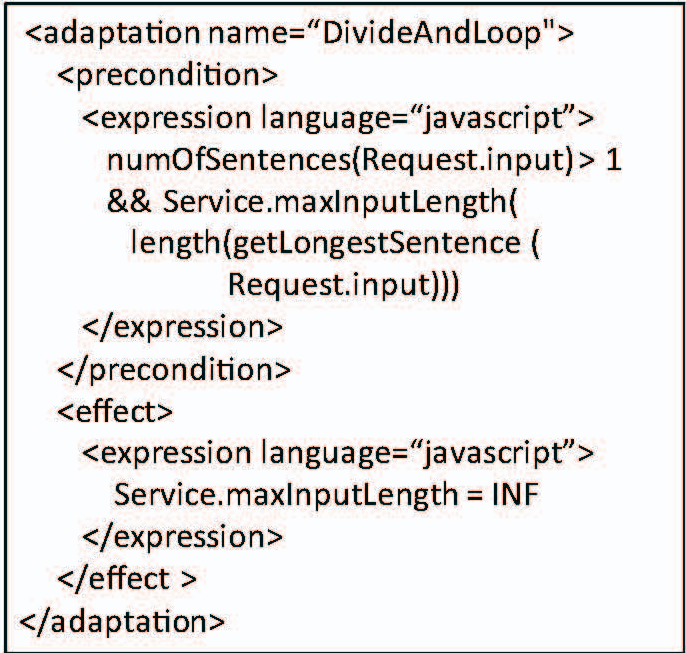 Figure: The profile and logic of an adaptation process used to overcome service limitations.
3. The Coordination Layer (Meta-Level Control)
Some policies affect the timing of execution. If two services cannot be run simultaneously, the system uses meta-level functions (suspend, resume) to force a parallel workflow into a sequential one.
- The Mechanism: It checks the workflow against a WS-CDL (Web Services Choreography Description Language) interpreter at runtime to ensure the protocol is never breached.
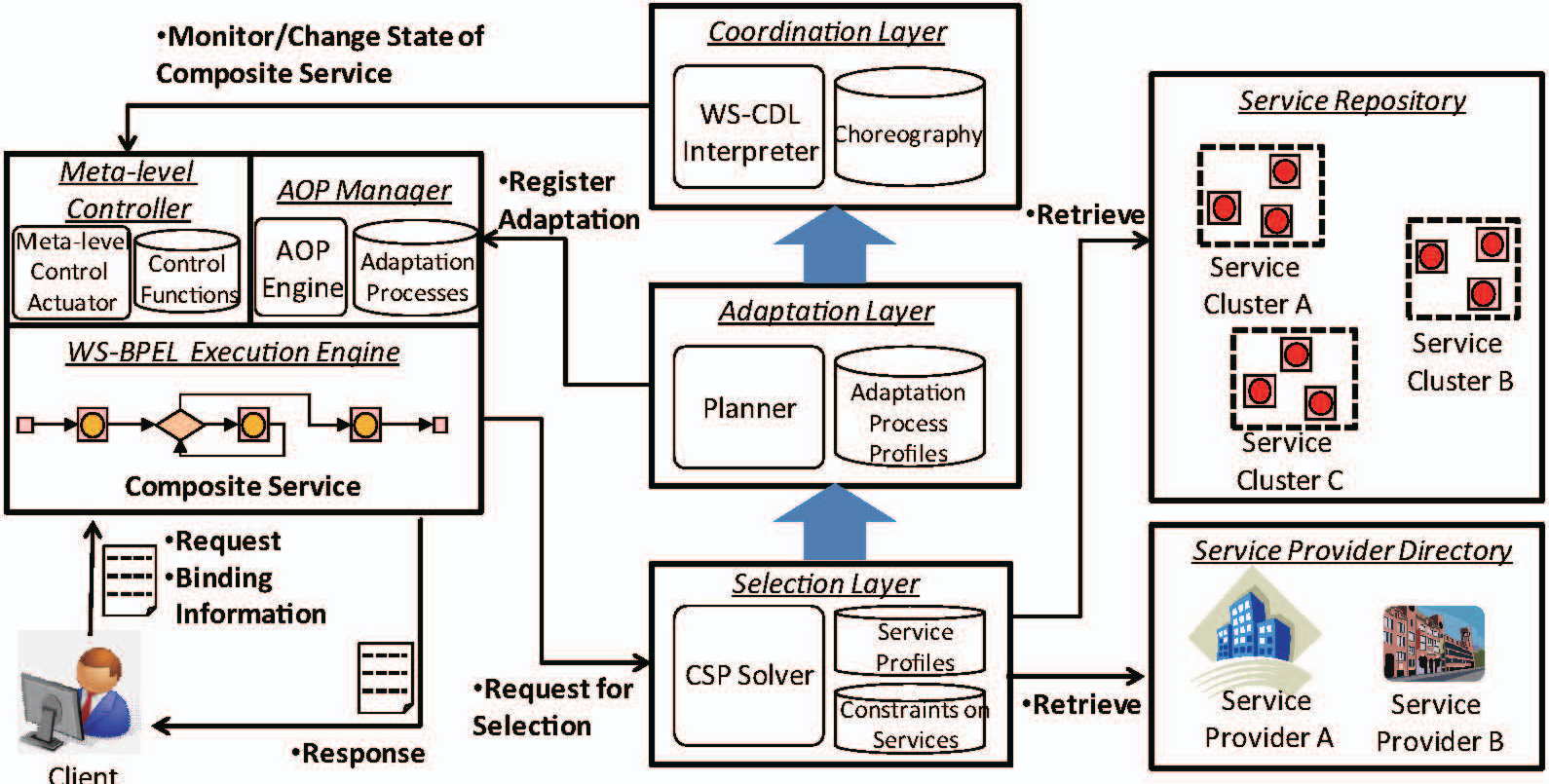 Figure: The architecture showing how Selection, Adaptation, and Coordination layers interact with the Service Repository.
Experimental Insight: Solving the Impossible
In a test scenario involving a translation workflow (Morphological Analyzer + Dictionary + Translator), the system encountered a conflict: the user requested a 1500-character translation, but the chosen translator (JServer) only allowed 1000.
- Selection Layer identified JServer as the best candidate despite the violation.
- Adaptation Layer searched its repository and found a
div_mergeprocess. - Coordination Layer monitored the two dictionaries involved to ensure they were accessed sequentially to satisfy the provider's load policy.
The result is a workflow that works not just functionally, but legally and technically within the constraints of all stakeholders.
Critical Analysis & Conclusion
Takeaway
The core value of "Service Supervision" is its ability to build trust. By providing a framework where service providers know their constraints (policies) will be enforced via meta-level controls, they are more likely to participate in collective intelligence ecosystems.
Limitations
- Scalability: While the paper suggests efficient CSP algorithms (Branch and Bound), the computational complexity grows significantly with the number of abstract services and constraints.
- Heuristic Nature: The hill-climbing approach for adaptation is susceptible to local optima; it might not always find the "best" way to adapt a service.
Future Outlook
As we move toward AI-agent-driven service consumption, this type of "Supervision" will be critical. AI agents will need to navigate not just APIs, but the complex legal and usage policies attached to them—this paper provides the architectural blueprint for that future.