
LDSA: Reducing Social Network Storage Costs via Set-Covering Theory
Set-Covering Theory-Based Data Placement Cost Optimization for Online Social Networks
This paper introduces LDSA (Latency-constrained Matrix-based Data Placement Strategy), a novel algorithm that optimizes data storage costs in Online Social Networks (OSNs) by transforming data placement into a minimum set-covering problem. Utilizing set-covering theory and discernibility matrices, it achieves significant cost reductions while ensuring 100% adherence to user latency requirements across distributed cloud data centers.
TL;DR
Managing data for billions of users across global data centers is a balancing act between cost and speed. This paper proposes LDSA, a heuristic algorithm that uses Set-Covering Theory to find the absolute minimum number of data replicas needed to satisfy user latency. Compared to traditional Genetic Algorithms, LDSA is not only 15-40% cheaper but also runs hundreds of times faster, making it a highly practical solution for real-world cloud environments.
The Core Challenge: The Cost of Connection
In Online Social Networks (OSNs), your data needs to be close to your friends to ensure low latency. However, blindly replicating data everywhere (the "Full Coverage" strategy) is prohibitively expensive. Existing strategies like Genetic Algorithms (GA) are often too slow to converge or get stuck in local optima, while simple distance-based strategies fail to account for the complex web of social relationships.
The authors identify a gap: How can we mathematically prove we are using the minimum number of replicas while guaranteeing that 100% of a user's friends can access their data within a specific time window (e.g., 150ms)?
Methodology: From Matrices to Optimization
The breakthrough in this paper is the application of the Discernibility Matrix from rough set theory to network topology.
1. The Latency Constrained Matrix (LCM)
The algorithm builds a matrix where:
- Rows represent users.
- Columns represent their friends.
- Cell Values contain the set of data centers that can serve the friend within the required latency threshold.
2. The Heuristic Reduction
Once the matrix is built, the problem becomes: Pick the smallest set of data centers such that every "friend" cell is covered.
- LDSA uses a greedy approach, calculating the frequency of each data center.
- It picks the "most useful" data center first—the one that satisfies the most latency requirements across the social graph.
 The mathematical definition of the Latency Constrained Matrix (LCM).
Experimental Results: Efficiency Reimagined
The authors tested LDSA against Facebook Egographical data. The results were stark in two dimensions: Cost and Time.
Cost Comparison
Under a strict 125ms latency constraint, the LDSA algorithm cost 71.24. As latency requirements get stricter, the "intelligence" of LDSA's set-covering approach becomes even more valuable.
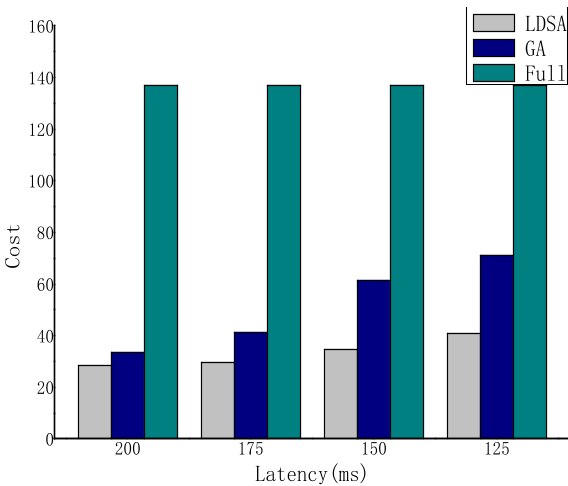 Cost comparison across different latency thresholds: LDSA consistently remains the most cost-effective solution.
Time Performance: 3 Seconds vs. 9 Hours
Perhaps the most impressive result is the computational overhead.
- LDSA: ~2.5 - 3.1 seconds.
- Genetic Algorithm: ~550 - 640 minutes.
This makes LDSA suitable for dynamic environments where data placement might need to be recalculated frequently as social graphs evolve.
Critical Insight & Future Outlook
While LDSA is a powerhouse for storage optimization, it currently assumes data centers have infinite capacity or homogeneous costs. The next frontier for this research—as noted by the authors—is integrating Load Balancing. If the "most frequent" data center in our set-covering solution becomes a bottleneck, the algorithm will need to intelligently "overflow" data to the next-best replica.
Takeaway: LDSA proves that classical mathematical theories like Set-Covering, when applied with the right "heuristic" insight, can vastly outperform modern black-box optimization algorithms in structured network problems.