
SFViz: Breaking the Social Discovery Barrier with Interest-Based Visualization
SFViz: interest-based friends exploration and recommendation in social networks
SFViz is a novel visual analytics system for friend recommendation that integrates social network topology with semantic interest structures derived from social tags. By combining a Radial Space-Filling (RSF) tree with circular network layouts, it allows users to interactively explore potential connections within specific interest contexts, demonstrated effectively on Last.fm music community data.
TL;DR
SFViz represents a bridge between Social Network Analysis (SNA) and HCI, providing an interactive system that recommends friends by analyzing both who you know and what you talk about (via tags). It utilizes a unique "Radial Space-Filling" tree layout to help users navigate social circles through hierarchical interests.
Context: Why "Who You Know" Isn't Enough
In the world of social networks, recommendation usually falls into two camps: Topology-based (recommending friends of friends) and Profile-based (matching static data like "University"). The former is often too narrow, while the latter is too static.
The authors of SFViz identify a critical gap: Interest is dynamic and hierarchical. You might like "Classic Rock," which is a subset of "Rock," and you want to find friends who share that specific sub-interest, not just any music lover.
Methodology: The Matched Compound Graph (MCG)
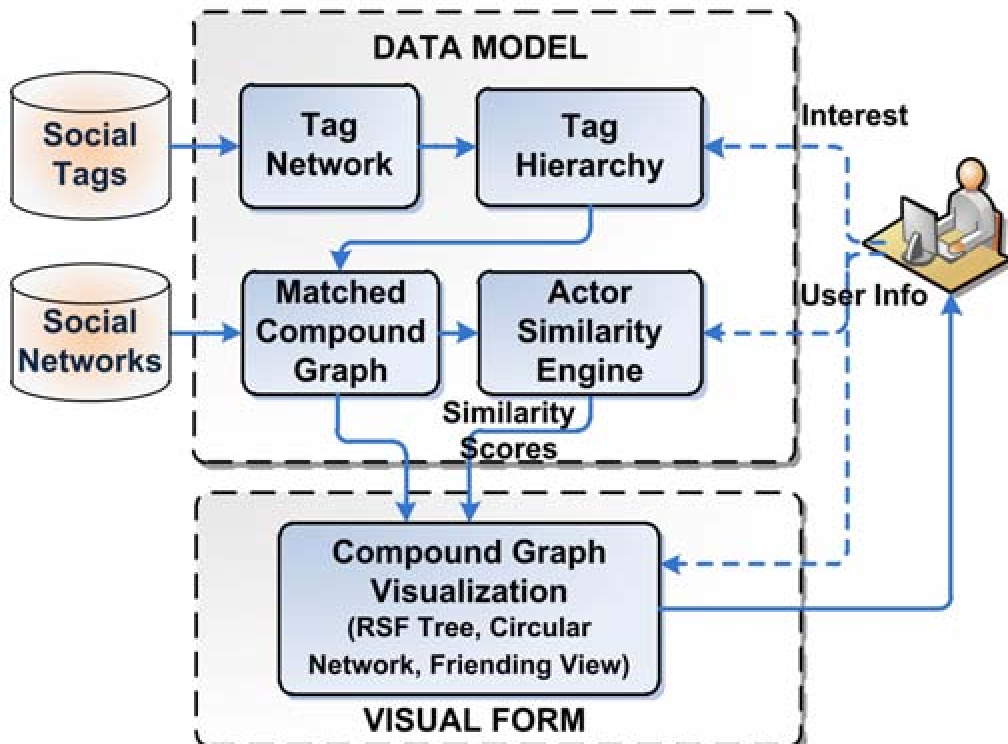
The brilliance of SFViz lies in its data modeling. It treats the social network and the interest tags as two distinct but interlaced structures:
- Tag Hierarchy Generation: Using user tagging behavior, the system builds a semantic network. It then applies the GN Algorithm (betweenness-based clustering) to create a tree structure where "Pop" might be a parent of "Synthpop."
- Mapping Actors: Each user is assigned a "Matching Score" to place them within the deepest possible node of the interest tree.
- Hybrid Similarity: The recommendation engine uses the formula: This mathematically balances your structural position in the social graph () with your semantic distance in the interest tree ().
Visualization Design: RSF Meets Circle Layouts
To solve the visual "hairball" problem of large networks, SFViz employs:
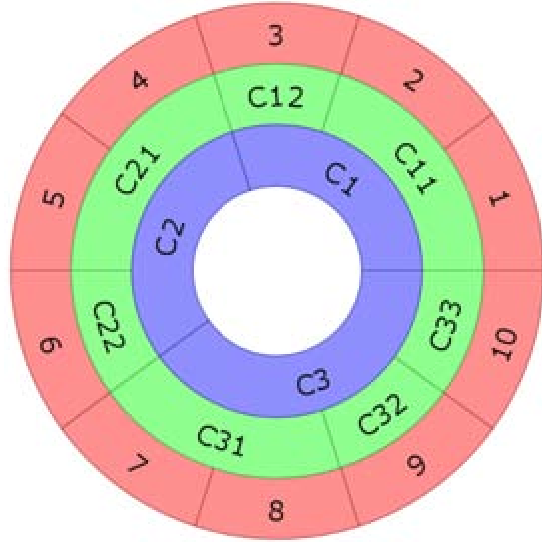
- Radial Space-Filling (RSF): The interest hierarchy is shown as nested rings.
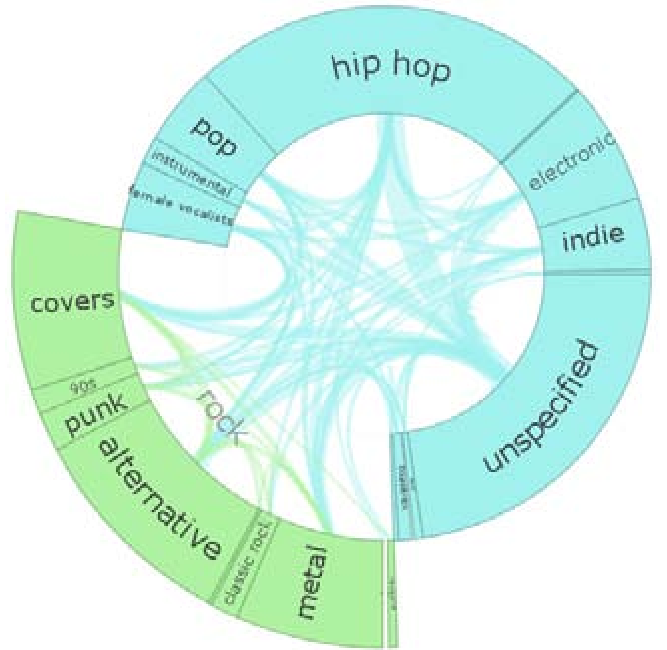
- Hierarchical Edge Bundling: To prevent the center of the circle from becoming a mess of lines, edges are "bundled" along the tree structure, making the flow of social connections visible.
- Distortion & DOI: Users can expand specific interest sectors (e.g., "Metal") to see more granular details, using a Degree of Interest (DOI) filter to hide irrelevant nodes.
Deep Dive: The Last.fm Case Study
Testing with Last.fm data, the researchers found that social behavior is heavily influenced by interest hierarchies.
- Cross-scale Discovery: By looking at the "Rock" category, users could see that while their local friends were into "Indie," the system recommended people in "Alternative" because of the high path similarity in the tag hierarchy.
- Evidence-based Feedback: The system doesn't just say "Connect with User X." It shows the Shared Neighbors (mutual friends) who bridge the gap, providing social proof for the recommendation.
Critical Insight & Limitations
While SFViz is a powerful step toward Explainable AI (XAI) in social discovery, it faces two main hurdles:
- Tag Sparsity: In the study, nearly 50% of users couldn't be categorized because they didn't tag enough data. This "cold start" for interests remains a challenge.
- Multiple Affiliations: Currently, a user is mapped to a single primary interest. In reality, a user might be equally passionate about "Jazz" and "Technology," requiring a multi-parent mapping approach.
Conclusion
SFViz demonstrates that by visualizing the context of a connection, we make social networks more navigable and human-centric. For future developers, the takeaway is clear: don't just show the connection; show the shared world that makes the connection meaningful.