
Beyond Greedy: Using Shapley Values to Combat Misinformation in Social Networks
Influence limitation in multi-campaign social networks: A Shapley value based approach
The paper introduces a game-theoretic framework for the "Influence Limitation" problem, aiming to identify top-k seed nodes for a positive counter-campaign to neutralize a negative misinformation campaign. The authors propose <strong>SV-MCICM</strong>, a heuristic based on the <strong>Shapley Value</strong>, which successfully handles both submodular and non-submodular influence functions in multi-campaign social networks.
TL;DR
The battle against misinformation is a race against time. This paper introduces a sophisticated game-theoretic approach using Shapley Values to select the most "influential protectors" in a network. Unlike prior methods that assume mathematical simplicity (submodularity), this approach works in complex, realistic scenarios where counter-campaigns might be less effective than the original rumor.
The "Submodularity" Trap
In the world of social network analysis, most algorithms love submodularity. It’s the mathematical equivalent of "diminishing returns"—adding one more seed node helps, but it helps a little less than the previous one. When a function is submodular, a simple greedy algorithm (picking the best node one by one) is nearly perfect.
The Problem: In the real world, influence is messy. If a positive campaign is launched with a delay or has a specific probability of failing, the math breaks. The function becomes non-submodular, and standard greedy algorithms lose their edge. Previous research often "simplified" the problem to keep the math easy, but at the cost of real-world accuracy.
The Solution: A Cooperative Game Theory Approach
Instead of viewing nodes as just points in a graph, the authors treat the influence limitation problem as a Cooperative Game. In this game, the "players" are the nodes, and the "payout" is the number of people saved from misinformation.
1. The Shapley Value Perspective
The Shapley Value is a famous concept from economics that fairly distributes the total gain of a coalition among its members based on their marginal contribution. Here, it helps determine: "How many extra people are saved specifically because Node X joined the counter-campaign?"
2. The SV-MCICM Algorithm
The authors propose SV-MCICM (Shapley Value based heuristic for Multi-Campaign Independent Cascade Model). The process involves:
- Live Graph Sampling: Simulating potential paths of infection.
- Intersection Sets: Focusing on nodes that are reachable by both the "bad" campaign and the "good" campaign.
- Marginal Estimation: Using sampling to estimate the Shapley Value, as calculating it exactly is computationally impossible (NP-Hard).
Note: The algorithm identifies nodes that act as strategic bottlenecks between the rumor source and the rest of the network.
Experimental Battleground
The researchers tested their method on diverse networks, from the Karate club (small) to the HEP citation network (nearly 10,000 nodes).
Key Performance Indicators:
- Top-K Selection: When picking a fixed number of seeds (), SV-MCICM consistently saved a higher percentage of the population than Degree Centrality and previous heuristics.
- -coverage: If the goal is to save 50% of the network, SV-MCICM required a much smaller "budget" of seed nodes compared to other methods.
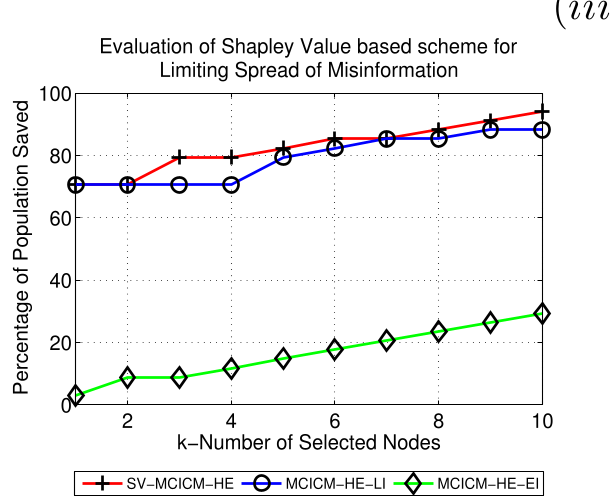 Figure: SV-MCICM (Red line) consistently maintains higher population savings as the seed set grows.
Handling Multiple Wars: Multi-Campaign Scenarios
A unique contribution of this paper is extending the logic to multiple competing campaigns. Imagine three different rumors spreading and two different organizations trying to stop them. By calculating "Weighted Average Shapley Values," the authors show that their method can prioritize certain campaigns (e.g., a lethal virus over a harmless rumor) while still optimizing the overall network safety.
Critical Insight & Conclusion
While the Shapley Value is mathematically elegant, its high computational cost remains the primary hurdle. The authors use a sampling technique to make it feasible, but for billion-node networks like X (Twitter) or Facebook, further optimization is needed.
The Takeaway: This research shifts the paradigm from simple "high-degree" node targeting to strategic contribution targeting. If you want to stop a rumor, don't just find the person with the most followers; find the person who is most uniquely positioned to block the rumor's path.
Limitations & Future Work
- Linear Threshold Models: The current work focuses on Independent Cascade models; moving to threshold-based behaviors remains an open challenge.
- Real-time Computation: In a real crisis, we might not have time for 10,000 simulations. Speeding up the "Marginal Contribution" calculation is the next frontier.