
Sharding Social Networks: Beyond the Chaos of Random Distribution
Sharding social networks
This paper presents a network-aware sharding framework for large-scale social networks, featuring the "VBLabelProp" community detection algorithm and the "BlockShard" allocation strategy. The method significantly outperforms traditional random sharding by co-locating tightly knit communities on the same physical servers, achieving up to a 60% reduction in average query load.
TL;DR
Social network databases are too large for one machine, but random sharding—the industry standard—is a recipe for latency. By treating sharding as a community detection problem, this research demonstrates how to group "friends" on the same server, cutting query loads by over 60% on platforms as large as Twitter.
Background Positioning
In the world of distributed systems, we often assume that uniform data distribution (Random Sharding) is the safest bet for load balancing. This WSDM classic argues the opposite for social graphs. It moves the needle from simple empirical observations to a rigorous theoretical framework based on the Stochastic Block Model (SBM), proving that network-aware sharding is not just an optimization but a necessity for neighborhood-centric queries.
The Problem: The "Scatter-Gather" Nightmare
When you open your Twitter or Facebook feed, the system performs a neighborhood query: it fetches the latest updates from everyone you follow.
- The Random Shard Pitfall: If your 200 friends are randomly assigned to 1,000 shards, your feed request might hit 150+ different servers.
- The Scalability Wall: As the network grows, the number of shards increases, and the probability of your ego-network being co-located drops to near zero.
The authors prove (Theorem 2) that even with massive replication, random sharding results in "provably poor" performance because it ignores the inherent community structure of human relationships.
Methodology: Community-First Sharding
The proposed solution follows a three-stage pipeline to turn a chaotic graph into an organized database.
1. VBLabelProp (Scalable Community Detection)
The authors derive a scalable version of Bayesian inference for communities. Unlike traditional Label Propagation, which can be unstable, VBLabelProp uses a weighted voting system where nodes join communities based on a balance of internal edge density and global "discounts" for block size.
2. BlockShard (Greedy Packing)
Once communities (blocks) are identified, they must be assigned to physical shards. Since communities often exceed a single server's capacity, BlockShard greedily packs the most "popular" blocks together, overflowing nodes into adjacent shards while maintaining co-locality.

3. NodeRep (Strategic Replication)
To solve the "hotspot" problem caused by celebrities, the authors replicate "locally popular" nodes. Instead of just caching the global top-1% (like Justin Bieber), they cache nodes that are frequently followed within the specific community hosted on that shard.
Experiments & Results
The researchers benchmarked their system against LiveJournal and Twitter (1.4 Billion edges).
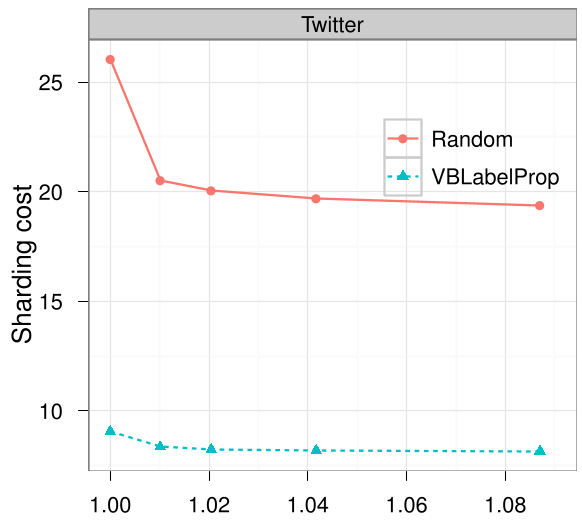
- Drastic Load Reduction: On Twitter, the average number of shards accessed per query dropped from 26 (Random) to 9 (VBLabelProp).
- Geography vs. Topology: Interestingly, sharding by user location (Zip Code) performed better than random but worse than the graph-based approach. Social "closeness" in the digital world is a more accurate predictor of access patterns than physical proximity.
- The Replication Paradox: Replicating just 1% of nodes yielded a massive 23% reduction in cost for Twitter, though the gains quickly plateau after that.
Critical Insight: The Load Variance Trade-off
The paper doesn't claim perfection. One critical finding is that while network-aware sharding lowers the average load, it increases variance (Load Dispersion). Because some shards host highly active communities or "local celebrities," they can become "hot shards."
The authors effectively counter this with their NodeRep strategy. By using a sliver of extra memory to replicate those high-degree nodes, they smooth out the spikes, making the system both faster on average and stable in the worst case.
Takeaway
If you are building a system where data access is defined by a graph (Social, Citations, Genomics), stop sharding by User_ID % N. By aligning your physical data layout with the latent community structure of your users, you can achieve performance gains that no amount of raw hardware can replicate.