
Beyond the Privacy Paradox: Why Your Facebook Habits Don't Match Your Fears
Sharing Ephemeral Information in Online Social Networks: Privacy Perceptions and Behaviours
This study investigates the "privacy paradox" in the context of ephemeral information sharing on Facebook (e.g., status updates and wall posts) among 103 users over two years. By merging scraped behavioral data with survey responses, the authors identify a significant gap between users' stated privacy concerns and their actual posting habits.
TL;DR
Is what you say about privacy on social media what you actually do? This study reveals a striking "Privacy Paradox" concerning ephemeral information (status updates, wall posts). While we worry about who sees our data, our daily posting habits often ignore the very privacy tools meant to protect us. Crucially, factors like age and gender significantly skew these behaviors, suggesting that social media platforms need a radical redesign of their privacy controls.
The "Static" vs "Ephemeral" Privacy Gap
Most early research into online privacy focused on static data—your email, your relationship status, or your workplace. But as social media evolved into an "always-on" stream of consciousness, the nature of information changed.
The authors argue that "ephemeral" information—the "where I am right now" or "how I'm feeling" posts—is qualitatively different. It is shared on impulse and carries unique contextual risks. The central problem is that despite being worried about strangers knowing our location, we often fail to use "on-the-fly" privacy settings to restrict that very information.
Methodology: Scraping Reality vs. Surveying Scenarios
To bridge the gap between what users think they do and what they actually do, the researchers used a two-pronged attack:
- Direct Scraping: They developed a Facebook app to collect two years of actual behavior (posts, status updates, and privacy settings) from 103 participants.
- Psychological Profiling: They conducted a comprehensive survey containing scenarios (e.g., "how would you share that you have a hangover?") to measure explicit privacy attitudes.
Key Findings: The Demographics of Privacy
The study highlights two main demographic drivers: Gender and Age.
1. The Gender Incongruity
Perhaps the most surprising finding was that females reported much higher levels of privacy concern than males, yet they posted more frequently and utilized fewer privacy restrictions.
- Finding: Females were less pro-active in using on-the-fly privacy settings despite their stated fears.
- Insight: This suggests that "safety concerns" (fear of predators or harassment) might drive the feeling of needing privacy, but the social reward of sharing overrides the technical effort of activating settings.
2. The Age Maturity Curve
Older users (35+) proved to be the most "privacy-literate" in practice. Although they actually posted more frequently than younger users, their settings were significantly more restrictive.
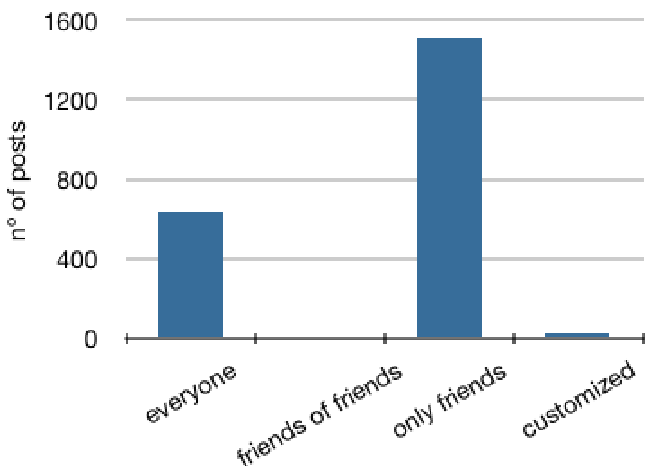
Why Does This Disconnected Behavior Persist?
The authors theorize that there is a failure in translation. Current social-technical environments make it too difficult for a user's need for privacy to be converted into a technical action.
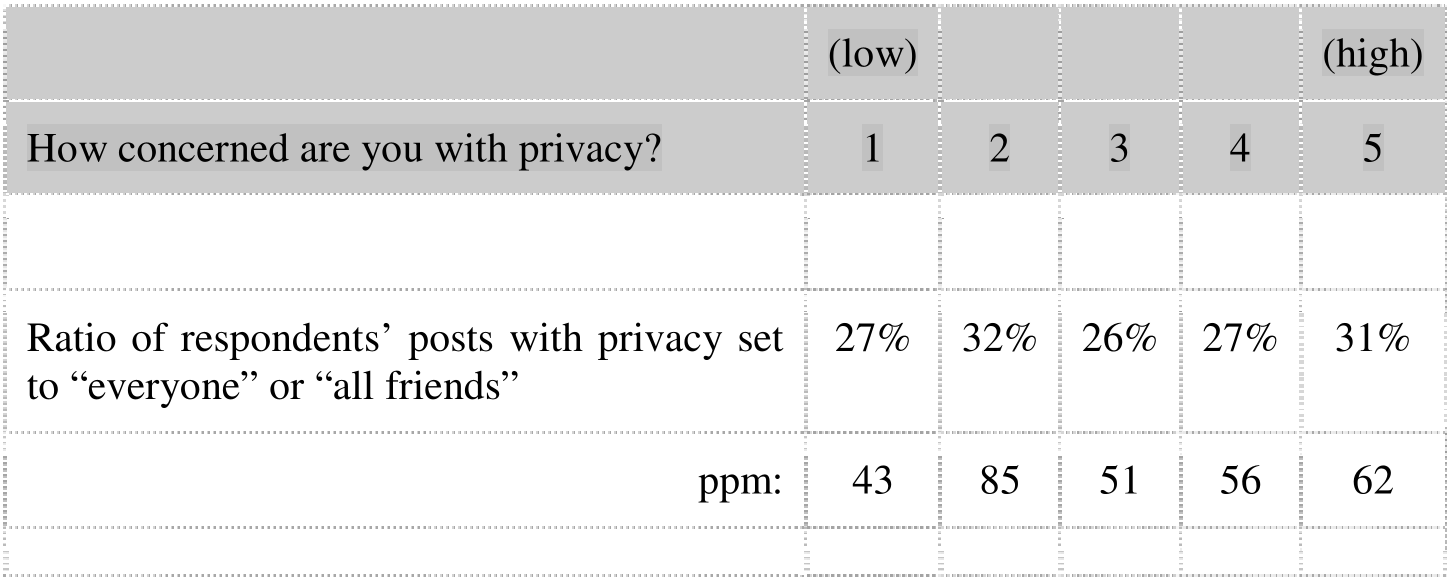
As shown in the table below, general concern for privacy (Scale 1-5) had almost no impact on the ratio of posts visible to "Everyone" or "All Friends."
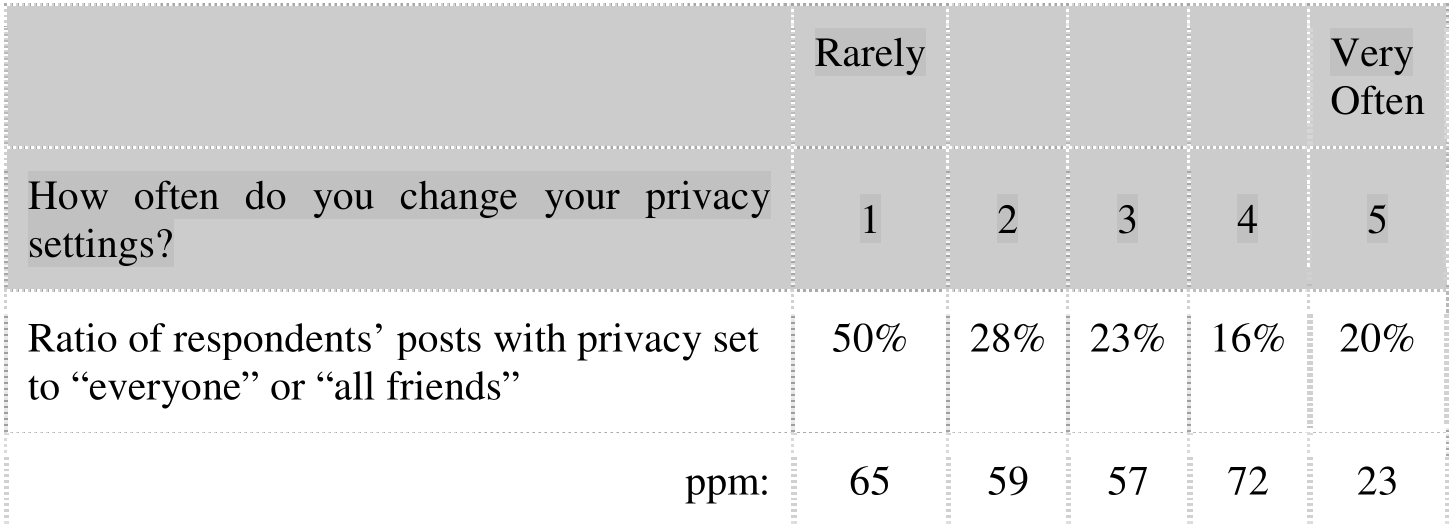
However, those who frequently changed their privacy settings (indicating technical familiarity) actually shared significantly less with broad audiences.
Design Guidelines: Designing for Humans, Not Users
The paper concludes with a call for "Privacy by Design" that acknowledges human flaws:
- Contextual Reminders: Since users underestimate their audience (average underestimation of 16 friends), systems should nudge users about the visibility of their posts.
- Demographic Sensitivity: Privacy defaults should perhaps be "pessimistic" (hidden by default) for groups who share frequently but lack the pro-activity to change settings.
- Usage-Based Triggers: New users should be frequently prompted to protect content until they establish stable privacy boundaries.
Critical Insight & Conclusion
This paper serves as a vital reminder that privacy concern does not equal privacy behavior. The "Privacy Paradox" in ephemeral sharing is driven largely by the friction of the interface. For product designers, the takeaway is clear: if you want to protect users, you cannot wait for them to find the settings menu—you must bring the settings to the moment of disclosure.