
The Pointing Gesture: Why We Share Misinformation and How to Fix It
Sharing (mis) information on social networking sites. An exploration of the norms for distributing content authored by others
This article, authored by Lavinia Marin, investigates the normative structures of content sharing on Social Networking Sites (SNSs). It proposes a non-epistemic framework where sharing is viewed as a "pointing gesture" analogous to rumor-spreading or gossip, rather than traditional information-giving testimony.
TL;DR
Lavinia Marin explores why traditional "truth-telling" rules fail on social media. She argues that sharing isn't about making a claim; it's a social signal. By treating social networking sites (SNSs) as "forms of life" where gossip and rumors are the primary language games, she suggests that the fix for misinformation isn't just fact-checking—it's explicit contextualization by the user.
Contextualizing the Chaos: Beyond "Fake News"
Since 2016, the "arms race" against misinformation has focused heavily on technological fixes: AI filters, database cross-referencing, and algorithmic bans. However, Marin argues that this treats a normative problem with a technological patch. The core issue is that we don't actually know what "rules" users are following when they hit the 'Share' or 'Retweet' button.
Are they testifying that the content is true? Or are they just saying, "Look at this"?
The "Language Game" of the Feed
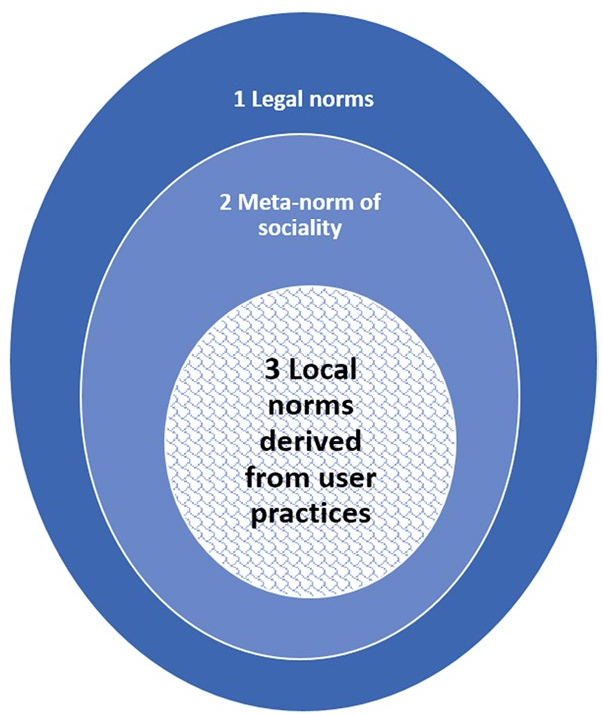
Drawing on Wittgenstein, the paper posits that SNSs like Facebook and Twitter are not just tools but "online lifeworlds" with three distinct layers of norms:
- Legal/Explicit Norms: The Terms of Service (T&Cs) that ban hate speech.
- The Meta-Norm of Sociality: The platform's DNA—encouraging us to expand our networks and "connect."
- Local Practices: The wild west of user-generated norms where groups decide what counts as a "good" post.
In this hierarchy, the meta-norm of sociality often trumps truth. If a rumor bonds a group together, the platform's design (and the users' social needs) will favor that bond over the fact-check.
Sharing is Not Posting
The central insight of the methodology is the distinction between Posting and Sharing:
- Posting: An assertion. You are the author. You are testifying to a truth.
- Sharing: A gesture of "quoting by indicating." It is functionally a "pointing gesture."
When someone says "Retweets are not endorsements," they are trying to navigate this gap. They want the social "points" of sharing something interesting without the epistemic "bill" of proving it's true.
Experimental Insight: Catchiness vs. Truth
The paper cites evidence showing that "falsity travels with greater velocity than the truth." Why? Because misinformation often functions as Gossip. Gossip isn't meant to be "News"; it's a mechanism for group cohesion, virtue signaling, and testing value allegiances. If I share a conspiracy theory, I might not be "informing" you; I might be checking to see if you are "on my side."
The Solution: The Responsibility of Context
Marin concludes that we cannot force users to act like journalists. However, we can hold them to a standard of Contextual Transparency.
If a user shares a link and adds a single word like "Funny," or "Outrageous," they have successfully "fixed" the context. This allows the audience to judge the share correctly. The harm of misinformation is most potent when the context is omitted—leaving the audience to assume the user is testifying to its truth.
Final Takeaway
The future of healthy social media isn't just better AI; it’s a culture (and perhaps technical nudges) that encourages users to state their intent. By making our gestures explicit, we stop being accidental soldiers in the misinformation war and start taking responsibility for the digital "forms of life" we inhabit.