
From Words to Character: Enhancing SMS Spam Filters with Personality Recognition
Short Messages Spam Filtering Using Personality Recognition
This paper introduces a novel SMS spam filtering approach that integrates Personality Recognition as an additional feature in classification models. By utilizing the Myers-Briggs personality model, the authors improve traditional text-based filters, achieving a peak accuracy of 98.94% on standard datasets.
TL;DR
Researchers have found a new way to catch spammers by analyzing the "personality" of their messages. By integrating Myers-Briggs personality traits into standard machine learning models, this study achieved an impressive 98.94% accuracy in SMS spam detection, proving that how a message feels is just as important as what it says.
Perspective: The Behavioral Gap in Filtering
For years, spam filters have operated like automated librarians, looking for "bad words" or suspicious patterns in text. However, as spammers become more adept at mimicking natural language, these traditional Bayesian filters are hitting a ceiling. The bottleneck isn't the vocabulary; it's the lack of contextual intent.
The authors of this paper identify a critical insight: Spam is almost always a campaign of solicitation. Whether it's a scam or a legitimate advertisement, it carries the "personality" of a salesperson or a fraudster, which differs fundamentally from the informal, personal tone of a message from a friend.
The Methodology: Decoding the "Spammy" Personality
The core of this research involves a two-phase workflow that bridges psychology and computer science.
1. Personality Vectorization
Each SMS is processed through the Myers-Briggs Type Indicator (MBTI) framework, focusing on four dimensions:
- Extroversion (vs. Introversion)
- Sensing (vs. iNtuition)
- Thinking (vs. Feeling)
- Judging (vs. Perceiving)
2. Feature Aggregation
Rather than replacing text analysis, the personality scores (ranging from 0.0 to 1.0) are appended to the traditional String-to-Word Vector. This creates a high-dimensional feature set that captures both the literal content and the "authorial fingerprint."
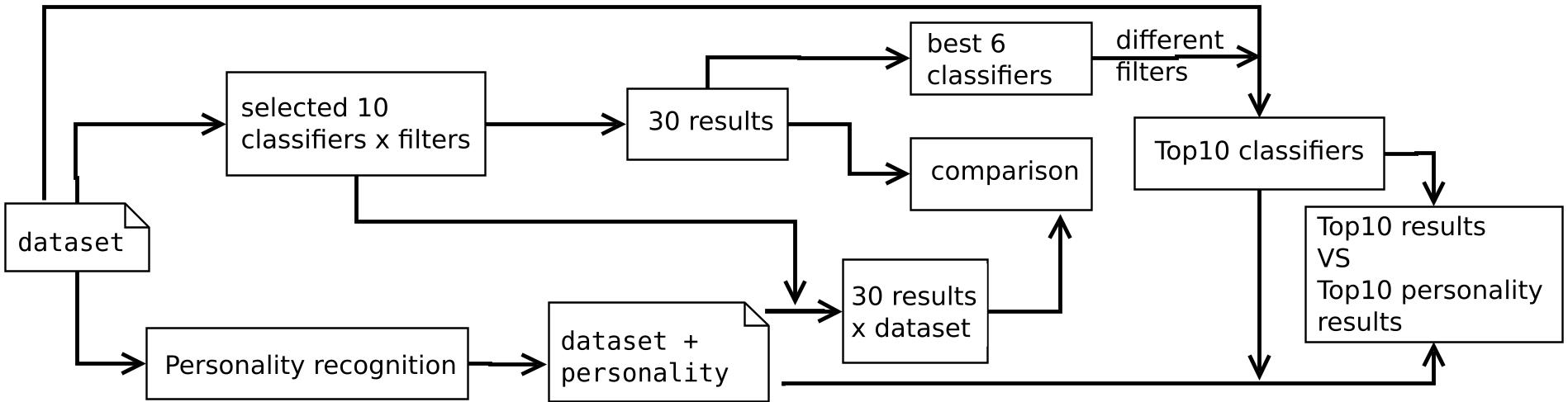 Figure 1: The workflow involves personality extraction followed by traditional ML classification.
Experimental Insights: Does it Work?
The authors tested their hypothesis against the SMSSpam Collection and the British English SMS corpora.
The "Spammer" Profile
The descriptive analysis revealed fascinating statistical differences. For instance:
- Legitimate messages (Ham) showed higher levels of "Extroversion" (91%) and "Sensing" (83%).
- Spam messages demonstrated a significantly higher "Judging" tendency (58% vs. 37% in ham).
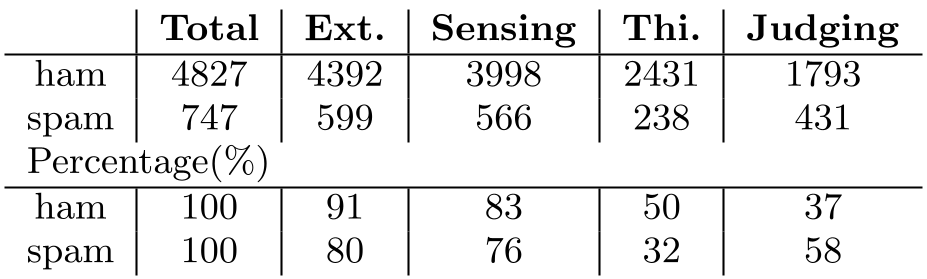 Table 2: Statistical differences in personality traits between Ham and Spam.
Results & SOTA Comparison
By applying classifiers like Support Vector Machines (SMO) and Naive Bayes Multinomial (NBM), the researchers observed a consistent trend: adding personality features almost always reduced the False Positive rate. In the world of spam filtering, a False Positive (blocking a real message) is the most "expensive" error.
- Top Accuracy reached: 98.94%
- The addition of personality traits allowed the models to catch nuances that pure word-based filters missed.
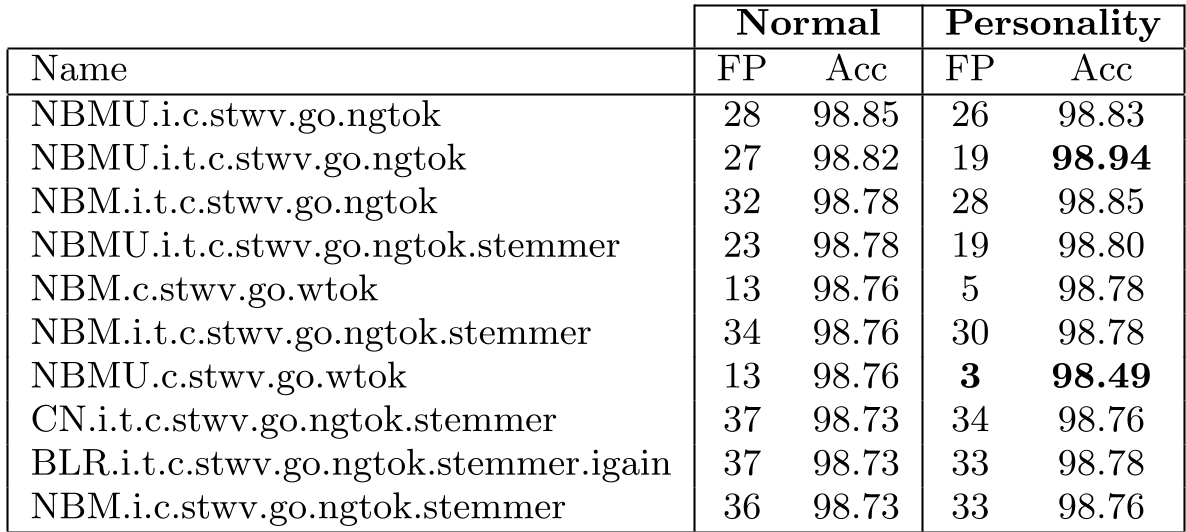 Table 4: Top results showing accuracy improvements when personality features are included.
Critical Analysis & Future Outlook
While the results are compelling, there are inherent limitations:
- Text Length: Personality recognition in 140 characters is notoriously difficult. The study relies on external APIs (uClassify) whose internal logic for such short texts may be a "black box."
- Evasion: If spammers realize personality is being monitored, they could theoretically use AI to "temper" their writing style to mimic a specific personality type.
Conclusion
This paper represents a shift from Content Analysis to Behavioral Profiling. By treating spam as a psychological artifact rather than just a sequence of tokens, the authors have opened a new front in the war against unsolicited communication. For product owners in the messaging space, the takeaway is clear: understanding your user's (and the attacker's) "voice" is the next frontier of security.