
Beyond Polarization: Decoding Signed Networks via Overlapping Leaders
Signed social networks: Link prediction and overlapping community detection
This paper introduces a two-phase leader-based approach for Overlapping Community Detection (OCD) in signed social networks, extending the DMID algorithm to handle both positive and negative links. It also proposes Extended Frustration Error (EFE), a novel metric for evaluating fuzzy community memberships in signed graphs.
TL;DR
This study presents a robust framework for identifying overlapping communities in signed social networks (containing both trust and distrust links). By introducing a leader-based detection phase and a fuzzy evaluation metric called Extended Frustration Error (EFE), the authors prove that "overlapping nodes"—those bridging multiple groups—are actually the most informative features for predicting future link signs.
Background: The Complexity of Signed Networks
Social networks are rarely just about "who knows whom." In the real world, edges carry sentiment: "friend vs. foe" or "trust vs. distrust." While Overlapping Community Detection (OCD) is well-studied for unsigned graphs, the presence of negative edges complicates everything from influence measurement to community evaluation. Previous metrics like the Frustration Index were binary, failing to capture the nuance of nodes that belong to multiple communities to different degrees.
Methodology: Identifying the True Leaders
The authors propose a two-phase extension of the DMID algorithm.
1. Leader Identification
Instead of just looking at raw degree, the paper defines Effective Degree (ED):
- ED considers the ratio of positive to negative incoming links. A leader must be trusted by many and distrusted by few.
- Disassortative-ness (DASS): Leaders are identified not just by their influence, but by how distinct they are from their immediate neighbors (heterogeneity).
A Local Leadership Degree (LLD) is calculated as a weighted sum:

2. The Coordination Game
Once leaders are identified, other nodes join communities through a "network coordination game." A node switches its community "behavior" if the payoff (derived from positive minus negative links to that community) exceeds its specific leadership threshold. This creates a natural, fuzzy membership structure.
Evaluating the "Fuzzy" Error
To measure how well the algorithm performed, the authors introduced Extended Frustration Error (EFE). This formula quantifies errors by penalizing negative edges within the same fuzzy community and positive edges between different ones, weighted by the degree of membership.
Experimental Insights: The Power of Overlapping Nodes
The researchers tested their approach on Wiki-Elec and Wiki-RfA datasets. The most striking finding was the role of three node classes:
- Intra nodes: Inside a single community.
- Extra nodes: Outside the local community.
- Overlapping nodes (Ovl): Straddling multiple communities.
As shown in the link prediction task, overlapping nodes consistently outperformed intra and extra nodes in predicting whether an edge would be positive or negative.

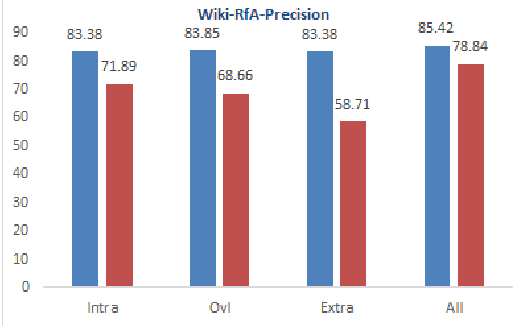 Fig 1: Precision results. Note how the Ovl feature set (overlapping nodes) shows superior performance across both Wikipedia datasets.
Critical Analysis & Conclusion
The study highlights that in modern social media, communities are not isolated silos. The dense overlapping structures found in Wikipedia (where thousands of nodes belong to multiple communities) suggest that the "borders" of a community are where the most critical social information resides.
Takeaway: If you want to predict trust/distrust behavior in a network, don't just look at the core of a community—look at the nodes that connect different worlds.
Limitations: The algorithm's reliance on a threshold parameter () suggests that sensitivity analysis is required for different network densities. Future work could automate parameter tuning using machine learning to adapt to drastically different social structures.