
WCCD: Bridging Uncertainty and Topology for Advanced Community Discovery
Study on similarity based on connection degree in social network
The paper develops a novel vertex similarity metric called Weighted Clustering Coefficient Connection Degree (WCCD) and a corresponding community detection algorithm, VSFCM. By leveraging Set Pair Analysis (SPA), the method treats social networks as identical-discrepancy-contrary systems, achieving superior community partition accuracy (measured by Modularity Q) across benchmark datasets.
TL;DR
In social network analysis, determining vertex similarity is the "Holy Grail" for community detection. This paper introduces the Weighted Clustering Coefficient Connection Degree (WCCD), which uses Set Pair Analysis (SPA) to handle relationship uncertainty. By combining node degrees, path reachability, and clustering coefficients, the proposed VSFCM algorithm systematically outshines traditional methods like GN and Label Propagation in modularity performance.
The Motivation: Why Link Counting is Not Enough
Traditional metrics like Common Neighbors (CN) operate on a binary logic: either a friend-of-a-friend exists, or they don't. However, social relations are inherently uncertain—discrepancies today might become identities tomorrow. Existing methods suffer from a "dual-trap":
- Local Underestimation: Ignoring the latent similarity between nodes connected by indirect paths.
- Global Complexity: Katz and Spectral indices are mathematically elegant but computationally "explosive" for modern massive graphs.
Authors Xiao Chen and team propose that a node is not just a point, but a part of an Identical–Discrepancy–Contrary system.
Methodology: The "Identical-Discrepancy-Contrary" Framework
The core contribution is mapping the network into a Set Pair. For any two nodes and :
- Identity (S): 1st-level common neighbors.
- Discrepancy (F): 2nd-level connections and 1-2 level cross-neighbors.
- Contrary (P): The remaining nodes in the network.
The WCCD Formula
The similarity is defined as a weighted vector:
The "secret sauce" lies in how they quantify (the discrepancy marker) and (the weight):
- Clustering Coefficient as : It measures local density. If a discrepancy node is part of a dense cluster, it has a higher probability of bridging the two targets.
- Degree-based weighting: Following the intuition that "a small-degree common neighbor provides more information than a high-degree one," the authors penalize high-degree hubs to prevent them from inflating similarity scores.
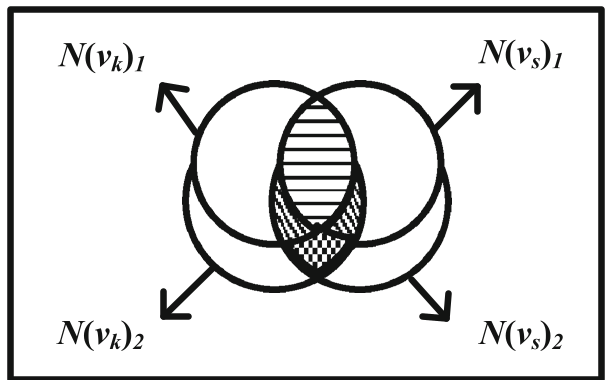 Figure 1: Visualization of the 1-level, 1-2 level, and 2-level common neighbor sets that form the basis of the WCCD index.
The VSFCM Algorithm
To utilize WCCD, the authors propose Vertices Similarity First and Communities Mean (VSFCM). Unlike standard Agglomerative Hierarchical Clustering, which can be overly sensitive to "mean" distances and merge nodes into massive, low-quality clusters, VSFCM prioritizes high-similarity vertex merges first. This ensures that the core of communities is tightly knit before larger structures are formed.
Experimental Results: SOTA Performance
The WCCD index was tested against staples like Katz, RA, and CN across multiple datasets (Karate, Dolphin, USAir, etc.).
1. Superior Modularity ()
In the USAir network, while the GN and LP algorithms failed to find meaningful structures (), VSFCM maintained a strong modularity of 0.328.
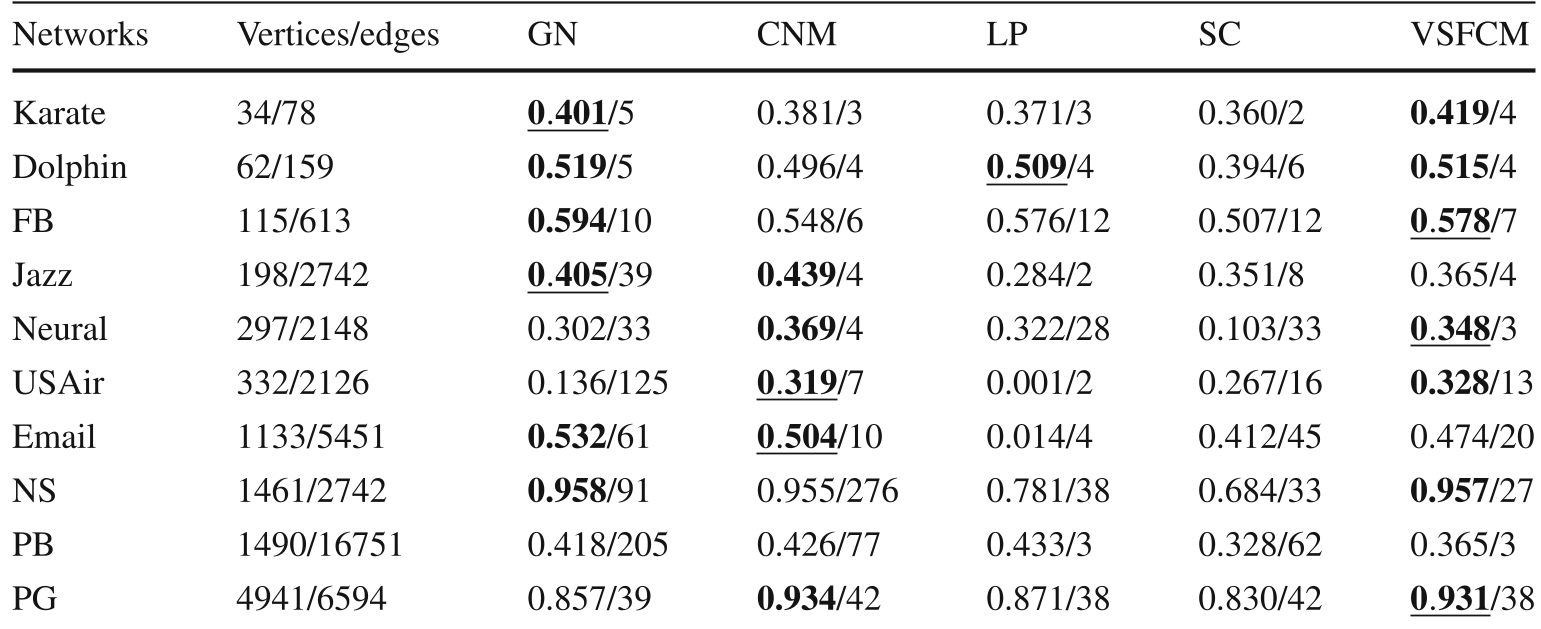 Table 1: Benchmark results showing VSFCM/WCCD consistently achieving top-tier modularity scores.
2. Resolving the "Resolution Limit"
A common problem in community detection is over-fitting (finding too many tiny communities) or under-fitting. As seen in the US Political Blogs (PB) dataset, where the GN algorithm branched into 205 communities, VSFCM found a much more representative 3 communities, matching the natural bipolarity of political data.
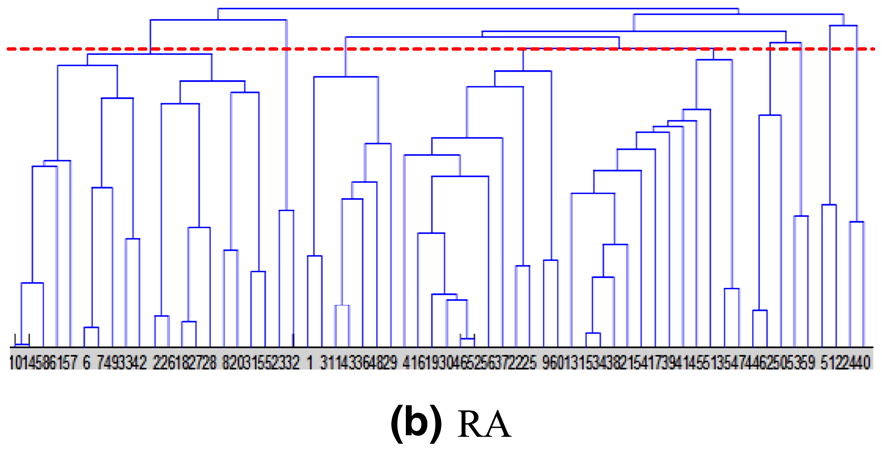 Figure 2: Dendrogram showing the hierarchical merging process in the Karate network using different indices.
Critical Insights & Takeaways
The brilliance of this work lies in its philosophical approach to uncertainty. Instead of treating the absence of a direct link as a "zero," SPA treats it as a "maybe" (Discrepancy).
Key Takeaways:
- Structural Context Matters: A common neighbor's value is modulated by its own local "clique-ishness" (clustering coefficient).
- VSFCM Advantage: By merging based on vertex similarity before community averages, the algorithm avoids the "chain effect" where weak links merge distinct groups prematurely.
Limitations: The current model is evaluated on undirected, unweighted networks. Future research is needed to see if this "Uncertainty Logic" holds in directed graphs (e.g., Twitter follower networks) or weighted transactional graphs.
Summary for Practitioners: If your community detection results are currently over-segmented or failing on sparse data, replacing your similarity metric with a Set-Pair-based approach like WCCD could provide the structural robustness needed to capture real-world clusters.