
LIIC: Breaking Language Barriers in Social Media Account Classification via Profile Images
A Simple Language Independent Approach for Distinguishing Individuals on Social Media
The paper introduces LIIC (Language Independent Individual Classifier), a deep learning-based framework designed to distinguish individual human accounts from non-individual accounts (organizations/brands) on social media. It primarily leverages profile images using a pre-trained VGG16 CNN, combined with screen name analysis and statistical profile features, achieving SOTA-level performance without relying on language-specific text.
TL;DR
Researchers have developed LIIC (Language Independent Individual Classifier), a multi-modal deep learning approach that identifies whether a social media account belongs to a human or an organization. By shifting the focus from what users say (text) to how they present themselves (profile images and usernames), LIIC achieves the same high accuracy as specialized English-language models while remaining universally applicable across all languages.
Background: The Hidden Diversity of Social Media
When we analyze social media for "human behavior," we often overlook a simple fact: not all users are humans. Brands, bots, and organizations account for approximately 9.4% of Twitter profiles. Standard research pipelines often treat these as individual humans, leading to skewed results in sentiment analysis or behavioral studies.
Most current detection tools rely on Natural Language Processing (NLP). While effective, they fail when they encounter the 68% of Twitter content that is not in English. The authors of this paper ask: Can we identify a human without reading a single word of their posts?
Methodology: Seeing is Believing
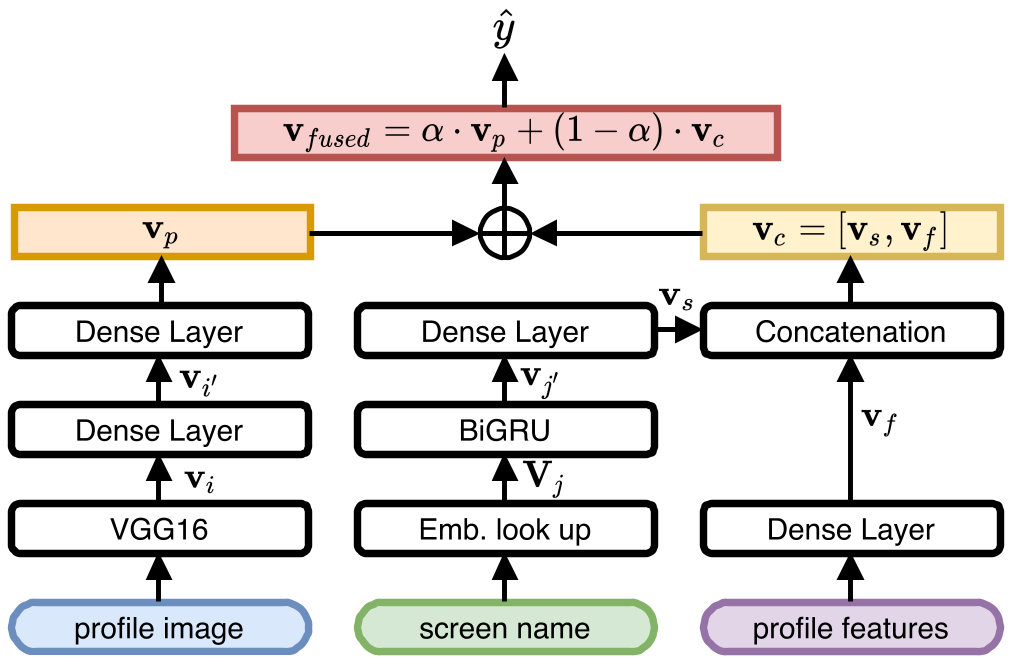
The core innovation of LIIC is its language-independent architecture. Instead of analyzing tweets or biographies, it processes three specific inputs:
- Profile Image: Using a pre-trained VGG16 model to recognize the visual difference between a human face and a corporate logo.
- Screen Name: Using a Bidirectional GRU to learn character-level patterns (e.g., "@JohnDoe" vs "@Corp_Global_HQ").
- Profile Features: 13 statistical metrics (followers-to-friends ratio, account verification status, etc.).
The LIIC Architecture
The model uses a specific fusion logic: it prioritizes the image representation () and only falls back to screen names and features () if the image is missing or a default placeholder.
Performance: Matching the SOTA Without the Text
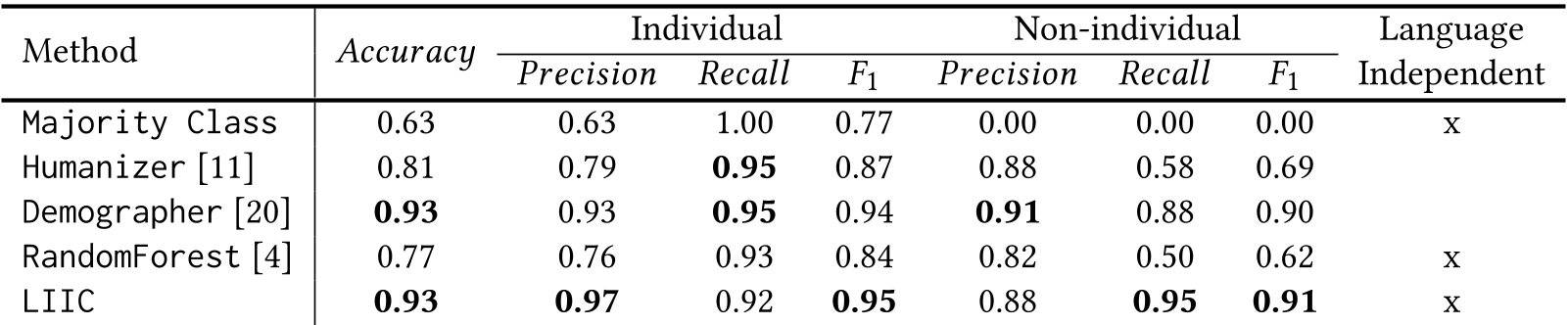
The authors tested LIIC against Demographer (a language-dependent SOTA) and RandomForest (a statistical baseline).
The results were striking: LIIC matched the accuracy of the language-dependent model (0.93) while showing superior robustness in identifying non-individuals (Organizations), achieving a 0.91 F1-score compared to the previous language-independent best of 0.62.
Key Experimental Results
The ablation study (Table 5) confirmed that the Profile Image alone is the most powerful single indicator, suggesting that visual identity is a universal "human" trait on social platforms.
Critical Insight: Why This Matters
The success of LIIC demonstrates that Inductive Bias—the assumption that humans use faces while brands use logos—is a more scalable way to clean social media data than building individual NLP models for every language on Earth.
Limitations:
- The model uses VGG16, which is relatively heavy for real-time web-scale inference compared to modern options like MobileNet or EfficientNet.
- The binary "Individual vs. Non-Individual" split may struggle with "Grey" accounts, such as professional influencers who use personal faces to represent a corporate brand.
Conclusion
LIIC provides a simple but effective blueprint for building more inclusive social science tools. By leveraging the universal language of imagery, researchers can now filter global datasets with high precision, ensuring that "human behavior" studies actually study humans.
For further technical details, visit the official repository: parklize/twitter-account-classification