
Beyond Static Graphs: Replicating Social Network Churn with Anti-Preferential Deletion
A simple model to characterize social networks
This paper introduces a dynamic social network model designed for relationship prediction, characterized by simultaneous node/edge addition and deletion. The model utilizes preferential attachment for growth and a novel anti-preferential attachment mechanism for deletion, successfully maintaining a SOTA power-law degree distribution (scale-free property).
TL;DR
While the Barabási-Albert (BA) model explained how the "rich get richer" in networks, it ignored a brutal reality of social media: users leave and connections die. This paper proposes a dynamic model that balances growth with anti-preferential deletion—where unpopular nodes are phased out—while ensuring the network never collapses below a critical size. It maintains the classic scale-free power-law distribution while achieving 73% accuracy in predicting future customer relationships.
The "Static" Fallacy in Social Modeling
Most complex network models focus on growth. However, real-world social networks are high-churn environments. People delete accounts, friendships fade, and "hot" topics become obsolete.
The authors identify three fatal flaws in prior work:
- Lack of Directionality: Most models use undirected links, which fails to capture the nuance of social influence (e.g., a "follower" vs. a "friend").
- Fixed Attractiveness: In reality, a node's ability to attract new links changes over time.
- Destructive Deletion: Randomly or aggressively deleting nodes in a model often breaks the "scale-free" property or destroys the graph entirely.
Methodology: The Mechanics of Growth and Decay
The proposed model operates in four distinct steps per time interval, introducing a sophisticated balance between expansion and contraction.
1. Preferential Addition
New nodes join and connect to existing nodes based on a probability , which considers both the current degree () and a time-varying attractiveness factor (). This ensures that "trending" nodes gain more visibility.
2. Anti-Preferential Deletion
The most innovative part of the model is how it handles "death":
- Link Deletion: Old links are removed using an anti-preferential attachment probability .
- Node Deletion: Nodes are removed with a probability that specifically accounts for the Minimum Network Size ().
The logic is intuitive: the less connected you are, the more likely you (or your links) are to be removed. However, deletions slow down as the network approaches to preserve its structural integrity.
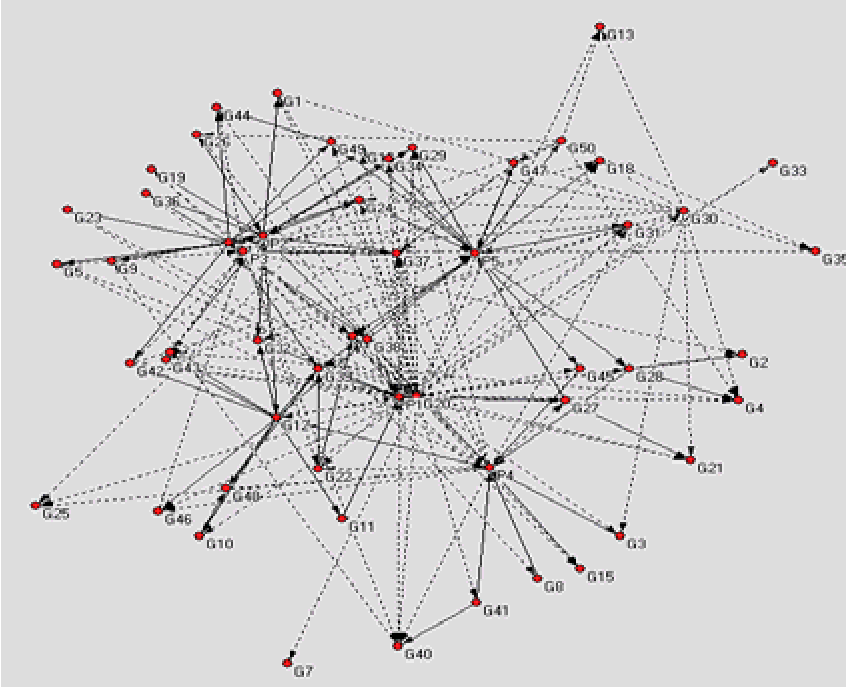 Figure 1 & 2: Evolution of a "Car Fan" network from to , showing node additions and selective deletions.
Mathematical Validation: Mean-Field Theory
Using Mean-Field Theory, the authors prove that despite constant deletions, the degree distribution still follows the power-law: This confirms that the model results in a self-organizing scale-free network where the exponent can be tuned between 2 and 3 by adjusting the parameters of addition and deletion.
Experiments: Real-World Prediction
The authors tested the model on 12 months of telecommunications data from a "car fans" social network.
- Visualization: Using PAJEK, they mapped the topology (Figure 5), showing a clear "hub-and-spoke" architecture typical of real social structures.
- Accuracy: The model reached an average 73% accuracy in predicting which nodes would be deleted and which new connections would form in the subsequent period.
- Power-Law Fit: The simulation's degree distribution (Figure 3) closely matched the statistical distribution of the real data (Figure 4).
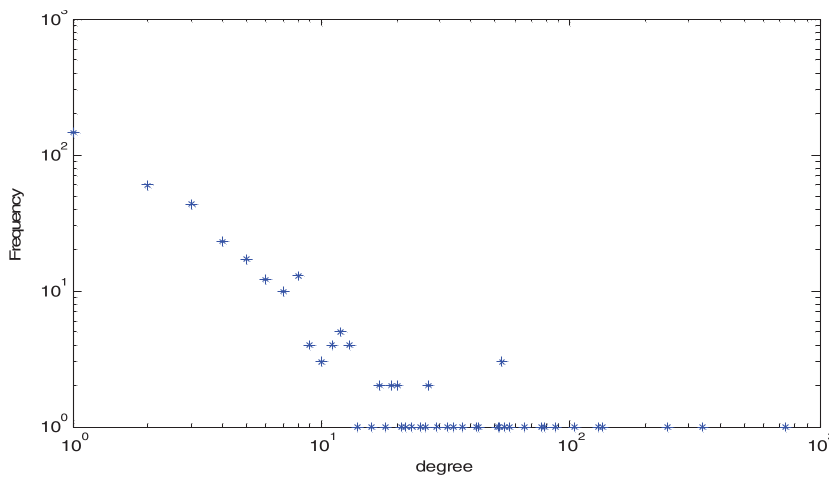 Figure 3: The simulated degree distribution confirms the power-law property.
Critical Insight & Conclusion
The genius of this model lies in its stability constraint. By proving that if (where is the node deletion rate), the network remains robust, the authors provide a blueprint for simulating biological and social systems that undergo constant renewal.
Takeaway: Future social CRM systems should not just look at who is "popular" now, but model the decay rate of "coolness" (attractiveness) and the mathematical probability of disconnection to accurately forecast customer churn.