
Simulating Collective Intelligence: How Agent-Based Models Map the Evolution of Knowledge Communities
Simulating Collective Intelligence of the Communities of Practice Using Agent-Based Methods
This paper investigates the simulation of Collective Intelligence (CI) within Communities of Practice (CoP) using Agent-Based Modeling (ABM). It specifically implements a "Team Assembly Model" in the NetLogo framework to demonstrate how individual collaboration preferences shape large-scale organizational knowledge networks.
TL;DR
As organizations face constant turnover, "Communities of Practice" (CoP) have become the primary defense against institutional amnesia. This paper uses Agent-Based Modeling (ABM) to simulate how professional teams assemble and how their interactions generate Collective Intelligence (CI). By modeling variables like reputation and collaboration history, the authors provide a sandbox for understanding how "newcomers" and "incumbents" create a self-organizing knowledge ecosystem.
Problem & Motivation: The Knowledge Leakage Crisis
When an employee leaves, an organization doesn’t just lose a worker; it loses a node in its intellectual network. Traditional hierarchies often fail to capture the informal ways knowledge flows. The authors argue that Individual Intelligence is no longer sufficient for complex modern problems. The solution lies in Collective Intelligence—the emergent ability of a group to outperform its smartest individual. However, understanding the "invisible" dynamics of how these groups form and share knowledge requires more than just observation; it requires simulation.
Methodology: Decoding the Team Assembly Model
The authors leverage Multi-Agent Systems (MAS) because they mirror the decentralized, autonomous nature of human communities. The core of their simulation is the Team Assembly Model, implemented in the NetLogo environment.
1. The Core Parameters
The model hinges on three structural drivers:
- Team Size (): Usually ranging between 2 and 10 agents.
- Incumbency Probability (): The likelihood that a selected member is an experienced agent rather than a newcomer.
- Propensity for Past Collaborations (): The tendency for "incumbents" to stick with previous partners.
2. Architecture of Interaction
Agents categorized as Newcomers (entry-level, no history) and Incumbents (reputation-carrying, experienced) create a network through four link types:
- Newcomer-Newcomer
- Newcomer-Incumbent
- Incumbent-Incumbent
- Repeated Incumbent-Incumbent
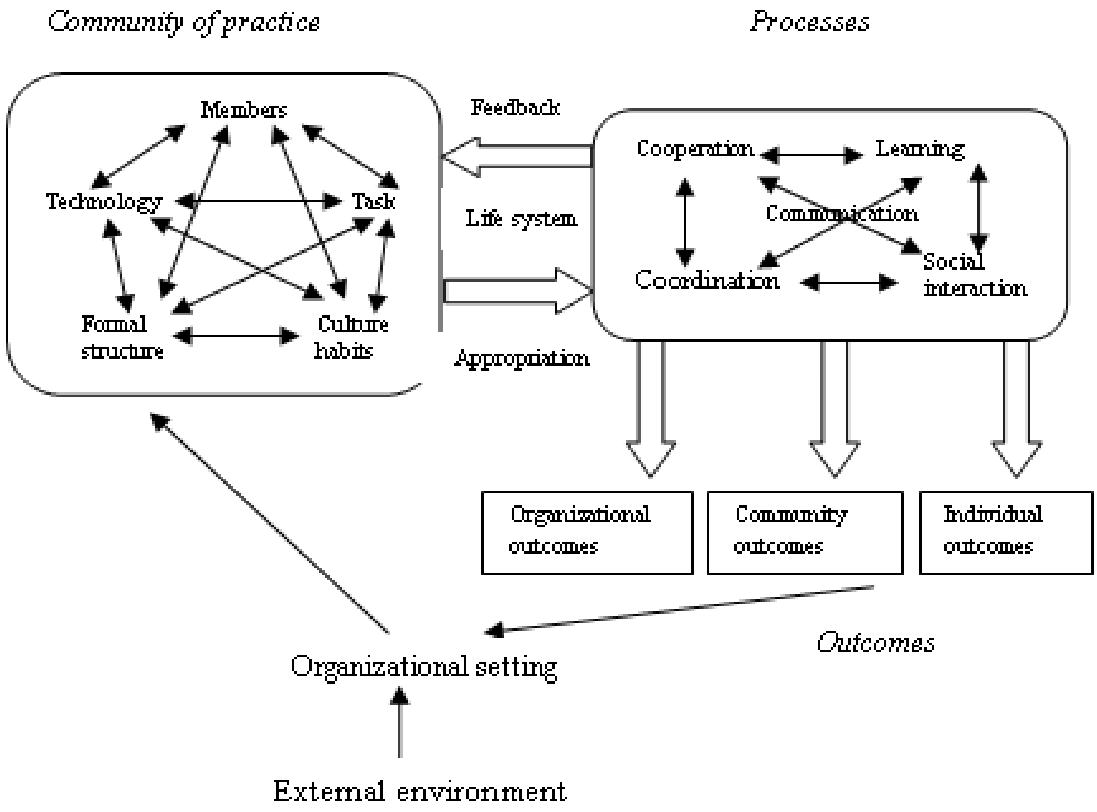
The Reputation Extension
A significant contribution of this work is the introduction of a Reputation Attribute (normalized between -1 and 1). In the simulation, reputation is an emergent property—the more a team selects an agent, the higher their reputation grows.
Experimental Insights
- The Proximity Effect: Newcomers typically gravitate toward the center of the network to find connections, while incumbents form specialized clusters.
- Diversity vs. Reliability: An overabundance of "incumbent-incumbent" links indicates a stagnant field lacking new ideas. Conversely, too many newcomer links suggest a field that fails to leverage historical expertise.
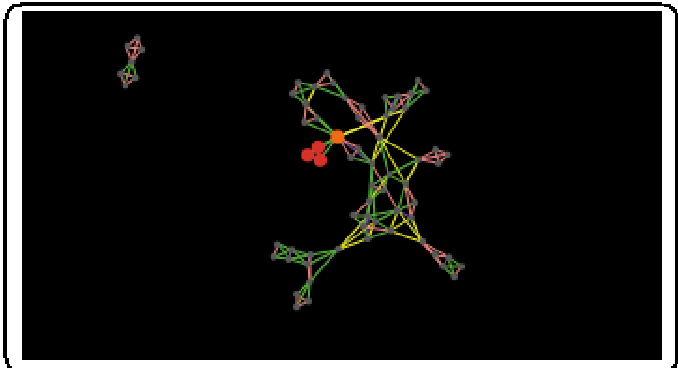 Figure: Simulation showing the network structure where team members are linked, forming a repository of accessible knowledge.
Results: The Power of the High-Reputation Node
The simulation results shown in the "Reputation Values" graph demonstrate a clear clustering effect. Agents with reputation values approaching +1 become "hubs" that facilitate more efficient collaboration.
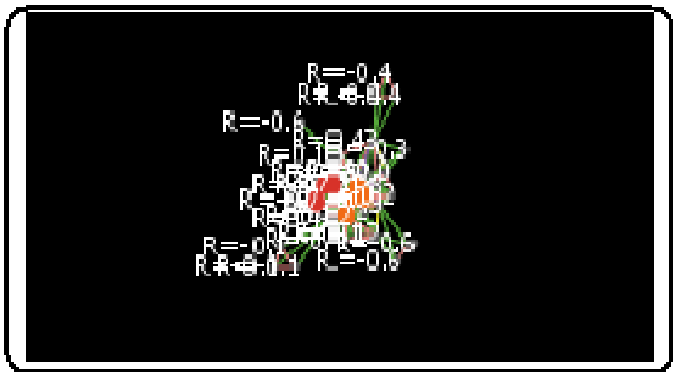 Figure: The distribution of reputation across the agent population.
The experiment proves that collective intelligence is not just about the sum of individual knowledge but the structure of the network. A well-balanced team assembly mechanism allows a large group of professionals to reach decisions that are significantly more robust than those made by isolated experts.
Critical Analysis & Future Outlook
Takeaway
For knowledge management, this paper indicates that "forced" team structures are often less effective than allowing self-organizing communities to develop based on reputation and mutual interest. Managers should focus on facilitating the "Peripheral Participation" of newcomers to ensure the long-term health of the knowledge pool.
Limitations
The current model treats "tasks" as generic. Real-world Collective Intelligence often depends on the specific difficulty and domain of a problem. Furthermore, the model does not fully account for "negative" social dynamics like groupthink or conflict, focusing primarily on the positive accumulation of reputation.
Future Work
The authors suggest extending these simulations to include more complex trust models. We can expect future iterations to look at how virtual environments (like Remote Work or VR) change these assembly dynamics compared to traditional physical offices.