
Beyond the Flat Graph: Simulating Information Diffusion in Multidimensional Social Networks with DEVS
15891_Simulating information diffusion in a multidimensional social network using the DEVS formalism (WIP).
This paper introduces a framework for simulating information diffusion within Multidimensional Social Networks (MSN) using the Discrete Event System Specification (DEVS) formalism. By leveraging the modularity of DEVS and the VLE toolkit, the authors model individuals with complex behaviors (based on Maslow's hierarchy) to track how information propagates across multiple relational layers such as kinship, friendship, and professional departments.
TL;DR
Information doesn't just travel through a single channel; it flows through a complex web of professional, personal, and casual relationships. This paper presents a Work-In-Progress (WIP) framework that uses the DEVS (Discrete Event System Specification) formalism to simulate how information moves through Multidimensional Social Networks (MSN). By separating individual behavior from network structure using a "Proxy-Server" architecture, the researchers provide a modular way to model human reactions to information based on Maslow’s hierarchy of needs.
The Problem: The "Flattening" Trap
In many social simulations, researchers simplify the world by "flattening" various relationships (coworkers, friends, family) into a single edge on a graph. While computationally simpler, this approach has a major flaw: non-separation of concerns.
If a model is flattened, the rules for how an individual behaves must be hardcoded alongside the rules of the network. This makes it nearly impossible to swap out a "friendship" network for a "professional" network without rewriting the entire agent's logic. In academic terms, this hampers the VV&A (Validation, Verification, and Accreditation) process because the model becomes a "black box" where structural dynamics and individual psychology are inextricably linked.
Methodology: The Proxy-Server Architecture
The core innovation of this paper is the application of the DEVS formalism to a decoupled architecture. DEVS is a timed, hierarchical formalism that treats systems as reactive entities.
1. The MSN Structure
The researchers define three distinct layers of interaction:
- Layer 1 (Departmental): Cliques formed within a specific workplace unit.
- Layer 2 (Intra-firm Friendship): Based on the principle of Homophily (birds of a feather flock together), where connections are formed based on similar attributes.
- Layer 3 (Inter-firm): Strategic links between different organizations.
2. The Node Specification
Instead of a single node, the authors propose a dual-layer approach:
- Server Node: Represents the "Individual." It holds static attributes (age, sex) and dynamic variables (attitude, Maslow’s needs). It contains the core behavioral logic.
- Proxy Node: Acts as the individual's "interface" for a specific network layer. Each network the individual belongs to has a corresponding Proxy.
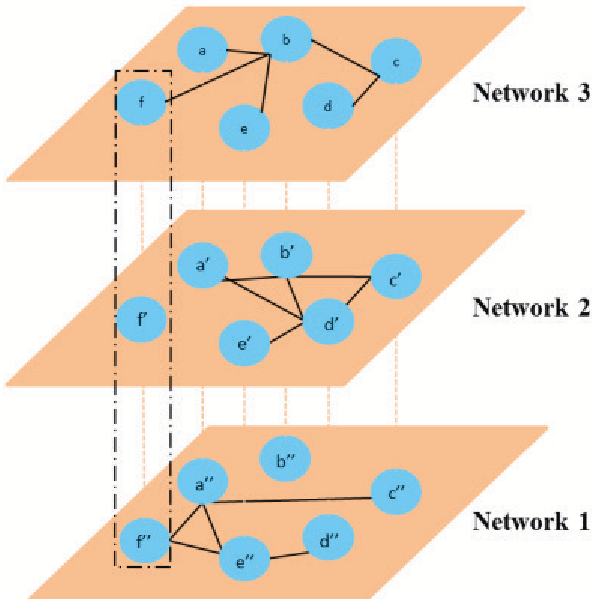 Figure: The proposed architecture keeping networks independent while sharing a central 'Server Node' for the individual.
When a Proxy Node receives a message on Network A, it notifies the central Server Node. The Server Node processes the information (deciding if the individual is "influenced" or "interested") and then instructs all its Proxies (on Networks A, B, and C) to propagate the message further if certain thresholds are met.
Human Behavior & Information Impact
To move beyond simple "infected/susceptible" models, the authors incorporate Maslow’s Hierarchy of Needs. An individual’s state can change based on the information received. If the "interest" or "strength" of the message falls below a threshold, the propagation stops. This creates a simulation that mirrors real-world fatigue and skepticism.
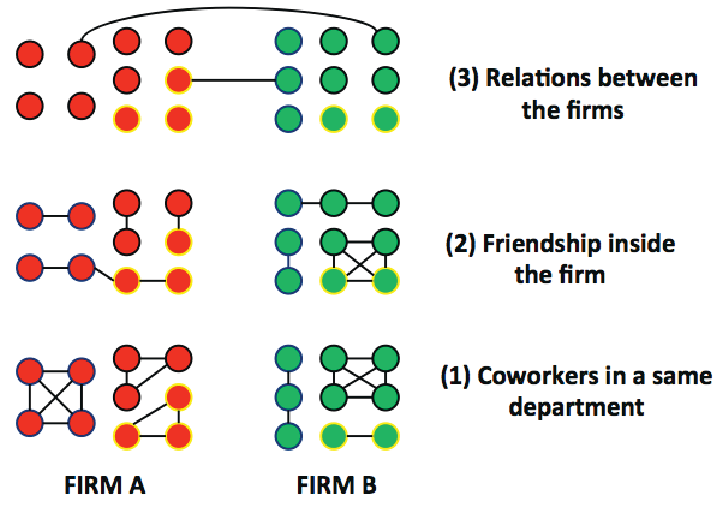 Figure: DEVS specification of an individual node model, showing transitions from 'idle' to 'state_1' upon receiving a message.
Case Study: Analyzing Ten Firms
The researchers validated the framework by generating a synthetic population of ten firms, each with multiple departments. Using the VLE (Virtual Laboratory Environment) toolkit, they simulated a 10-hour window of information spread.
The modularity proved successful: they could initialize agents using XML files containing psychological attributes and track the exact path of information through different relational dimensions. This allowed them to analyze how two people who are not "friends" might still share information through a mutual "departmental" connection or an "inter-firm" link.
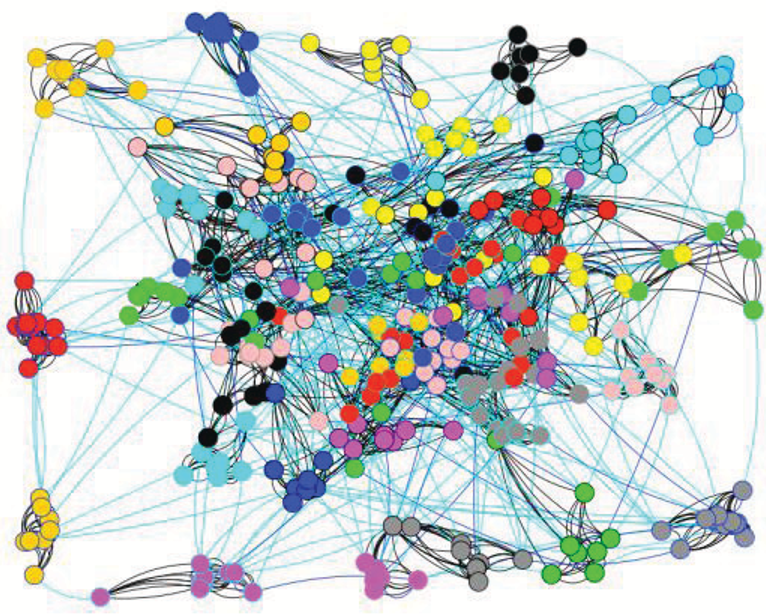 Figure: Visualization of the ten-firm multidimensional network simulation.
Critical Insight & Conclusion
While this is a "Work-in-Progress," the primary takeaway is the power of formalism-based modularity. By using DEVS, the authors provide a template for "plug-and-play" social simulations.
Future Outlook: The current behavior models are relatively simple. The real value of this framework will be realized when complex social science datasets are plugged into the Server Nodes. This architecture also opens the door for testing viral marketing strategies or organizational change impacts in a risk-free, highly granular virtual environment.
Limitations: The increased number of nodes (due to Proxies) and bindings significantly increases the computational overhead compared to flattened models. Scaling this to millions of nodes will require advanced distributed simulation techniques.