
The Social NAA: Why a Lack of Options Hardens Group Belief
Simulating the No Alternatives Argument in a Social Setting
This paper formalizes and simulates the Social No Alternatives Argument (Social NAA), investigating how the reduction of perceived feasible choices for individuals affects group-level belief. Using Bayesian network simulations in core-periphery social structures, it demonstrates that decreasing the number of alternatives generally strengthens belief in the majority choice.
TL;DR
When we feel there are fewer viable alternatives to a plan, our belief in the remaining option tends to strengthen. This paper explores the Social No Alternatives Argument (Social NAA), using Bayesian simulations to show that as a community's perceived menu of choices shrinks, the majority consensus usually intensifies—unless the most "influential" people in the group are stubborn.
Problem & Motivation: The Logic of "TINA"
In the 1980s, Margaret Thatcher famously used the slogan "There Is No Alternative" (TINA) to defend her economic policies. Epistemically, this is known as the No Alternatives Argument (NAA): the idea that a lack of found alternatives is itself evidence that the current hypothesis is correct.
While previous work by Dawid, Hartmann, and Sprenger (DHS) provided a formal proof for NAA in scientific inquiry, it treated scientists as isolated or abstract entities. This paper argues that decision-making is essentially social. Whether it's voters in an election or scientists choosing a theory, we don't just look at the data; we look at what our peers are saying. The author seeks to bridge the gap between individual psychological "pre-screening" of options and the eventual group-level majority vote.
Methodology: Agents as Bayesian Networks
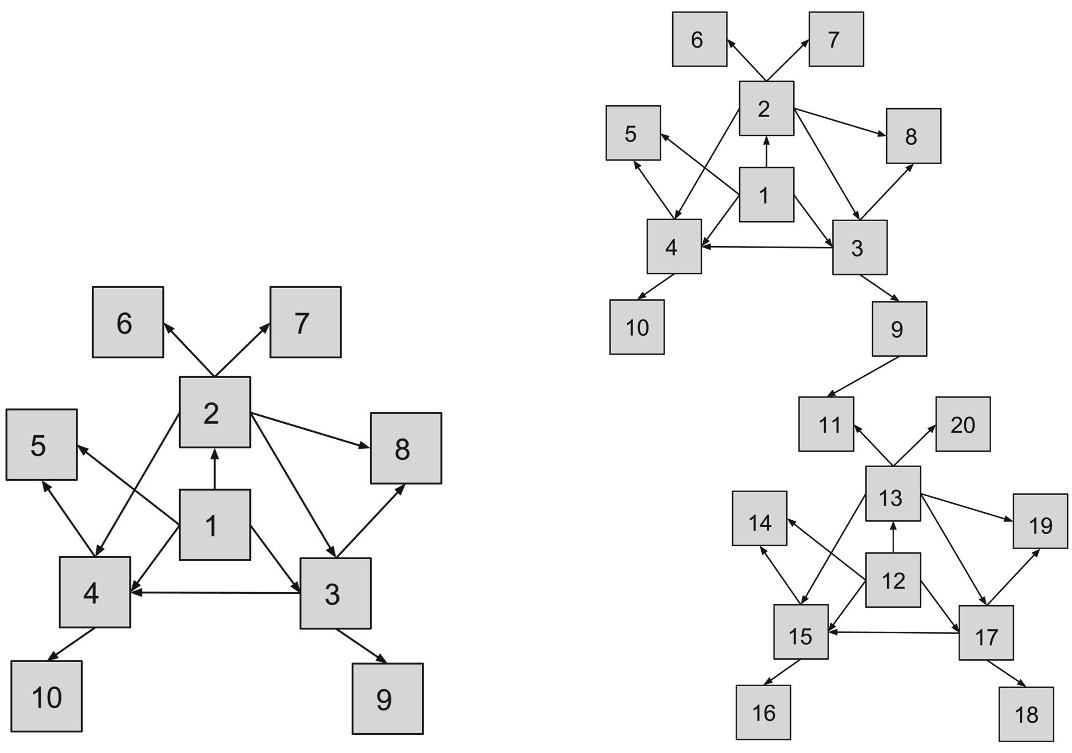
The author models a community as a directed graph where each node is an agent represented by a Bayesian Network.
1. The Individual Level
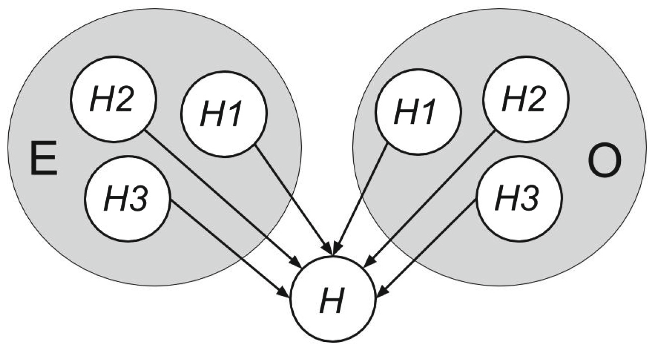
Each agent's belief distribution is shaped by two inputs:
- E (Experience): Private reasoning, values, and evidence.
- O (Others): The aggregated opinions of the agent's "parents" in the social network.
2. Agent Personalities
The model introduces three behavioral archetypes based on how they weight these inputs:
- Mules: Heavily weight their own experience (high E, low O).
- Sheep: Follow the crowd (low E, high O).
- Balanced: Give equal weight to both.
3. The Social Structure
The simulations use Core-Periphery networks. This design mimics real-world communities where a small, highly connected "core" of influencers is surrounded by a "periphery" of less connected followers.
Experiments & Results: When the Heuristic Fails
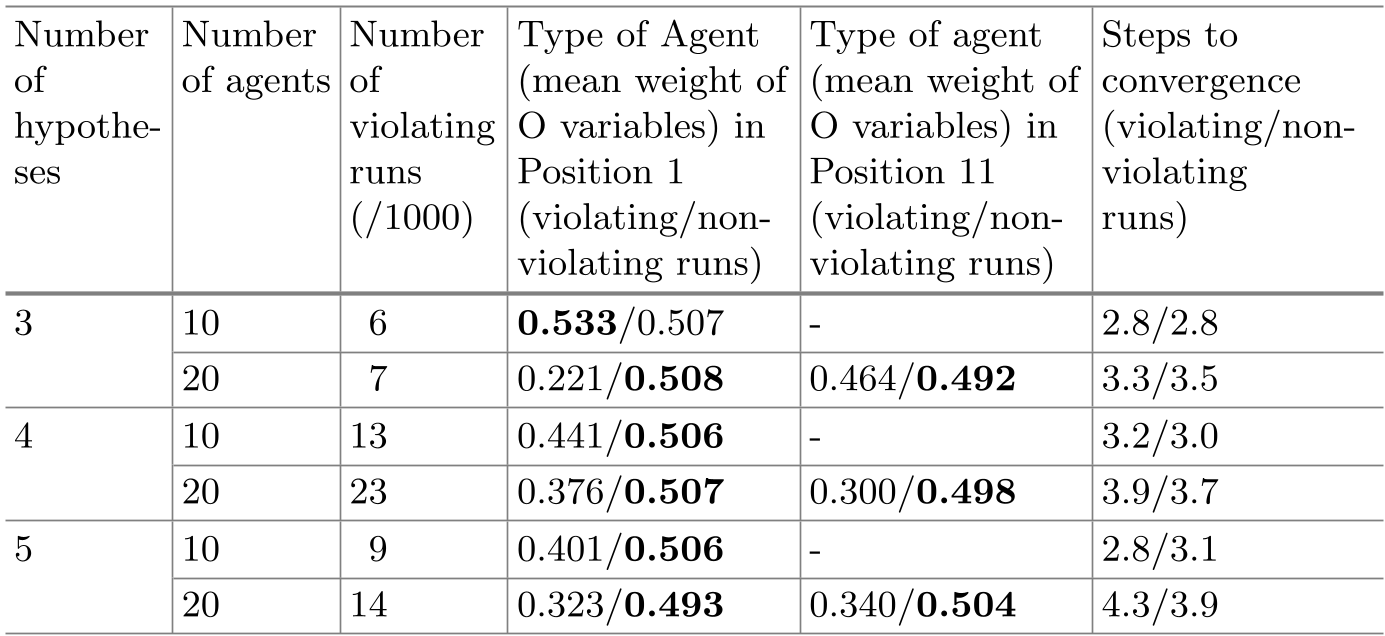
The author ran 1,000 simulations across various scenarios (3, 4, or 5 hypotheses; 10 or 20 agents).
Key Findings:
- NAA is a Strong Heuristic: In over 97% of cases, the Social NAA assumption held true. As agents dropped unfeasible options, the majority "vote" for the leading hypothesis grew stronger.
- The Power of Central "Mules": The rare violations (where belief did not increase despite a reduction in options) typically happened when the most central agent (Agent 1) or a "bridge" agent was a Mule.
- Stability: If the core influencer refuses to budge, it prevents the usual "swing" toward consensus, creating a bottleneck in the community’s opinion dynamics.
Critical Analysis & Conclusion: Insights for Real-World Dynamics
The primary takeaway is that the "There is No Alternative" effect is not just a psychological trick but a predictable outcome of social information exchange. However, this reinforcement relies on the topology of the network.
Limitations & Future Paths
- Unidirectional Flow: The current model uses DAGs (Directed Acyclic Graphs), meaning it cannot fully capture bidirectional "echo chambers" or feedback loops.
- Real-World Application: The author suggests applying this model to election data (specifically the 2016 US election) where voters often "pre-screen" candidates until only two remain.
Ultimately, this work highlights that if we want to understand why communities become dogmatic about a single "feasible" choice, we must look at both the number of options available and the personality of the influencers sitting at the center of the social web.
Takeaway: The Social NAA is a robust phenomenon, but influential "Mules" are the primary disruptors of group consensus.