
From Logs to Logic: Revolutionizing IT Governance with System Dynamics
Simulation-Based IT Process Governance
This paper introduces a simulation-based approach for IT Process Governance, leveraging System Dynamics to analyze operative log files from incident management systems. By moving beyond static dashboards to dynamic simulation, the authors demonstrate a refined method for evaluating Key Performance Indicators (KPIs) and Key Goal Indicators (KGIs) within an international telecommunications provider's environment.
Executive Summary
TL;DR: This paper bridges the gap between raw operative data and high-level IT Governance by introducing a System Dynamics simulation framework. By transforming standard incident logs into dynamic models, enterprises can move beyond "what happened" (dashboards) to "what will happen" (simulation), significantly improving the alignment between IT performance and business goals.
Positioning: This work serves as a practical bridge between the theoretical Process Mining domain and the operational ITIL/COBIT frameworks, specifically targeting the telecommunications sector.
The "Dashboard" Trap: Why Current Governance Fails
Most IT departments rely on Business Intelligence (BI) dashboards to monitor incident management. However, these tools are inherently limited:
- Static Nature: They show the state, not the system behavior.
- Lack of Causality: Dashboards tell you that incident volume is up, but they don't explain the feedback loops causing the surge.
- Binary Compliance: Traditional process mining often measures "similarity" to a reference model as a 0-to-1 score, which lacks the traceability required for organizational accountability.
Methodology: The System Dynamics Engine
The authors propose a framework that transforms log data (CSV format) into a System Dynamics model. System Dynamics is uniquely suited for this because it handles complex causality structures that are often counterintuitive.
The Data Pipeline
- Extraction: Pulling incident numbers, priority, timestamps, and process steps.
- Transformation: Converting UNIX timestamps to readable formats and creating "incident increments" to correlate time values with volume.
- Simulation: Using the Consideo Modeller to execute the quantitative model.
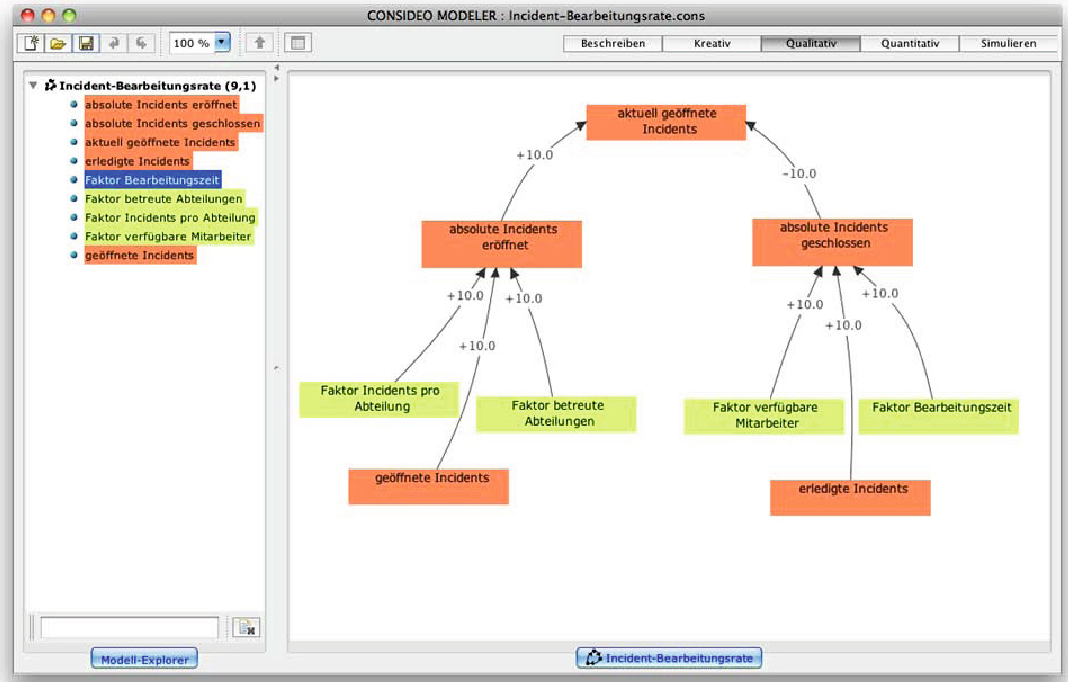 Above: An excerpt of the quantitative modeling approach used to bridge the gap between logs and KPIs.
Case Study: Telecom Incident Management
The feasibility was tested using real-life log files from an international telecommunications provider covering services like E-mail, Video-on-Demand, and Web-hosting.
Key Findings
The simulation allowed the researchers to visualize the Incident Processing Rate over time, revealing how systemic bottlenecks evolve. Unlike a static table, the simulation shows the "flow" of work through the organization.
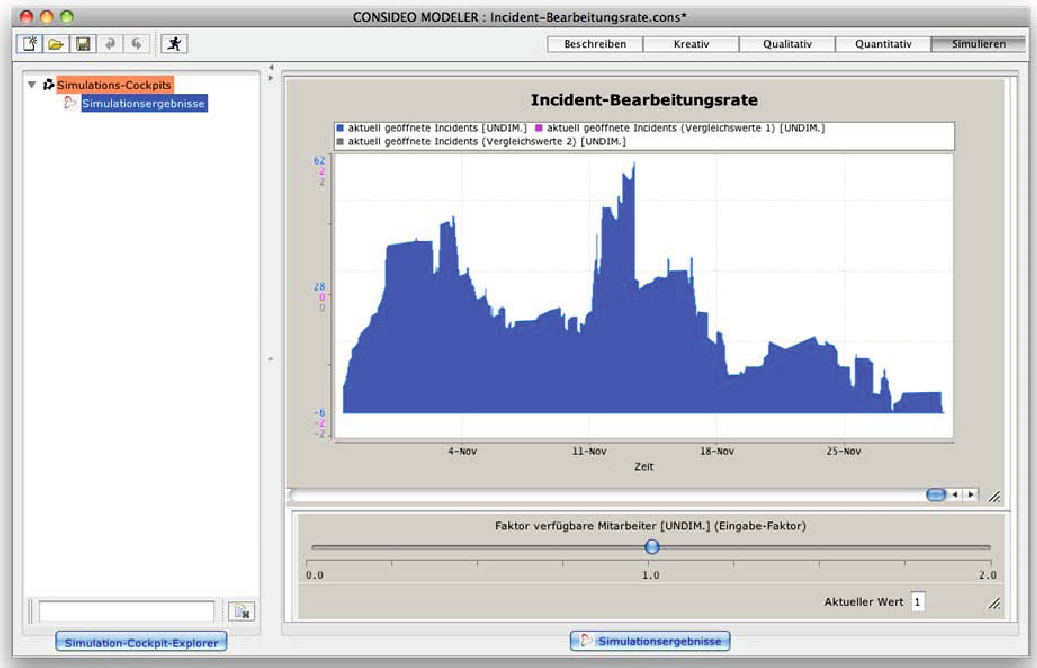 Above: The simulation output showing the dynamic processing rate, allowing for proactive resource allocation.
Critical Insight: The Cloud & SOA Extension
A significant portion of the paper discusses the evolution of governance in the age of Cloud Computing (IaaS, PaaS, SaaS). The authors argue that as control shifts to providers, the "Four-Eyes Principle" and SLA-based governance must be integrated into the simulation models to ensure compliance across virtualized boundaries.
Conclusion & Future Outlook
Central Contribution: The work successfully demonstrates that simulation adds significant value to standard data visualization by uncovering deep-rooted process patterns.
Limitations: The data transformation step remains manual and highly dependent on the quality of the log files. Future work should focus on automating the "Log-to-Simulation" pipeline.
Takeaway for Practitioners: If your IT department is drowning in data but starving for insights, look beyond the dashboard. Simulation is the key to understanding the pulse of your IT processes.