
Simulating the War on Truth: An Agent-Based Approach to Misinformation Diffusion
Simulation of misinformation spreading processes in social networks: an application with NetLogo
This paper introduces an open-source agent-based modeling (ABM) framework developed in NetLogo to simulate the competition between misinformation and fact-checking. Based on the SBFC (Susceptible-Believer-FactChecker) compartmental model, it provides a highly customizable tool to study information diffusion dynamics across various social network topologies.
TL;DR
In an era where fake news travels faster than the truth, understanding the mechanics of "digital contagion" is vital. This paper presents an open-source tool built on NetLogo that simulates the battle between hoaxes and fact-checking. By modeling agents as Susceptible, Believers, or Fact-Checkers, the researchers provide a sandbox for "what-if" analysis to find the tipping points where debunking successfully eradicates misinformation.
Problem & Motivation: Beyond Simple Contagion
Most early models of information spread treated rumors like biological viruses: once you are "infected," you stay infected until you recover. However, misinformation is more complex—it involves:
- Credibility (): Some lies are more believable than others.
- Active Competition: Fact-checking isn't just a "recovery" state; it’s a competing piece of information.
- Forgetting (): Humans are fickle; we forget both the lie and the correction over time.
The authors recognized that while mathematical "mean-field" models exist, they lack the spatial and topological granularity provided by Agent-Based Modeling (ABM). They chose NetLogo to bridge the gap between complex mathematics and intuitive, visual simulation.
Methodology: The SBFC Model Mechanics
The heart of the paper is the SBFC (Susceptible-Believer-FactChecker) model. Unlike standard SIR models, it defines three specific states for agents (turtles):
- Susceptible (S): Ignorant of the news.
- Believer (B): Has accepted the hoax.
- Fact-Checker (FC): Has verified the news or seen a debunking.
The Mathematics of Belief
The transition from Susceptible to either Believer or Fact-Checker is ruled by a competition function. The probability of an agent becoming a believer () depends on the ratio of Believer neighbors to Fact-Checker neighbors, weighted by the hoax's credibility :
This formula captures the Inductive Bias that highly credible hoaxes require significantly more fact-checkers to counter their spread.
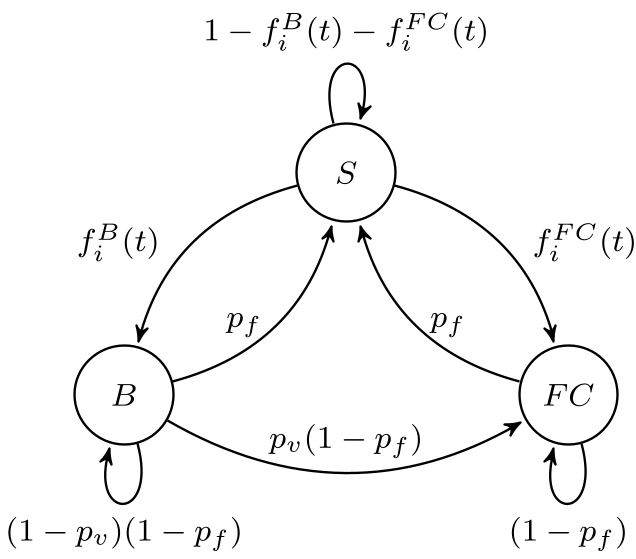 Fig 1: The SBFC state transition diagram illustrating the flow between S, B, and FC states.
Implementation: NetLogo as a Research Sandbox
The authors leveraged NetLogo’s graphical interface to allow researchers to toggle parameters like spreading rate and network type (e.g., Barabási–Albert for scale-free social networks) in real-time.
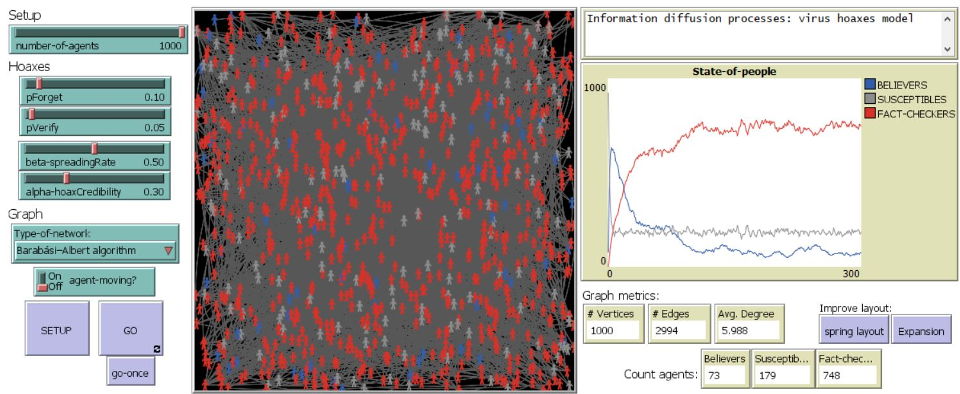 Fig 2: The NetLogo dashboard showing the real-time evolution of agent states and the underlying social network.
Experimental Validation
To prove the tool's worth, the authors ran simulations on networks of 1,000 agents. They found:
- Verification Thresholds: There is a critical value for (verifying probability). Below this value, the hoax persists indefinitely; above it, the hoax is eventually eradicated.
- Topology Matters: The dynamics on scale-free networks (where a few "hubs" have many connections) differ significantly from random networks, highlighting the importance of influential spreaders.
At a 10% initial believer rate, the simulation converged to a state where approximately 70% of the population became Fact-Checkers when verification was encouraged, effectively "immunizing" the network against the hoax.
Critical Insight & Future Outlook
The true value of this work isn't just the simulation—it's the democratization of misinformation research. By releasing this as a Free and Open Source Software (FOSS) tool, the authors allow other scientists to:
- Test specific layout interventions: What if "influencers" are always fact-checkers?
- Apply Genetic Algorithms: Future work intends to use NetLogo’s BehaviorSpace to evolve optimal strategies for debunking using search heuristics.
Limitations: Currently, the model assumes agents are homogeneous in their tendencies toward skepticism. In reality, "echo chambers" (network segregation) play a massive role, which the authors suggest as a vital next step for the tool's evolution.
Conclusion
The SBFC framework in NetLogo provides a robust, visual, and scientifically validated environment to study the most pressing social engineering challenge of our time. It proves that with enough "verification probability," the truth can indeed catch up to the lie.