
Simulating Social Capital: Why Face-to-Face Interaction is the Engine of Regional Networks
A Simulation Model Perspective on Social Capital
This paper presents a semi-empirical agent-based simulation model to quantify social capital production within regional social networks. Utilizing data from two Austrian social projects (Styria and Upper Austria), the author demonstrates that the frequency of face-to-face meeting opportunities serves as a critical proxy for generating and sustaining network-based social capital.
Executive Summary
TL;DR: This research bridges the gap between Bourdieu's abstract sociological theories and quantitative analysis by using Agent-Based Modeling (ABM). It posits that social capital isn't just a "feeling"—it is a quantifiable result of "accumulated time" spent in face-to-face interactions, which transforms fragmented project teams into robust, resilient networks.
Strategic Positioning: This work moves beyond traditional static social network analysis (SNA). It serves as a methodological bridge, providing a generative simulation framework to see how small interaction shifts at the micro-level (individual meetings) lead to macro-level structural shifts in regional social capital.
The Quantification Crisis: Can Trust be a Number?
Social capital is the "glue" of society—comprising trust, solidarity, and reciprocity. However, as the author Andreas Koch points out, these are normative qualities. We cannot simply "double the trust" in a community. The problem with prior work is twofold:
- The Incommensurability Problem: Translating social qualities into economic quantities often feels reductionist and ignores "accumulated history."
- The Static Trap: Standard surveys provide a snapshot, but social capital is dynamic; it grows and decays through specific mechanisms.
The insight here is to use spatial meeting opportunities as a proxy. By counting the chance to interact, we create a "social-spatial dummy variable" that can be computed and validated.
Methodology: The Team Assembly Mechanism
The study utilizes an Agent-Based Model (ABM) built in NetLogo, grounded in empirical data from Styria and Upper Austria.
The Core Logic
Agents (Team Leaders and Team Members) are placed in a simulation representing a 160-week project period. The model simulates linkage processes based on:
- Meeting Frequency: The number of events (workshops, juries, informal meets) ranging from 1 to 160.
- Selection Affinity: The probability that an agent will choose a collaborator they already know vs. a stranger.
- Tie Dissolution: The potential for social ties to fade over time if not reinforced.
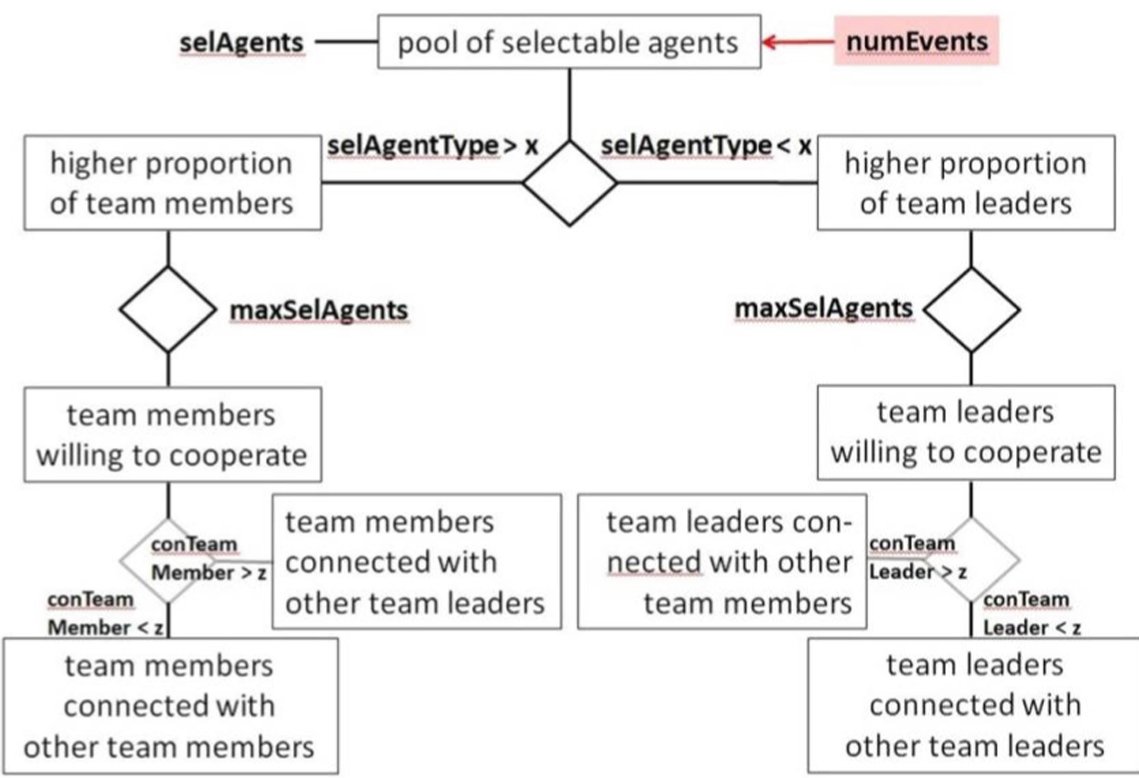
The flow diagram illustrates the iterative selection process where meeting opportunities act as the primary filter for agent interaction.
Key Findings: The Power of Events
The simulation results underscore a clear hierarchy of influence. In both Austrian regions, the number of meetings was the dominant predictor of network growth.
SOTA Comparison & Centrality
The research observed two distinct regional "personalities":
- Styria (S-Network): Less fragmented from the start, showing higher stability and resilience.
- Upper Austria (UA-Network): Highly fragmented project "islands." Here, the simulation showed that increasing meeting frequency was vital to prevent the network from remaining a series of isolated cliques.
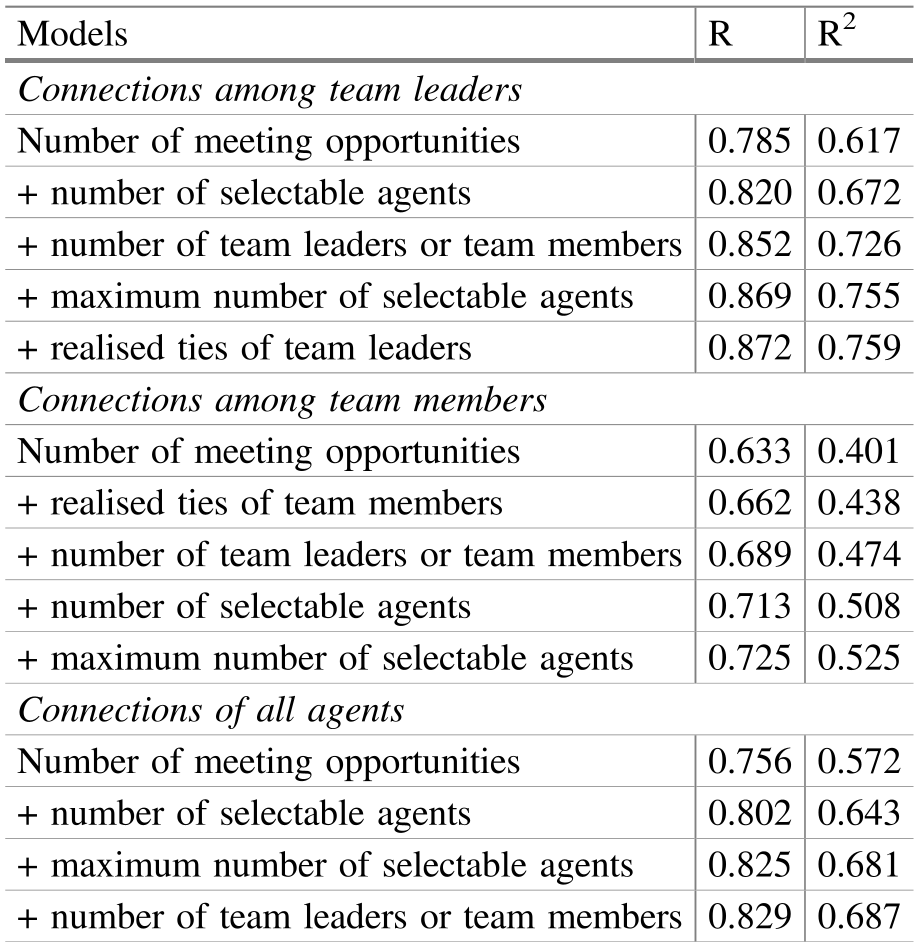
The regression models show that "Number of meeting opportunities" consistently explains the majority of the variance (R²) in connections across all agent types.
The "Leader Bias"
Evidence suggests that Team Leaders are the primary beneficiaries of increased social capital. They act as "glue agents" with high Betweenness Centrality (mediating information) and Closeness Centrality (quick access to others). However, the study warns that for a network to be truly sustainable, mechanisms must also empower the roles of regular team members to avoid an "elite lock-in."
Critical Insights & Future Outlook
Takeaway for Practitioners
If you are managing a regional project, frequency matters more than complexity. Even mid-range frequencies (bi-weekly) significantly decrease fragmentation.
Limitations
The model is "semi-empirical," meaning it fills in gaps where real-world data on team members was missing. While the simulation logic is sound, the "virtual interaction" variable remains a black box—a critical gap in the post-pandemic era.
Conclusion
By treating social capital as "accumulated labor" through the lens of Bourdieu, Koch successfully demonstrates that social network structure is not a matter of chance—it is a result of deliberate spatial and temporal design. The simulation provides a "missing link" for researchers to test how policy changes might ripple through the social fabric of a region.