
StoRM: Infusing Social Intelligence into the IoT via Microservices
Simulation Modelling Practice and Theory
StoRM (Social Trust model adopting Microservice architecture) is a novel decentralized reputation framework for the IoT that conceptualizes "Things" as intelligent agents. It integrates social graph-based recommendation mechanisms with a microservice-oriented design to establish trustworthiness in heterogeneous, distributed environments.
Executive Summary
In the hyper-connected era of the Internet of Things (IoT), the question of trust—who to collaborate with and whose data to believe—remains a fundamental bottleneck. This paper introduces StoRM, a social, distributed, and hybrid reputation model that treats IoT devices, services, and humans as "Intelligent Agents." By adopting a Microservice Architecture (MSA), StoRM overcomes the heterogeneity of IoT hardware while utilizing social graph principles to locate and verify reputation ratings in massive, decentralized networks. It marks a significant shift from "smart objects" to "socially conscious objects."
The Core Friction: Why Traditional Trust Fails in IoT
Trust management in open systems like the IoT is notoriously difficult for three reasons:
- Identity Shifting: Malicious agents can leave and re-enter the network with new IDs to wipe their bad history.
- The Information Silo: In a P2P network, how does an agent find a rating for a stranger if no local neighbor has interacted with it?
- Hardware Heterogeneity: A tiny sensor lacks the storage and compute power to run the same trust algorithms as a high-end server.
The authors' insight is at the intersection of Social Science and Software Engineering: they treat network interactions as social relationships and use Microservices to decouple the "logic" of trust from the "physicality" of the device.
Methodology: The Architecture of Trust
StoRM is built upon two pillars: Microservice modularity and the LOCATOR mechanism.
1. The Microservice Trio
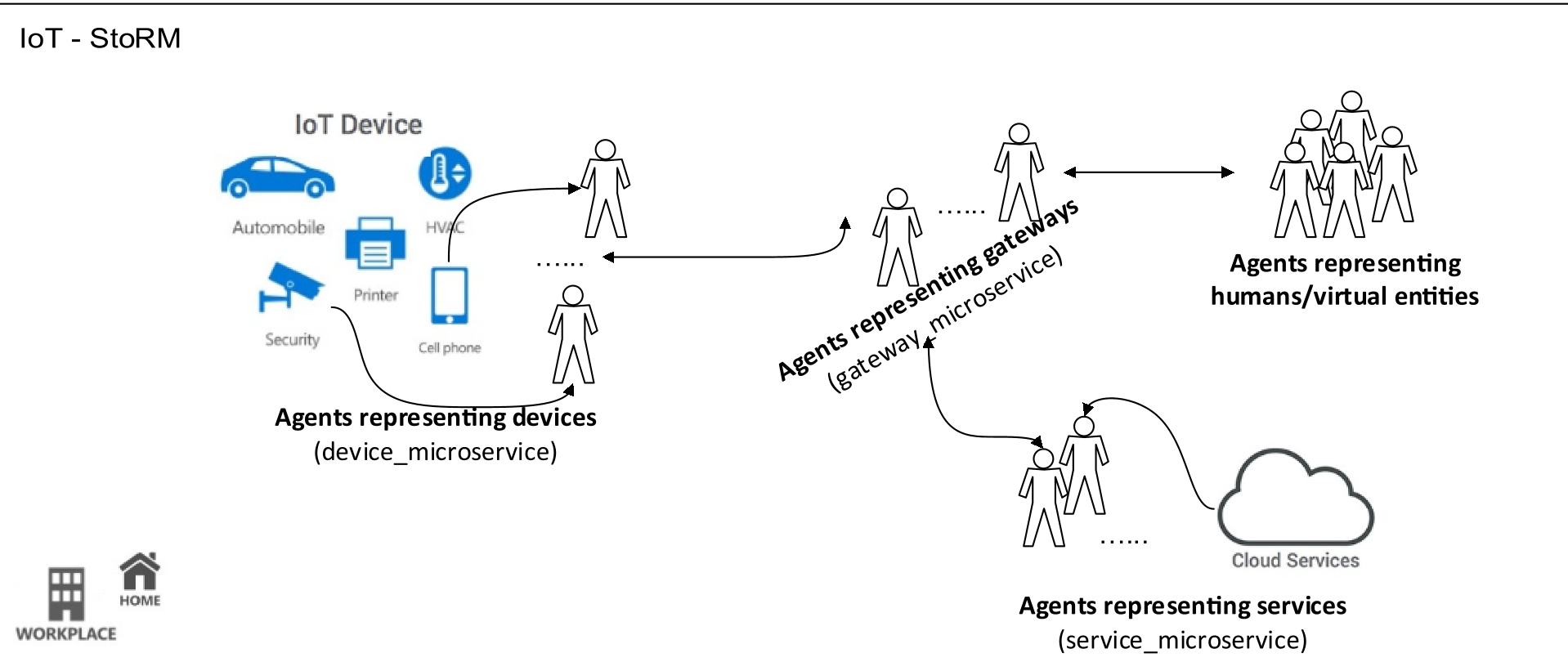
To solve the hardware footprint problem, StoRM decomposes agent functionality into three microservice types:
- Device Microservice: Manages the core hardware function (e.g., sensing, acting).
- Gateway Microservice: Acts as an intelligent middleware, discovering nearby services and handling communication protocols.
- Service Microservice: Handles higher-level logic and data processing.
2. The LOCATOR Mechanism
How do you find a rating in a sea of millions? StoRM adopts the LOCATOR algorithm, which treats the IoT as a social network. It categorizes neighbors into "local," "longer ties," and "longest ties" based on the length of the trusted path.
The model uses a Logarithmic Transformation for reputation estimation: By using a logarithm (base 10), the model moves large values closer and stretches small values, making it easier to detect subtle changes in behavior while dampening the impact of outliers.
Experimental Results: Performance and Resilience
The authors validated StoRM using the EMERALD framework across three scenarios: equal distribution of entities, service-heavy networks, and device-heavy networks.
Key Insights:
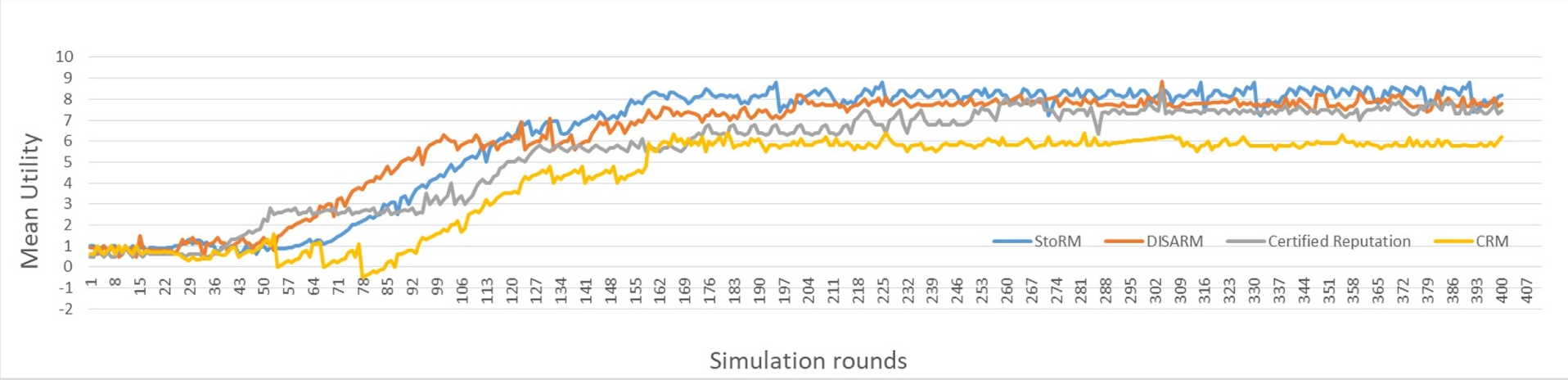
- Utility Gain (UG): StoRM showed a consistent upward trend, meaning agents quickly learned to identify "Good" and "Ordinary" tenderers while blacklisting "Bad" and "Intermittent" ones.
- Efficiency: Compared to the Comprehensive Reputation Model (CRM), StoRM achieved higher utility values because its social-graph approach allowed it to find high-quality recommendations faster.
- Storage Overhead: StoRM uses a "demand-based" rating fetcher, meaning it consumes significantly less memory than broadcast-intensive models—a vital trait for IoT devices.
Critical Analysis & Takeaways
The brilliance of StoRM lies in its Inductive Bias: the assumption that trust in a digital network follows the same patterns as human social trust (i.e., we trust our friends' friends more than strangers).
Takeaways for the Industry:
- Architecture Matters: If you want to build a secure IoT ecosystem, monolithic code is a dead end. Microservices allow for "Trusted Gateways" that shield "Dumb Devices."
- Social Consciousness: Future IoT products shouldn't just be "connected"; they need a "reputation history."
Limitations: While StoRM is resilient, the "Intermittent Malicious Agent" (an agent that acts good 50% of the time and bad 50% of the time) remains the hardest nut to crack. Future work integrating Machine Learning could potentially predict these behavioral shifts before they happen.
Conclusion
StoRM represents a bridge between academic Multi-Agent Systems and practical IoT deployment. By leveraging the modularity of microservices and the efficiency of social graphs, it provides a scalable, fair, and robust framework for the next generation of intelligent environments.