
Smart Freight: Leveraging Crowdsourcing and Markov Chains for Intelligent Detouring
Simulation Modelling Practice and Theory
This paper introduces a Discrete-Time Markov Chain (DTMC) simulation framework to enable "Smart Freight" mobility using crowdsourced data. It models the probabilistic ability of freight trucks to detour via exit ramps to avoid downstream congestion, leveraging real-time data from social media and connected vehicle technology (CVT).
TL;DR
Freight mobility is often the "forgotten child" of smart city crowdsourcing initiatives. This paper bridges that gap by proposing a Discrete-Time Markov Chain (DTMC) simulation model. By treating trucks as "smart entities" that receive real-time congestion alerts via crowdsourcing, the authors demonstrate that trucks can improve routing efficiency by 31% to 52% through strategic detours at freeway exit ramps.
The Motivation: Moving Beyond "Dumb" Freight
While passenger car drivers have long used apps like Waze to dodge traffic, freight operations have been slower to adopt real-time crowdsourcing. The problem is two-fold:
- Systemic Planning: Apps like Waze are consumer-facing and don't help transportation planners simulate "what-if" scenarios for infrastructure investment.
- Physical Constraints: A 40-ton truck cannot maneuvers as easily as a sedan. Simply knowing there is a crash ahead doesn't guarantee the truck can reach the exit ramp in time.
The authors' insight was to create a mathematical framework that models the probability of a successful detour, accounting for the physical presence of other vehicles (the "crowd") that might block a truck's path to the exit.
Methodology: The DTMC Framework
The researchers discretized the freeway near an exit ramp into a grid of seven zones. Each zone represents a 2-second headway at 60 mph (approx. 175 feet).
1. State Definition
A "state" at any time is defined by the arrangement of vehicles in these seven zones. The model tracks three types of entities:
- 0: Empty slot.
- 1: Vehicle without crowdsourced info.
- 1*: Smart vehicle (freight) with access to detour info.
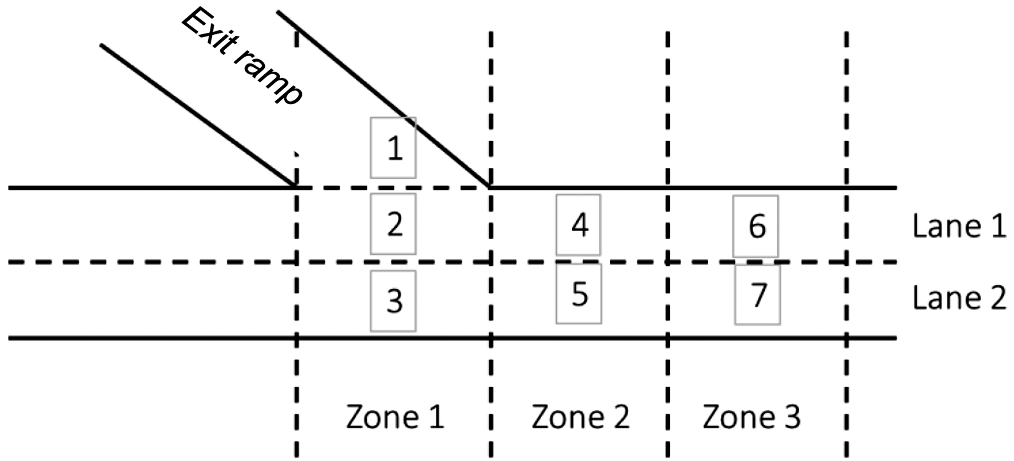 Figure: Simplified representation of the zone-lane pairs around an exit ramp.
2. Transition Probabilities
With (2187) possible states, the core of the paper is the Transition Probability Matrix . The model calculates the likelihood of moving from one state to another every 2 seconds. A "Good State" occurs when a smart truck successfully reaches Slot 1 (the exit ramp). A "Bad State" occurs when a truck is "trapped" by surrounding traffic (1s) and forced into the downstream congestion.
Experiments & Results: The SoCal Case Study
The model was tested using real-world data from Interstate 405 (I-405) and I-605 in Southern California, a region notorious for freight bottlenecks.
Efficiency Ratios
The researchers defined efficiency as the ratio of trucks successfully exiting to the total number of trucks entering the simulation zone.
- Free Flow Conditions: Efficiency improved by 52%.
- Congested Scenarios: Efficiency improved by 31%.
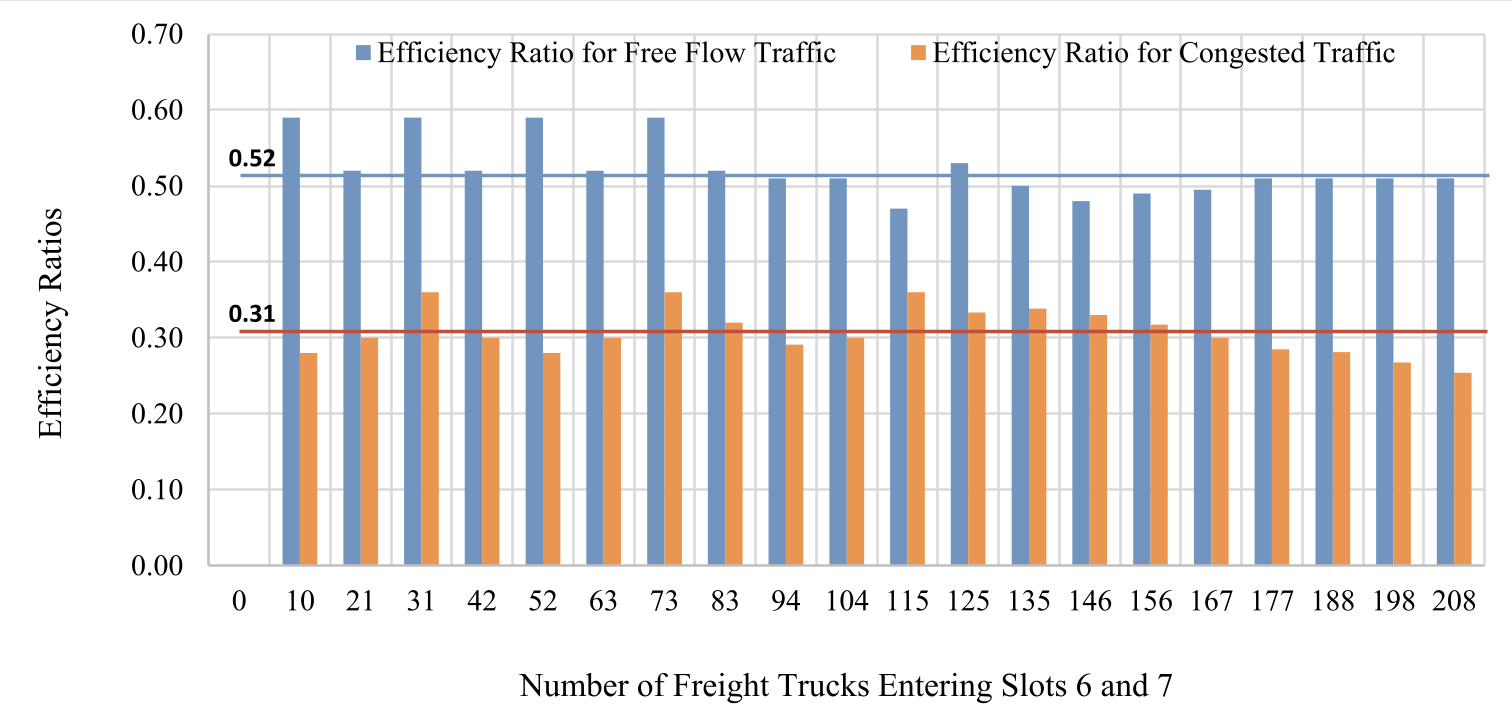 Figure: Variation of efficiency ratios vs. the number of smart freight trucks entering the system.
Critical Insight: The "Saturation" Effect
Interestingly, the simulation showed that the efficiency ratio remains relatively stable even as more trucks become "smart." This suggests that the bottleneck isn't the availability of information, but rather the physical geometry of the road. Even if every truck knows about the congestion, they still need an empty gap in the adjacent lane to move toward the exit.
Critical Analysis & Conclusion
The Takeaway
This paper provides a rigorous mathematical bridge between Big Data (crowdsourcing) and Traditional Traffic Engineering (Markov Chains). It proves that providing real-time data to freight fleets can significantly reduce ton-miles traveled in congested zones.
Limitations & Future Work
- Data Quality: The model assumes the crowdsourced data is filtered and 100% accurate. In reality, "noise" in social media data could lead to phantom detours.
- Induced Demand: If all trucks detour to local streets, those streets may become the new bottlenecks. The authors suggest "Delay Analysis" and "Induced Traffic Analysis" as the next frontiers.
By viewing the freight truck not just as a vehicle, but as a "smart node" in a connected network, this research paves the way for the next generation of Connected Vehicle Technology (CVT) in logistics.