
SADM: Alleviating Outpatient Congestion through Healthcare Big Data Analytics
Simultaneously aided diagnosis model for outpatient departments via healthcare big data analytics
The paper introduces the Simultaneously Aided Diagnosis Model (SADM), a machine learning framework leveraging Support Vector Machines (SVM) and Neural Networks (NN) to assist outpatient doctors. Focused on hyperlipidemia diagnosis using real-world EHR data, it achieves a high classification accuracy of 90%, significantly optimizing clinical workflows.
TL;DR
With the massive influx of patients in China's outpatient departments, doctors are facing unprecedented workloads. This paper proposes the Simultaneously Aided Diagnosis Model (SADM), which uses SVM and Neural Networks to classify diseases like hyperlipidemia with 90%+ accuracy. By providing an automated "second opinion," the model helps doctors narrow their diagnostic scope, effectively reducing waiting times and physician fatigue.
Problem & Motivation: The Outpatient Bottleneck
Since the 2013 Chinese health insurance reform, Class II and Grade A hospitals have seen a staggering 263% increase in outpatient volume. This surge has two critical consequences:
- Patient Side: Waiting times have increased significantly, leading to hospital congestion.
- Doctor Side: The average number of patients per doctor has doubled (from 13.2 to 27.6 per unit time), drastically reducing the time available for thorough diagnosis.
While most AI research targets "spectacular" diseases like cancer or Alzheimer’s, this paper addresses the "trench warfare" of medicine: the daily outpatient department, where high-volume conditions like hyperlipidemia dominate the workload.
Methodology: The SADM Framework
The researchers developed a systematic pipeline to turn raw Hospital Information System (HIS) data into actionable diagnostic insights.
1. Data Selection and Feature Engineering
The model utilizes nine core features extracted from EHRs, categorized into:
- Conventional Indices: Gender, Age, BMI, Diastolic Blood Pressure (DBP), and Systolic Blood Pressure (SBP).
- Targeted Indices: TG (Triglyceride), TC (Total Cholesterol), LDLC, and HDLC.
2. Dual-Algorithm Approach
The study compares two classic yet powerful machine learning paradigms:
- Support Vector Machines (SVM): Utilizes a Radial Basis Function (RBF) kernel to map clinical features into a high-dimensional space, finding the optimal hyperplane to separate healthy individuals from those with hyperlipidemia.
- Neural Networks (NN): A bio-inspired parallel structure that learns non-linear relationships between body indices and disease states.
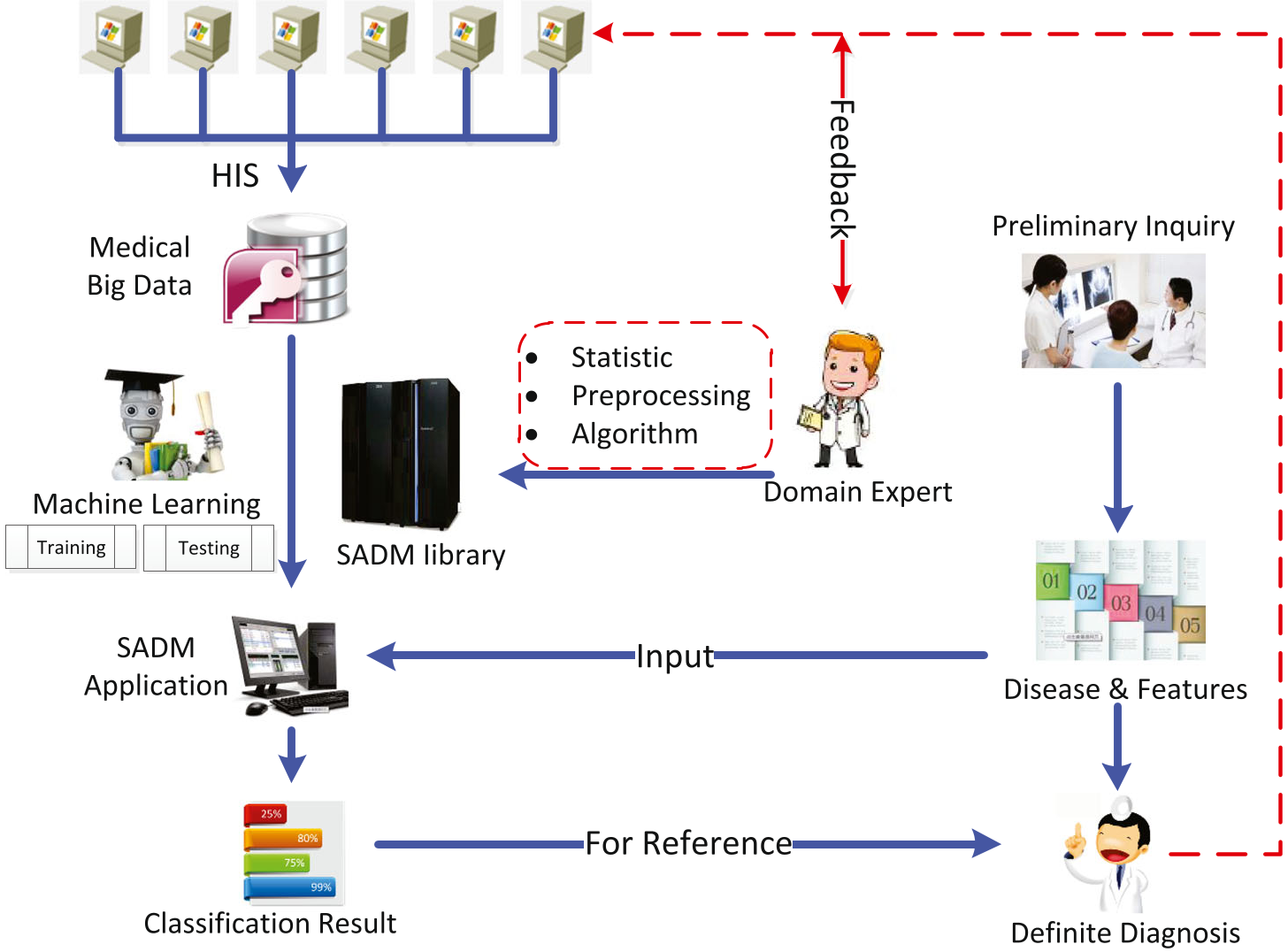 The five-step workflow of SADM: from acquisition to simultaneous diagnosis.
Experiments & Results: Big Data, Big Accuracy
The model was tested on 1,600 real-world clinical instances (800 healthy, 800 diagnosed).
Key Performance Metrics
The study proved that as data volume increases, so does the model's reliability. When the training set reached 87.5% of the total data (1,400 instances), the performance peaked:
| Algorithm | Accuracy | Precision | Recall | F1-Measure |
|---|---|---|---|---|
| SVM | 0.9100 | 0.9239 | 0.8854 | 0.9043 |
| NN | 0.9150 | 0.9307 | 0.9308 | 0.9171 |
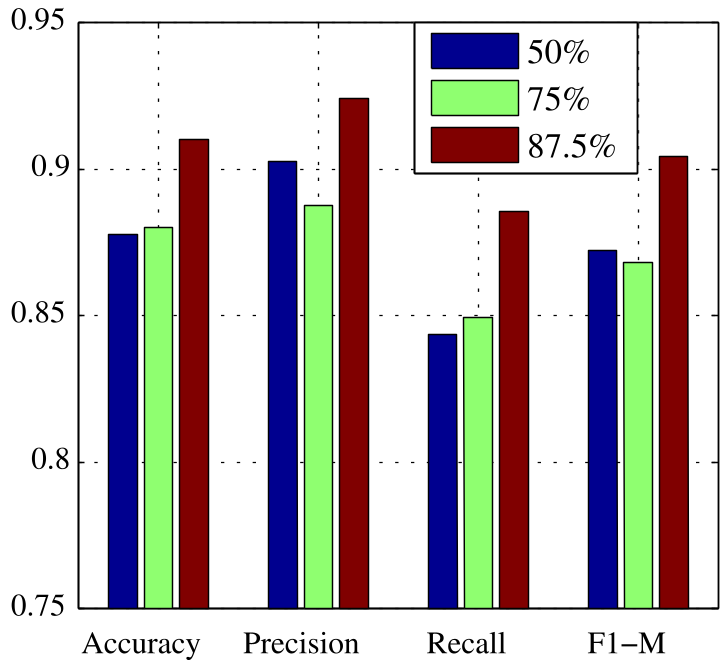 The impact of training data scale: A clear upward trend in accuracy as the dataset expands.
Age-Specific Insights
The researchers performed an ablation-style analysis on age groups (split at 49 years old). Interestingly, the accuracy for the younger demographic (<49) reached 92.68% using SVM, suggesting that the model is particularly effective at catching early-stage metabolic issues in younger populations.
Critical Analysis & Future Outlook
Why it works
The effectiveness of SADM lies in its Clinical Inductive Bias. By selecting features specifically recommended by medical experts (the nine indices), the model avoids the "noise" typically found in raw medical big data, allowing even simple algorithms like SVM to perform at SOTA levels for specific diagnostic tasks.
Limitations
- Feature Complexity: The current model relies heavily on biochemical test values (TG, TC, etc.). In real outpatient settings, "symptom-based" data (subjective complaints) is more varied and harder to quantify.
- Single Disease Focus: While hyperlipidemia is a great proof-of-concept, outpatients often present with comorbid conditions.
Conclusion
The SADM serves as a blueprint for "Smart Outpatient" systems. By automating the preliminary classification of common diseases, we can return valuable time to doctors, allowing them to focus on complex cases while maintaining a high standard of care for the majority. The next frontier involves Deep Learning and Transfer Learning to handle unlabeled medical imagery and more complex symptom profiles.