
Sina Weibo: Decoding the DNA of an Information-Driven Social Network
Sina Microblog: An Information-Driven Online Social Network
This paper presents the first quantitative topological study of Sina Weibo, the leading Chinese microblogging platform. By analyzing 1.12 million user profiles, the authors characterize Weibo as an "information-driven" social network, distinct from relationship-oriented platforms like Facebook.
TL;DR
Is Sina Weibo just a "Chinese Twitter"? This seminal study argues it is something more specific: an Information-Driven Online Social Network (OSN). Unlike Facebook, where links reflect real-world friendships, Weibo's topology is defined by one-way information consumption, a hyper-connected core of elite users, and a "small-world" radius that allows news to travel across 55 million users in roughly 6 hops.
Evolution vs. Static Connection
The authors identify a critical distinction in how Weibo grows compared to traditional networks. While friendship networks are relatively static, Weibo's overlay is dynamic.
The study proposes a four-stage evolution model:
- Startup: Initial seed nodes and links.
- Growth: New users join with up to 2000 initial followings (often recommended by the system).
- Link Selection: Users follow based on interests or existing following-of-followings.
- Evolution: Continuous "unfollowing" and "following" ensures the network topology shifts rapidly to refine information flow.
The Core Mechanism: Who Drives the Conversation?
One of the most striking findings is the role of Verified Users (Vusers). The researchers split the population into Common Users (Cuser) and Vusers, revealing a massive disparity in structural influence.
- The Matthew Effect: The correlation coefficient of 0.55 between current followers and new follower acquisition suggests that "the rich get richer."
- The Core Network: Vusers make up a tiny fraction of the population but command 7.38% of all following links. Within this core, users are organized into professional clusters (Movie Stars, Journalists, IT Executives) with high clustering coefficients and ultra-short diameters.
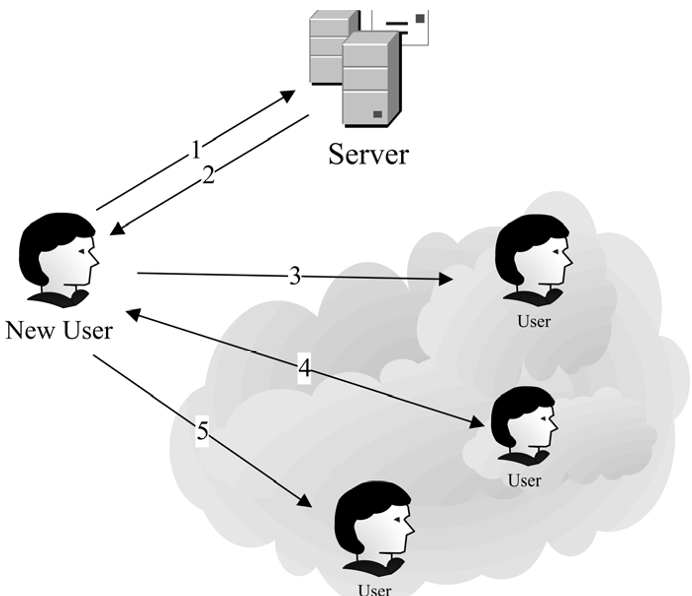 Figure 1: The self-organizing process of new users joining the Weibo overlay.
Methodology: Measuring a Moving Target
Because Weibo's topology changes so fast, the authors used a one-month "snapshot" (Nov-Dec 2010). They analyzed 1.12 million profiles. To solve the problem of measuring the "radius" (the average distance between any two users) without having the full global graph, they developed a mathematical model based on Breadth-First Search (BFS) expectations.
By defining the probability of a node being "new" during a search, they derived: Where is the average degree and is the total population. This formula proves that Weibo maintains a "small-world" property despite its massive scale.
Quantitative Battle: Weibo vs. Twitter vs. Facebook
The paper highlights three key metrics that set Weibo apart:
- Reciprocity Rate: In Facebook, this is nearly 1.0 (you are friends with your friends). In Twitter, it's moderate. In Weibo, it's remarkably low (16.9% for Cusers and <0.7% for Vusers), proving users are there to listen, not necessarily to interact.
- Growth Speed: Reaching 100 million users 2x faster than Twitter, largely due to the "Information-Driven" nature of its 140-Chinese-character limit (which conveys significantly more data than English characters).
- Degree Distribution: Both followers and followings follow a Power-Law distribution, showing a "long tail" of inactive users dominated by a few "super-hubs."
 Figure 2: Power-law distribution of followings and followers among common users.
Critical Insight: Two Types of OSN
The authors conclude by proposing a new taxonomy for social networks:
- Relationship-Driven (e.g., Facebook): Slow-changing, high reciprocity, small individual following counts, focused on privacy and mutual trust.
- Information-Driven (e.g., Weibo): Fast-changing, low reciprocity, presence of a "super-core," focused on timely dissemination and public reach.
Conclusion & Limitations
This the work effectively identified that Weibo functions more as a broadcast media than a digital coffee shop. However, the study acknowledges its sampling limitation (crawling only 2% of total users). Future work is needed to map the "true core" of Weibo and how non-verified users might organically rise to become "hidden hubs" within the network.
As OSNs continue to evolve into algorithmic feeds, the "Information-Driven" model proposed here remains the foundation for understanding how viral content behaves in the modern digital age.