
Sindbad: Redefining Social Connectivity with Spatial Intelligence
Sindbad: A Location-based Social Networking System
Sindbad is a location-based social networking (LBSN) system that integrates spatial awareness into core social services, featuring the GeoFeed news feed, LARS recommender, and a spatial ranking module. It is built directly into the PostgreSQL engine to achieve high scalability and efficiency in processing spatial-social queries.
TL;DR
Sindbad is a pioneering location-based social networking system that moves beyond simple "check-ins" by injecting spatial awareness into the very fabric of social interaction. By integrating three core modules—GeoFeed, LARS, and Location-Aware Ranking—directly into the PostgreSQL engine, it provides users with news and recommendations that are geographically relevant to their current position and movement.
Background Tracking
In the landscape of 2012, social media was bifurcated: giants like Facebook dominated social graphs but ignored "where" you were, while Foursquare tracked "where" you were but offered little social depth. Sindbad bridged this gap, positioning itself as a comprehensive spatial-social middleware capable of powering both desktop and mobile applications.
The Motivation: Why Space and Social Don't Mix Easily
The technical challenge of a Location-Based Social Network (LBSN) is the Three-Body Problem of Data:
- User Mobility: Locations change constantly.
- Social Complexity: Millions of "friend" connections.
- Message Volume: High-frequency updates with spatial extents.
Existing systems failed because they treated location as a static attribute rather than a dynamic query filter. The authors realized that to make this efficient, spatial logic must be moved from the application layer down into the Database Management System (DBMS).
Methodology: The Architecture of Sindbad
Sindbad’s power stems from its three-pillar internal architecture, all encapsulated within PostgreSQL for performance.
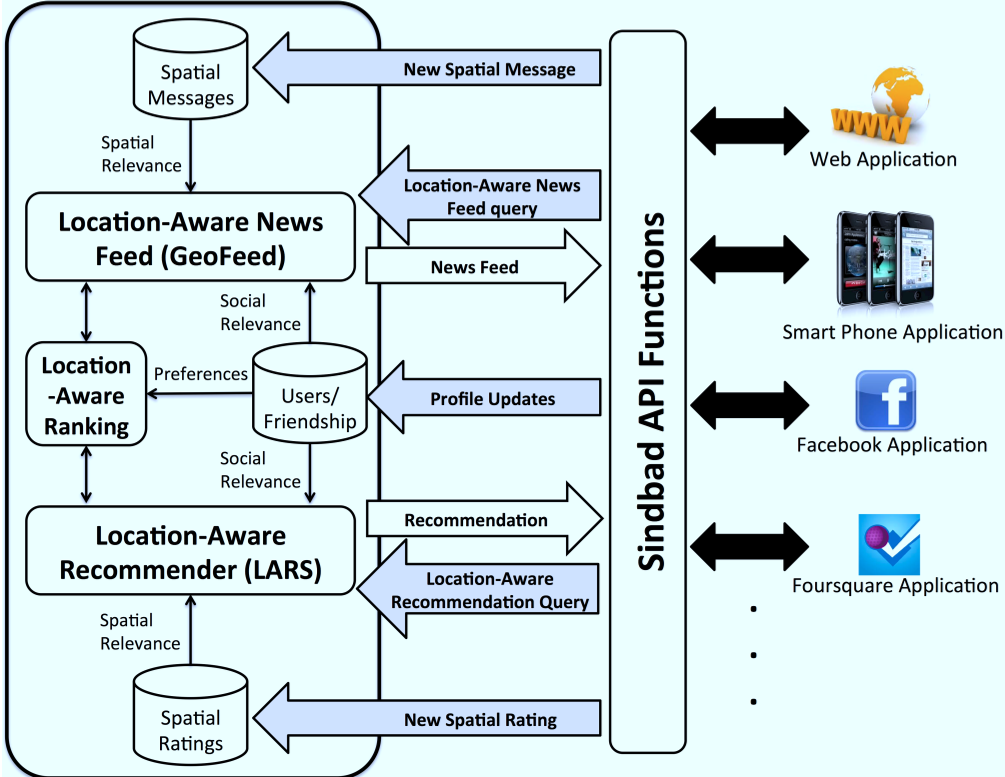
1. GeoFeed (Location-Aware News Feed)
GeoFeed solves the message delivery problem using a decision model that chooses between:
- Spatial Pull: On-demand indexing for infrequent users.
- Spatial Push: Pre-computed materialized views for high-traffic users.
- Shared Push: Optimizing views shared across multiple users.
2. LARS (Location-Aware Recommender System)
Unlike Amazon or Netflix which use non-spatial Collaborative Filtering (CF), LARS uses:
- User Partitioning: An adaptive pyramid structure that groups users by location to provide "local" suggestions.
- Travel Penalty: A mathematical discount applied to items further away from the user, ensuring the recommendation is practical.
3. Location-Aware Ranking
This module acts as the final arbiter, combining social relevance (how much you like a friend) with spatial relevance (how close the message/item is). Crucially, it uses early pruning—stopping the search once the top-k results are mathematically guaranteed, saving immense CPU cycles.
Experiments & Interface
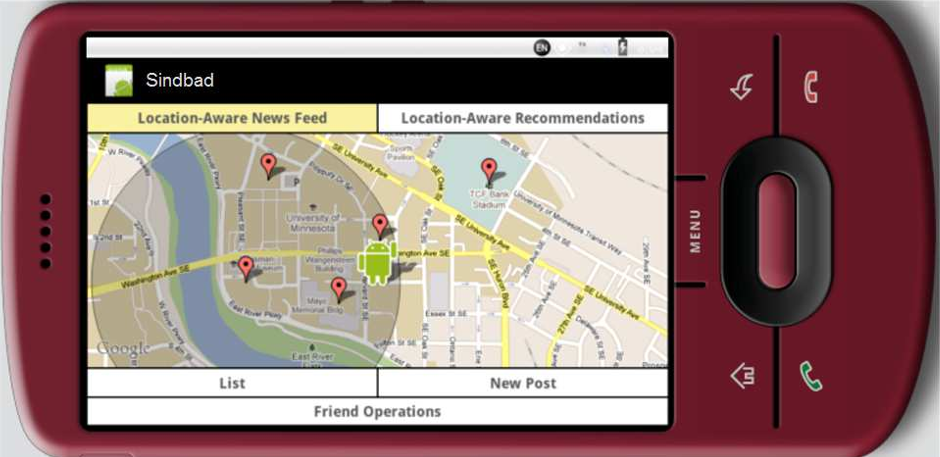
The system was demonstrated using real-world data from Foursquare in Scottsdale, Arizona. Users can interact via a web interface or an Android app, where dragging a location pin instantly updates the "Spatial News Feed" (represented by circles on a map).
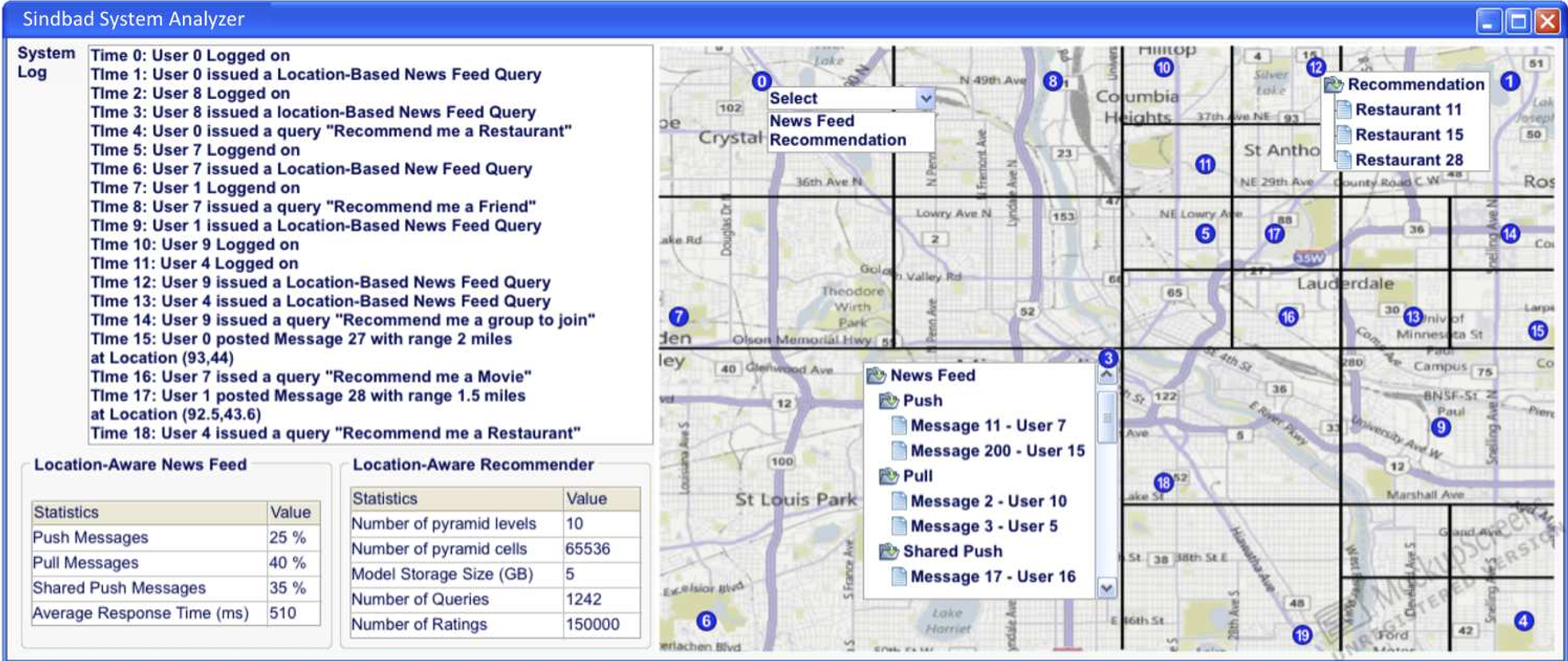
The Sindbad System Analyzer (shown below) provides a "god-view" for administrators, tracking user movement and visualizing the decision-making process of the GeoFeed module (pull vs. push).
Critical Analysis & Future Outlook
Sindbad’s decision to build inside PostgreSQL was a masterstroke for 2012, leveraging decades of query optimization. However, its current limitation lies in the reliance on structured SQL for what has now become highly unstructured social data.
Takeaway: Sindbad proved that for LBSNs to be viable, the database must understand that a "friendship" is not just a row in a table, but a dynamic relationship bound by geography. This paved the way for modern "Hyper-local" services like Uber and DoorDash, which rely on similar spatial-social logic.
Note: This post is based on the SIGMOD '12 demonstration paper "Sindbad: a location-based social networking system" by Mohamed Sarwat et al.