
SIoT: Building a Social Network for Intelligent Objects
SIoT: Giving a Social Structure to the Internet of Things
This paper introduces the Social Internet of Things (SIoT), a paradigm that applies social networking principles to intelligent objects. It defines a social structure for devices and proposes a cross-layer architecture to enable autonomous service discovery and trustworthiness management among "socially connected" things.
TL;DR
The Social Internet of Things (SIoT) is a revolutionary paradigm that argues if humans can solve complex search and trust problems via social networks, so can machines. This paper defines how objects can form "friendships," outlines a three-layer architecture to manage these ties, and demonstrates how social structures improve service discovery and trust in massive-scale IoT ecosystems.
Problem & Motivation: Beyond the Passive Web of Things
As we head toward an era with billions of connected devices, two massive bottlenecks emerge: Discovery (How do I find the right sensor in a sea of billions?) and Trust (How do I know this data isn't malicious?).
Existing IoT frameworks treat objects as passive data producers or web resources. The authors argue that this is inefficient. By contrast, human social networks are remarkably "navigable"—we are all connected by roughly six degrees of separation. The SIoT's core insight is to grant objects the autonomy to build their own social circles, allowing them to "crawl" their friend networks to find services without human intervention.
Methodology: The Social Fabric of Machines
To make objects "social," the authors define a taxonomy of five relationship types:
- Parental (POR): Objects from the same manufacturer/batch.
- Co-location (C-LO): Objects permanently residing in the same place (e.g., smart home sensors).
- Co-work (C-WO): Objects that periodically cooperate for a task (e.g., emergency response systems).
- Ownership (OOR): Different devices belonging to the same user.
- Social (SOR): Objects that "encounter" each other because their owners are friends.
Architectural Blueprint
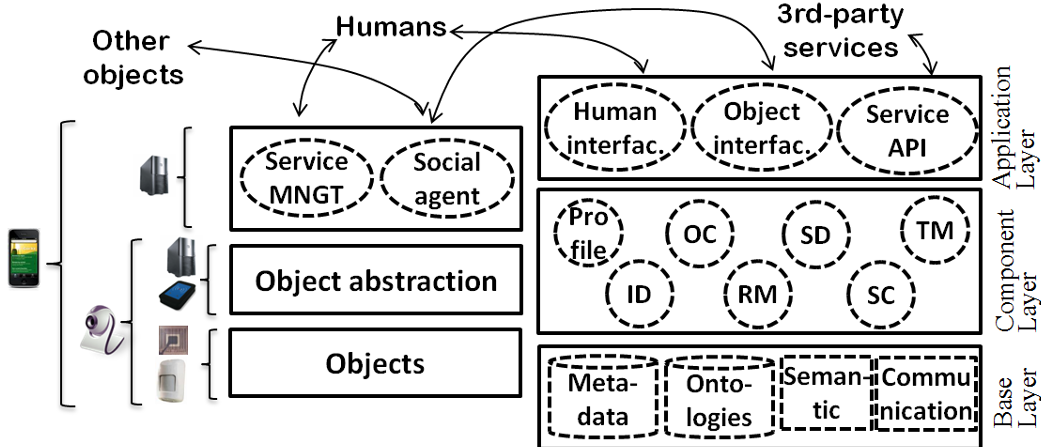
The SIoT architecture is split between a Server Side (managing the massive graph of relations) and an Object Side (handling the local logic).
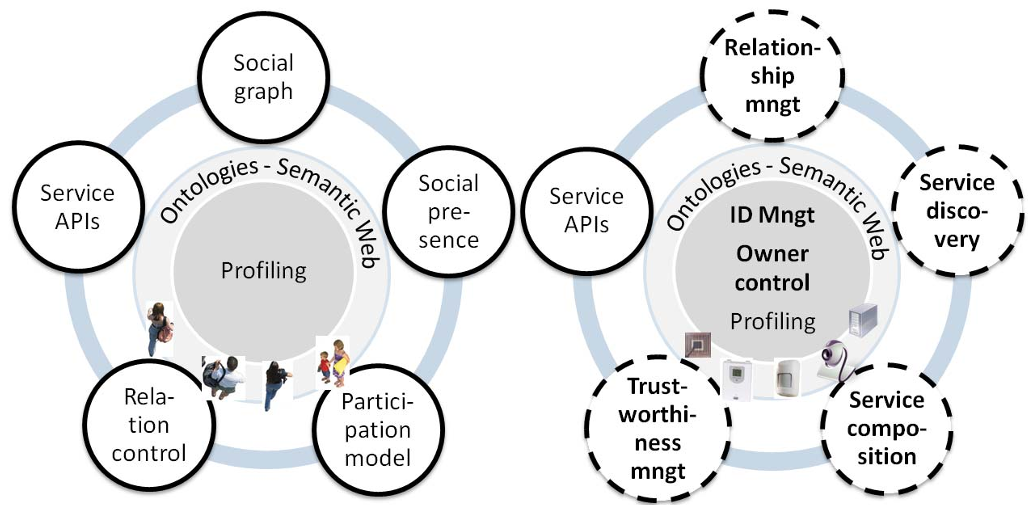
The Social Agent on the device is the brain of this operation—it manages the "Social Profile" of the object and decides which "friendships" to accept based on owner-defined policies.
Experiments & Results: The Small-World Phenomenon
The authors validated the concept through statistical simulations of object mobility and interactions.
- Network Navigability: The resulting network topology mimics human social structures (Small-World properties). This means an object can find a specific service in a massive network in very few "hops."
- Trustworthiness: By applying social network metrics like Centrality and Prestige, the system can identify reliable "influencer" objects, effectively filtering out noise or malicious nodes.
Critical Analysis & Conclusion
Takeaway
The SIoT moves IoT from "connected things" to "social things." It provides a scalable solution for service discovery that grows more efficient as the network becomes more complex, much like how LinkedIn or Twitter become more valuable as users increase.
Limitations & Future Work
While the social model is elegant, it introduces significant privacy concerns. If my toaster is "friends" with your fridge, what data is leaking? The paper mentions "Owner Control," but the complexity of managing policies for hundreds of social devices remains a challenge. Future research should look into Automated Policy Generation and Privacy-Preserving Social Discovery.
SIoT is not just a theoretical model; it’s a roadmap for the next generation of autonomous, collaborative machine intelligence.