
The Green-Eyed Monster in the Machine: Understanding Situational Envy on Social Networks
How do you feel about your friends? Understanding situational envy in online social networks
This study investigates the drivers of Online Social Network Situational Envy (OSN-SE) through the dual lenses of the Five-Factor Model (FFM) of personality and Uses and Gratifications (U&G) theory. Analyzing data from 625 Facebook users, the authors identify specific personality traits and usage behaviors—primarily passive information seeking—that significantly correlate with increased feelings of envy.
TL;DR
Why does scrolling through Facebook make some people feel inadequate while others remain unfazed? This study reveals that Online Social Network Situational Envy (OSN-SE) isn't just a byproduct of the platform; it is a complex interaction between your personality and your motivation for login. Passive "surveillance" and attention-seeking are high-risk behaviors, whereas extraversion and active relationship maintenance act as emotional shields.
Context: The Digital Comparison Trap
Online Social Networks (OSNs) have created an "upward social comparison-rich" environment. Because users tend to curate only their most socially desirable identities, the information we consume is often a "highlight reel" rather than reality. This research moves beyond the simple "is social media bad?" debate to ask a more sophisticated question: Which specific user characteristics invite the "green-eyed monster"?
The Core Drivers: Personality vs. Behavior
The authors combine two psychological frameworks:
- The Five-Factor Model (FFM): Exploring how dispositional traits like Neuroticism or Extraversion set our "baseline sensitivity" to social stimuli.
- Uses & Gratifications (U&G) Theory: Analyzing the why behind our use—are you searching for info, seeking attention, or just killing time?
1. Methodology & Framework
The researchers surveyed 625 active Facebook users, applying rigorous Structural Equation Modeling (SEM) to test how these traits influence situational envy.
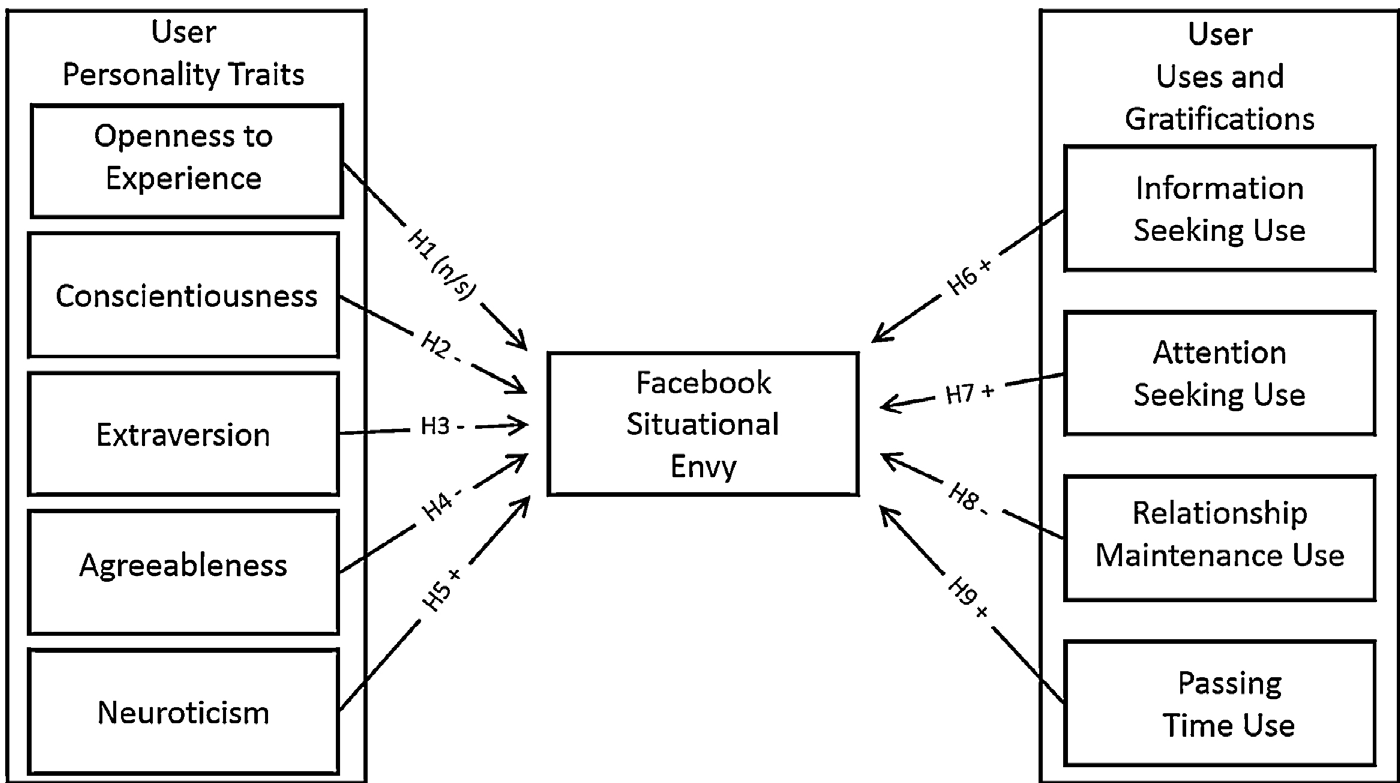 Figure 1: The Research Model illustrating the paths between Personality/Use Motivations and Situational Envy.
Key Insights: Why Some Users Suffer More
The Personality Shield
- Extraversion & Agreeableness: These traits are negatively correlated with envy. Extraverts view social interactions as rewarding/communal rather than competitive, while agreeable individuals use coping mechanisms to feel genuine happiness for others’ successes.
- Conscientiousness: Highly conscientious people tend to be more disciplined with their time, viewing OSNs as potential distractions, which naturally limits their exposure to envy-inducing content.
- The Neuroticism Risk: Neurotic individuals are more sensitive to social exclusion and cues of inferiority, making them highly susceptible to OSN-SE.
The Dangerous Uses (Passive vs. Active)
The most striking finding lies in the type of use:
- Information Seeking (+0.23): "Following" what others are up to without interacting (surveillance) is the strongest driver of envy.
- Attention Seeking (+0.24): Narcissistic use—posting to feel important—paradoxically makes users more vulnerable to envy when they inevitably encounter others who appear "superior."
- Relationship Maintenance (NS): Actively communicating with real-life friends does not increase envy. Because you know your real friends' struggles, you are less likely to fall for their "perfect" online persona.
 Table 1: Path coefficients showing the significant positive impact of Information Seeking and Attention Seeking on Envy.
Critical Perspective: Redesigning the Digital Experience
This paper provides a roadmap for both users and platform designers:
- For Users: To avoid envy, move from Passive Surveillance to Active Participation. Send a message instead of just scrolling the newsfeed.
- For Platforms: If OSN designers want to improve user well-being, they should incentivize "Community-oriented" features (Direct Messaging, Group Interaction) over "Surveillance-oriented" features (infinite scrolling of distant acquaintances).
Conclusion & Takeaway
Envy on social media is not a bug; it’s a feature of how we choose to engage. By mimicking the "extraverted" style of active interaction and the "conscientious" style of time-limited use, even envy-prone individuals can reclaim their well-being in the age of the algorithm.
Limitations: The study focused on Facebook and a younger demographic. Future work should investigate whether these dynamics change on TikTok (algorithmic discovery) vs. BeReal (forced authenticity) or among older populations with different social priorities.