
FlexPara: Breaking the Linear Assumption to Solve Skewness in Iterative ML Jobs
Addressing Skewness in Iterative ML Jobs with Parameter Partition
FlexPara is a novel parameter partition approach designed for iterative Machine Learning (ML) jobs in multi-tenant data-parallel clusters. It employs a non-linear capacity model and a proactive parameter reassignment strategy to mitigate computational skewness, achieving speedups of up to 54% over standard hash partitioning in Spark.
TL;DR
Distributed Machine Learning (ML) jobs on shared clusters often suffer from "stragglers"—slow nodes that drag down the entire iteration. Traditional fixes assume that if you halve the data, you halve the time (Linearity). FlexPara proves this is wrong for iterative ML. By using non-linear capacity modeling and smart "Parameter Reassignment," FlexPara slashes execution time by up to 54% in real-world multi-tenant environments.
The "Linearity Myth" and the Binding Problem
In the world of Big Data (MapReduce), we often assume task time is linearly dependent on data size. However, iterative ML algorithms like PageRank or LDA (Topic Modeling) are more complex. Update functions often have super-linear complexities (e.g., ), meaning small imbalances in partitioned parameters lead to massive gaps in execution time.
Furthermore, iterative ML has a unique constraint: Parameter-Input Binding. Parameters are updated against specific input data. Moving a "straggler" task to a faster node requires moving both the parameters AND the massive input dataset, often leading to network bottlenecks that cost more time than they save.
Methodology: The FlexPara Architecture
FlexPara shifts the paradigm from reactive "speculative execution" to proactive "adaptive partitioning."
1. The Non-Linear Capacity Model
Instead of assuming a constant rate, FlexPara uses Polynomial Regression to profile each worker. It correlates the size of bound input data to the actual processing time of parameters. This allows the system to predict exactly how long a specific worker will take to process a specific subset of the model.
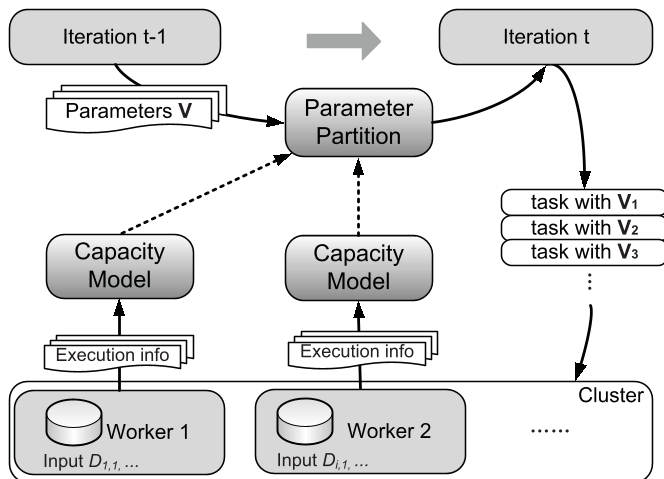
2. Proactive Parameter Reassignment
Rather than starting from scratch, FlexPara starts with a Hash Partition (which ensures zero data movement initially). If it predicts a skew:
- It identifies "Slower" and "Faster" tasks.
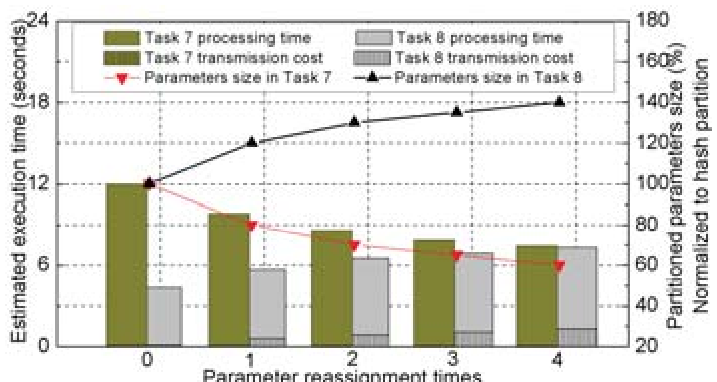
- It calculates a "reassignment unit"—moving just enough parameters from slow tasks to fast ones.
- It incorporates a Network Cost Model to ensure that the time gained by shifting the CPU load isn't lost to the network delay of moving the bound input data.
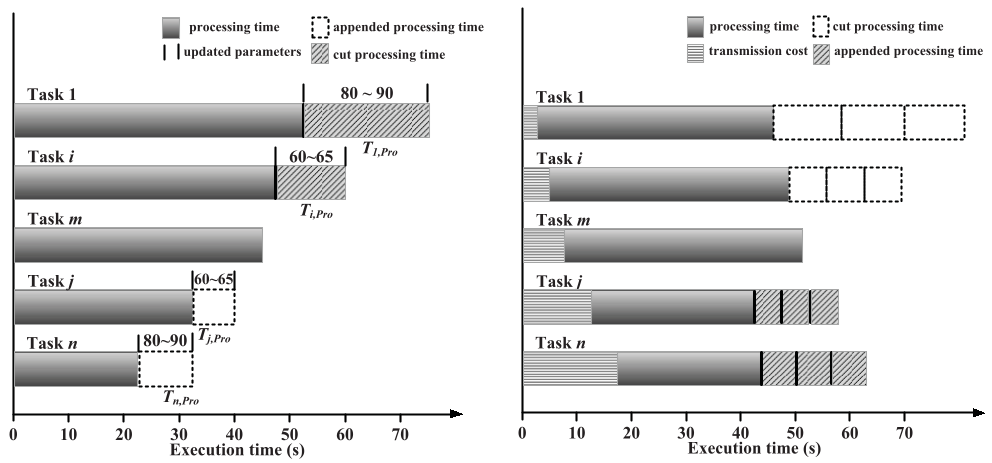
Experimental Validation
The authors tested FlexPara on two distinct testbeds: a 37-node private cluster and a 10-node NSF Chameleon cloud. They ran heavy-duty workloads including PageRank, Matrix Factorization, and LDA.
Performance Gains
The results were striking. By accurately predicting machine capacity, FlexPara achieved:
- 54% speedup compared to Spark's default Hash Partitioning.
- 100% (2x) speedup compared to PIKACHU (a state-of-the-art linear partitioner).
As shown in the Task Execution graph below, FlexPara successfully "leveled" the execution time across different tasks (the purple bars), whereas other methods saw tasks ranging from 40s to over 100s.
Deep Insight: Why Reassignment Trumps Speculation?
Previous methods like Speculative Execution (cloning tasks) are "late to the party"—they only act after a straggler is detected. In iterative ML, the "Binding Relationship" makes cloning prohibitively expensive. FlexPara’s genius lies in its fine-grained shuffler. By splitting parameter buckets into multiple smaller files, it can move 5% or 10% of a task's load with surgical precision before the iteration even hits its bottleneck.
Conclusion & Takeaways
FlexPara demonstrates that in modern cloud environments, "one-size-fits-all" partitioning is dead.
- Non-linearity matters: High-order polynomial regression is necessary to capture true CPU behavior.
- Locality is king: Any load balancing must be "binding-aware" to avoid drowning the network.
As ML models grow and move toward even more heterogeneous environments (like edge computing or multi-cloud), the principles of FlexPara—proactive, non-linear, and locality-aware partitioning—will become the standard for distributed systems.