
SLADE: Optimizing the Economy of Scale in Crowdsourcing via Smart Task Decomposition
SLADE: A Smart Large-Scale Task Decomposer in Crowdsourcing
This paper introduces the Smart Large-scAle task DEcomposer (SLADE), a framework for optimizing crowdsourcing workflows. It focuses on decomposing thousands of atomic tasks into variable-sized task bins to minimize total incentive costs while meeting strict reliability constraints.
TL;DR
Managing large-scale crowdsourcing is a balancing act between cost and quality. While bigger task batches (bins) are cheaper per item, they exhaust workers and tank reliability. SLADE is a new optimization framework that mathematically determines the best mix of different batch sizes to hit a target reliability at the absolute minimum cost.
Introduction: The Batching Dilemma
In the world of crowdsourcing (like Amazon MTurk), we rarely send one task at a time. Instead, we pack "atomic tasks" (e.g., "Is there a car in this image?") into bins.
- The Pro: Larger bins reduce overhead and lower the per-task price.
- The Con: As bins get larger, worker fatigue sets in, leading to higher False Negative rates.
Previously, researchers either used fixed bin sizes or simple heuristics. This paper argues that a mixed-size strategy—similar to a database query optimizer—is the key to efficiency.
The SLADE Problem: Complexity and Insight
The authors define the Smart Large-scAle task DEcomposer (SLADE) problem. The goal is to select task bin sizes , their associated costs , and worker confidence such that every task meets a reliability threshold .
Key Insight
There is a non-linear mismatch between the drop in reliability and the drop in cost as batch sizes grow. By selecting a variety of bin sizes, one can "fill" the reliability requirements more precisely than using a single size.
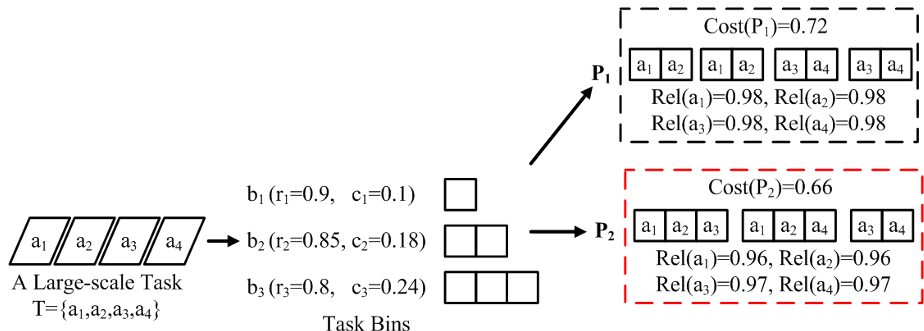 Fig 1: Comparing different decomposition plans. Plan P2 uses variable sizes to achieve the same reliability as P1 but at a lower cost.
Methodology: Taming the NP-Hardness
The paper proves that finding the optimal decomposition is NP-hard. To solve this, they introduce two main approaches:
- Greedy Algorithm: It selects bins based on a cost-confidence ratio. It asks: "Which bin gives me the most 'reliability-bang' for my buck?"
- OPQ-Based Approximation: The "Optimal Priority Queue" structure ranks combinations of task bins. It uses a depth-first search to prune inefficient combinations (where one is strictly worse than another in both cost and reliability) and then greedily fills the task requirements.
For Heterogeneous SLADE (where different tasks have different reliability needs), the authors use a quantile-based partitioning method to group tasks and solve them segmentally.
Experimental Validation
Using real-world data from "jelly-bean counting" and "micro-expression identification" experiments, the authors tested SLADE against standard batching.
- Effectiveness: The OPQ-based algorithm consistently found lower-cost plans than the Greedy approach.
- Efficiency: Despite the complexity, the OPQ structure allows the system to handle 10,000+ tasks in reasonable timeframes.
- Scalability: The method holds up even as the number of available bin sizes () increases.
Critical Insight & Future Outlook
The brilliance of SLADE lies in treating human workers like a computational resource with a diminishing return profile. By formalizing the reliability as , the authors bring rigorous combinatorial optimization to the traditionally "fuzzy" field of human computation.
Limitations: The model assumes independent atomic tasks. In the future, exploring dependent tasks (where one answer affects the next) or worker-specific modeling (where changes based on the specific person's skill) would be the next logical step for this research.
Takeaway for Industry
If you are running large labeling campaigns for AI, stop using fixed batch sizes. A dynamic binning strategy informed by cost-reliability curves can likely slash your annotation budget by 15-30% without sacrificing dataset quality.