
Slices of Attention: Decoding the "Black Box" of AI Job Interviews
Slices of Attention in Asynchronous Video Job Interviews
The paper introduces a methodology to interpret hirability predictions in asynchronous video interviews using "HireNet," a deep learning model. By leveraging an attention-based Recurrent Neural Network (RNN), the authors extract "attention slices"—brief segments of non-verbal behavior that the model deems critical for recruitment decisions.
TL;DR
How does an AI decide if you are "hirable" just by watching a video? This research moves beyond simple predictions to explain why certain moments matter. By analyzing the "Attention Slices" in a deep learning model called HireNet, researchers discovered that AI focuses on specific micro-behaviors—like lip tightening and eye blinking—occurring at the start and end of answers, mirroring how human recruiters evaluate candidates.
Background: The Rise of the Asynchronous Interview
Asynchronous video interviews (AVIs) have become a staple in modern recruitment. Candidates record answers to pre-set questions, and recruiters review them later. While AI models can now predict recruiter scores with high accuracy, the "why" remains elusive. Is the AI biased? Is it looking at the right cues? This paper seeks to validate if an AI's "attention" actually corresponds to meaningful human social signals.
The Problem: Attention is Not Always Explanation
In the world of Deep Learning, Attention Mechanisms are often touted as a "window" into the model's mind. However, critics argue that attention weights are sometimes just noisy fluctuations. Most researchers simply show a picture of a peak and call it an "explanation." This paper challenges that superficiality by asking: Are these peaks actually different from the rest of the video, and do they hold more information?
Methodology: Finding the "Thin Slices"
The researchers utilized HireNet, a hierarchical model using Gated Recurrent Units (GRUs) and attention layers. To move from raw attention curves to actionable data, they followed a sophisticated pipeline:
- Unsupervised Detection: They used DBSCAN (a density-based clustering algorithm) to find temporal clusters of high attention.
- Thin-Slice Extraction: They focused on segments lasting 0.5 to 4 seconds—the same duration as typical human facial expressions.
- Feature Analysis: They extracted visual features (Action Units/AUs) using OpenFace to see what was happening during those specific moments.
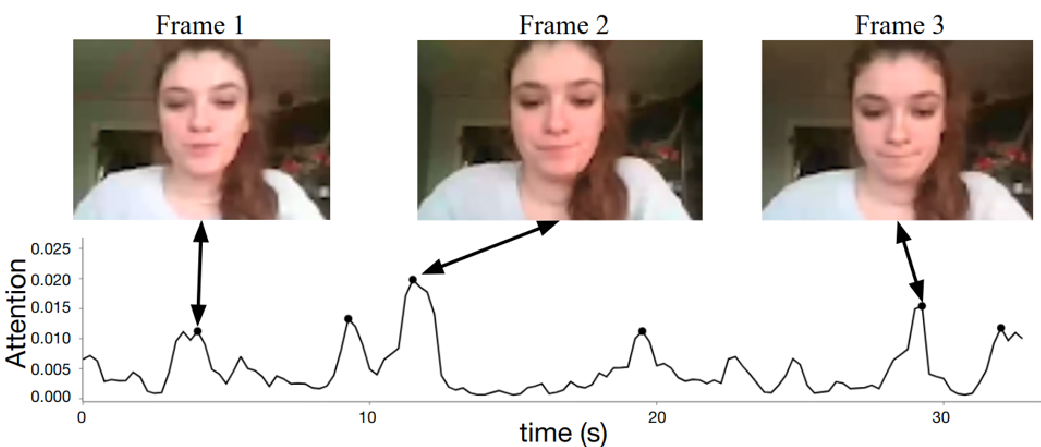 Figure 1: An example of the attention curve generated by HireNet, where peaks indicate "salient moments" identified during the interview.
Key Findings: What is the AI Watching?
1. The Anatomy of an Important Moment
The study found that the "important" moments aren't random. They occur most frequently at the beginning (turn-taking) and end (turn-giving) of an answer. This aligns perfectly with social science: how you start and finish a thought heavily influences the listener's impression.
2. The "Anxiety" Signal
By using a Lasso classifier to distinguish attention slices from random ones, the authors identified the most influential visual cues:
- Lip Stretcher (AU20) & Lip Tightener (AU23): Often associated with anxiety or cognitive load.
- Blinking (AU45): Extended eye closure or rapid blinking.
- Jaw Drop (AU26): Interestingly, the absence of a jaw drop (meaning the candidate is silent/pausing) was a high-attention signal.
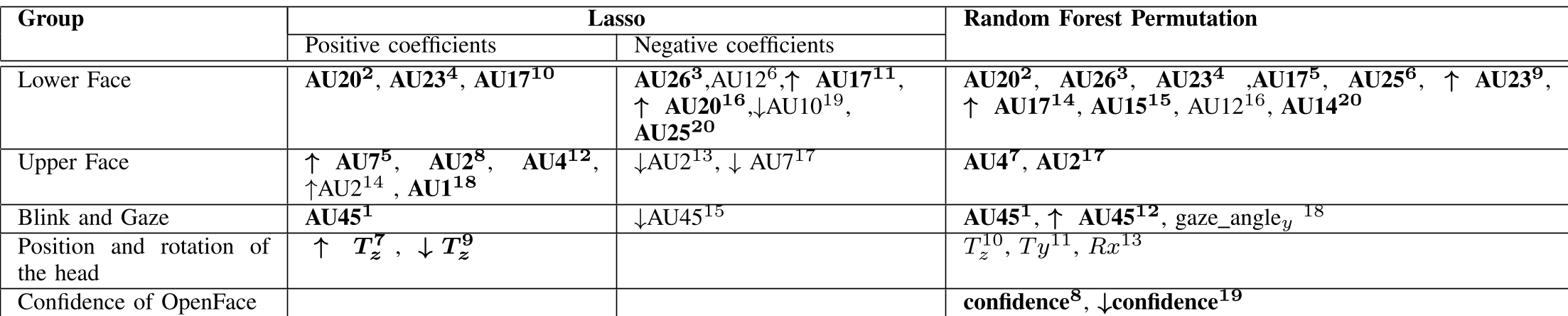 Table 1: Ranking of visual features that trigger the model's attention. Top features include blinking and lip movements.
3. Superior Predictive Power
To prove these slices weren't just noise, they trained a model to predict hirability using only the 2-second attention slices versus random 2-second slices. The attention slices consistently produced better results, confirming the model effectively "zooms in" on the most informative parts of the interview.
Critical Insight: Why This Matters
The value of this work lies in Accountability. If we know that an AI focuses on "anxiety cues" (like lip tightening) to label someone "not hirable," we can:
- Help candidates train to manage these specific non-verbal signals.
- Help recruiters identify if they are unfairly penalizing candidates for "interview nerves" rather than actual competence.
Conclusion and Future Outlook
While the study confirms that attention filters out the "fluff," it has limits. Currently, the model knows a moment is important, but it doesn't explicitly state if that moment was positive or negative (e.g., did that smile help or hurt?). The next frontier is "Valence-Aware Attention"—models that can tell a recruiter, "I liked this candidate because of their confident turn-taking at the 30-second mark."
By bridging the gap between deep learning and social psychology, this research paves the way for AI tools that don't just "score" humans, but help us understand the complex dance of social interaction.