
SWLD: Redefining Leader Detection in Dynamic Social Streams
A Sliding Window-Based Algorithm for Detecting Leaders from Social Network Action Streams
This paper introduces the Sliding Window-based Leader Detection (SWLD) algorithm, a novel method for identifying influential users from dynamic social network action streams. By employing a sliding window and a dynamic programming approach, it effectively detects "leaders" in real-time while maintaining significantly lower computational overhead than static baselines.
TL;DR
The paper introduces SWLD (Sliding Window-based Leader Detection), an efficient algorithm designed to identify influential users—"leaders"—from continuous streams of social network actions. Unlike previous static methods, SWLD uses a sliding window and dynamic programming to calculate influence metrics, resulting in faster performance, lower memory usage, and high precision in detecting those who drive viral information spread.
Deep Dive into the Motivation
In modern social networks, influence is not a static property; it is a temporal phenomenon. A user who was influential a year ago might not be relevant today. Previous SOTA methods, like the APPM algorithm, treated action logs as static entities, requiring exhaustive scans of the entire dataset to detect influence paths. This "global" view is not only computationally prohibitive for massive streams but also masks the "local" dynamics of real-time viral marketing.
The authors recognized two main hurdles:
- Memory Explosion: Storing the entire history of actions is unfeasible.
- Combinatorial Complexity: Enumerating every possible path of influence between users leads to an exponential surge in processing time.
Methodology: The Core Architecture
SWLD tackles these challenges through two primary innovations: the Sliding Window and Recursive Path Calculation.
1. Sliding Window (Temporal Filtering)
Instead of processing the whole action log, SWLD maintains a window of size . This ensures the system only focuses on active influence within a specific timeframe, significantly reducing the search space for leaders.
2. Avoiding Path Enumeration (The DP Insight)
Rather than explicitly finding every path (), the authors use a Forward Result (FR) and Backward Result (BR) structure.
- FR[u][n]: Counts how many length-n paths start with user .
- BR[u][n]: Counts how many length-n paths end with user .
By using the recurrence relation: the algorithm builds complex influence patterns from simple 1-step interactions. This is a classic dynamic programming approach that turns an exponential problem into a polynomial one.
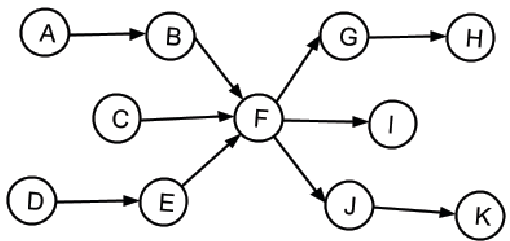 Figure 1: The propagation graph where directed edges represent the temporal flow of identical actions (e.g., retweets) between connected users.
Experimental Validation
The authors tested SWLD against the APPM baseline using the MovieLens dataset.
Execution Efficiency
As shown in the performance charts, SWLD consistently outperformed APPM in speed. A unique finding was that as the window size increased to 12 hours, the execution time actually decreased in some scenarios due to more effective pruning of windows with sparse action counts ( threshold).
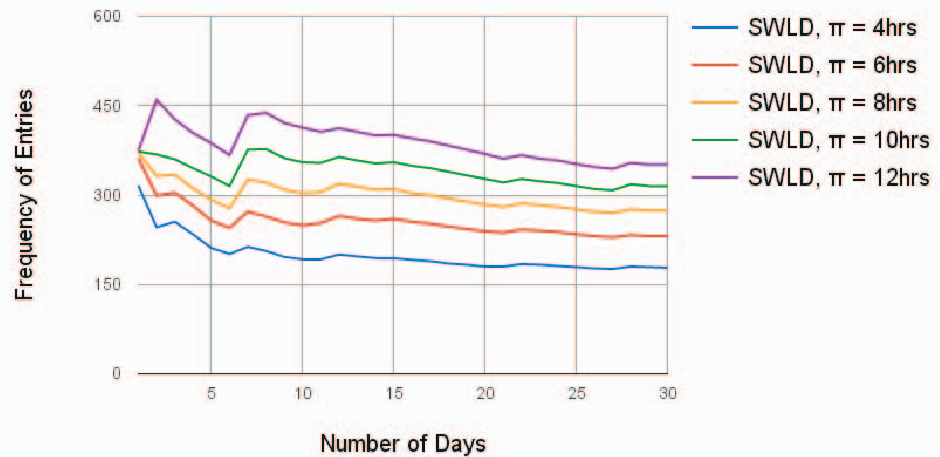 Figure 2: Execution time comparison showing SWLD's superior efficiency across varying window sizes.
Accuracy (Precision and Recall)
The experiments revealed a direct correlation between window size and recall. Larger windows capture more "participation" in influence paths, thereby identifying leaders more reliably. Specifically, for length-2 leaders, the recall for a 12-hour window was nearly double that of a 4-hour window.
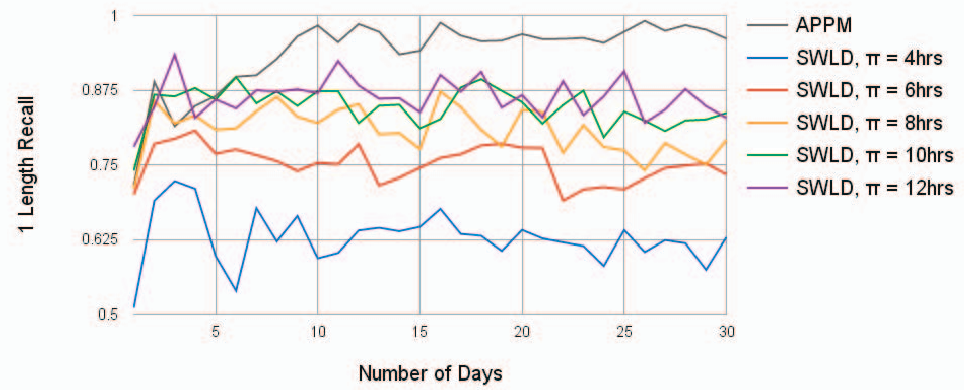 Figure 3: Recall for length-2 influential users, illustrating the benefit of larger temporal windows in capturing deep influence.
Critical Analysis & Conclusion
Takeaway
SWLD successfully bridges the gap between theoretical influence mining and practical, real-time application. By shifting the perspective from "all-time leaders" to "window-based leaders," the algorithm provides a much more actionable metric for advertisers and social analysts.
Limitations
- Window Sensitivity: The choice of (window size) is critical. Too small, and you miss long-range influence; too large, and you lose the benefit of stream processing.
- Homogenous Actions: The current model assumes all actions are identical. In reality, a "like" has a different weight than a "share" or an "original post."
Future Outlook
Future work could involve integrating weighted influence types (assigning different values to different actions) and exploring asynchronous sliding windows where the window size adapts based on the burstiness of social media traffic.