
Beyond Connectivity: Unveiling the Small-World Nature of Vehicular Social Networks
Analysis of Small-World Features in Vehicular Social Networks
This paper investigates the topological characteristics of Vehicular Social Networks (VSNs) by comparing the SCARF (Social-Aware Reliable Forwarding) protocol against the traditional Barabási-Albert (BA) model. The study demonstrates that VSNs, when using social-aware dissemination, evolve into a "Small-World" structure characterized by high clustering and low average path lengths.
TL;DR
Is a connected vehicle just a node in a random graph? This paper argues "No." By analyzing the SCARF (Social-Aware Reliable Forwarding) protocol, researchers have demonstrated that Vehicular Social Networks (VSNs) naturally evolve into Small-World structures. Unlike the standard Barabási-Albert scale-free model, social-aware vehicular networks exhibit significantly higher clustering and shorter communication paths, proving that "sociality" is the secret ingredient for efficient data dissemination on the road.
The "Scale-Free" Trap vs. Social Reality
For years, the Barabási-Albert (BA) model has been the gold standard for understanding networks that grow via "preferential attachment"—the rich-get-richer phenomenon where new nodes link to existing high-degree hubs. However, vehicular networks are not just about physical proximity; they are driven by human behavior (commuting patterns, shared interests, and social circles).
The authors point out a critical gap: standard models fail to account for "Regional Specialization." In a real-world VSN, vehicles don't just connect to the most popular node; they cluster around social hubs, creating a network that is more tightly knit than a generic scale-free graph.
Methodology: SCARF and the Small-World Evolution
The core of this study lies in the analysis of SCARF, a technique that selects "social vehicles" for message rebroadcasting based on their social degree.
The authors mathematically compare how a VSN evolves under two regimes:
- The BA Model: Based on a Linearized Chord Diagram (LCD), where link probability is purely degree-dependent.
- The SCARF Model: Where connections are influenced by social features like relationships (friend/family) and common interests (commuters).
The study defines a Small-World structure using two critical metrics:
- High Clustering Coefficient: Neighbors of a node are likely to be connected to each other.
- Low Average Distance: Any two nodes can reach each other via a very small number of hops.
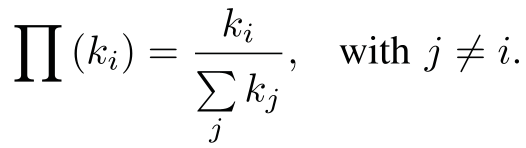 Eq 1: The Preferential Attachment probability used in the BA model comparison.
Experimental Insights: Social Aware > Topology Aware
The analytical results provide a clear distinction between generic network growth and social-aware growth.
1. The Proximity Paradox
As the network size increases from 50 to 55 nodes, SCARF consistently maintains a lower average distance than the BA model. In a 55-node scenario, the network diameter (maximum average distance) for SCARF was 42.20, compared to 44.23 for BA. This indicates that social-aware nodes act as more effective bridges, shortening the "hops" across the network.
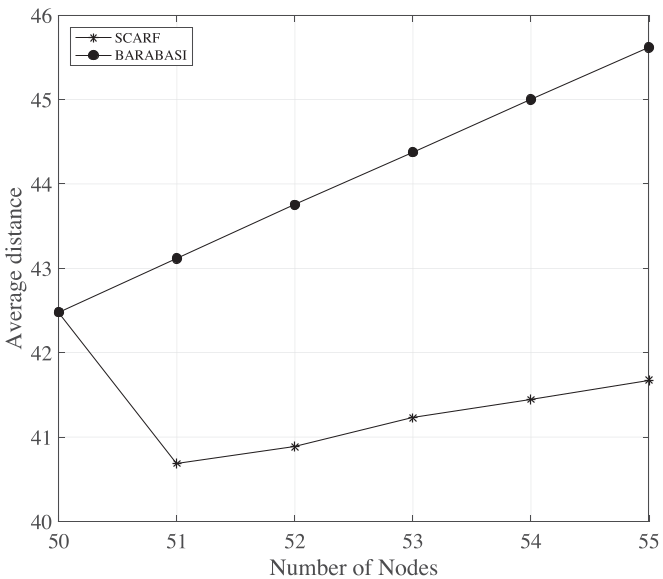 Fig 1: Average distance comparison showing SCARF efficiency.
2. The Clustering Power
The most dramatic difference is seen in the Clustering Coefficient. SCARF achieves a coefficient of ~0.8, which actually increases as the network grows. In contrast, the BA model stays significantly lower. This high clustering suggests the formation of dense "communities" of vehicles that can reliably share information locally, a hallmark of Small-World behavior.
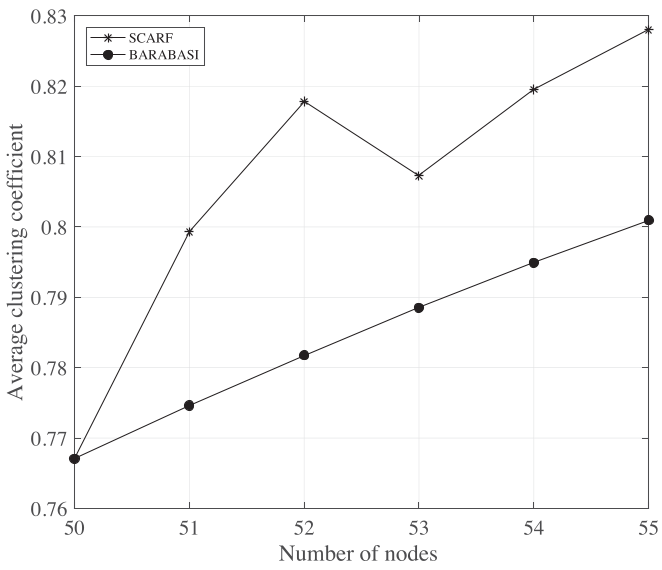 Fig 2: SCARF demonstrates superior node clustering compared to the BA model.
Critical Analysis: Why This Matters
The "Small-World" discovery is not just a theoretical curiosity—it has massive implications for Network Resilience and Traffic Safety:
- Failure Tolerance: By identifying high-centrality social hubs, network designers can forecast which links are critical. If a "social hub" vehicle exits the network, we now know exactly how and where the communication map might fracture.
- Efficient Dissemination: Instead of flooding the network, data can be "injected" into social clusters where it will spread fastest.
Limitations: The study uses a relatively small node count (50-55). While the analytical trend is clear, VSNs in mega-cities involve thousands of nodes. Future work should investigate whether these Small-World features hold under extreme density or high-mobility scenarios where social links are transient.
Conclusion
This paper effectively refutes the idea that VSNs are just another flavor of ad-hoc networks. By proving the existence of a Small-World architecture, the authors provide a roadmap for the next generation of social-aware vehicular protocols. In the future of autonomous driving, your car might not just talk to the nearest vehicle—it will talk to its "friends" to keep the whole network fast and reliable.