
EWS & HC Models: Bridging Small-Worlds and Hierarchical Communities in Social Networks
Small world models for social network algorithms testing
This paper introduces the Extended Watts and Strogatz (EWS) and Hierarchical Communities (HC) models to synthesize social networks that simultaneously exhibit small-world properties and community structures. Additionally, it proposes the Iterated Community Recognition Algorithm (ICRA), which leverages local link correlation for efficient community detection.
TL;DR
This research addresses a critical void in network science: the lack of synthetic models that represent both "small-world" characteristics and hierarchical community structures. By extending the classic Watts-Strogatz framework, the author provides a robust benchmarking tool for social network algorithms and introduces ICRA, a community detection method that achieves high precision by exploiting local clustering.
The Benchmarking Gap: Why Better Models Matter
In the study of social networks, researchers face a "ground truth" dilemma. Real-world data is often messy or lacks definitive community labels. To test if an algorithm actually works, we need synthetic models. However:
- Scale-free models (Barabasi-Albert) mimic degree distributions but ignore the fact that humans form tight-knit groups (communities).
- Existing community models often lose the "small-world" magic—the ability to reach any node in a few steps while maintaining high local density.
The author’s insight is that social networks are not just random graphs; they are collections of regular grids (representing local social circles) with "short-cut" links that define inter-community relations.
Methodology: Building a Hierarchical Small-World
The paper proposes two primary synthetic generators:
1. Extended Watts and Strogatz (EWS)
Instead of starting with one ring/grid, the EWS model starts with separate grids. Links are redirected using two parameters:
- : Randomization within the community.
- : Randomization between different communities. This creates a controlled environment where the "strength" of a community can be mathematically adjusted.
2. Hierarchical Communities (HC)
To simulate the "communities within communities" nature of human society, the author introduces a collapsing operator . By recursively applying link redirections and collapses, the model generates self-similar structures where local clusters aggregate into larger social structures.
ICRA: Exploiting Local Correlations
The proposed Iterated Community Recognition Algorithm (ICRA) uses a local link weighting strategy. The weight of a link between two nodes is defined by the ratio of common neighbors over the total neighbors:
If the weight exceeds a threshold , the nodes are considered part of the same community. This method is computationally light, with a complexity of , making it suitable for large-scale graphs.
Experimental Insights
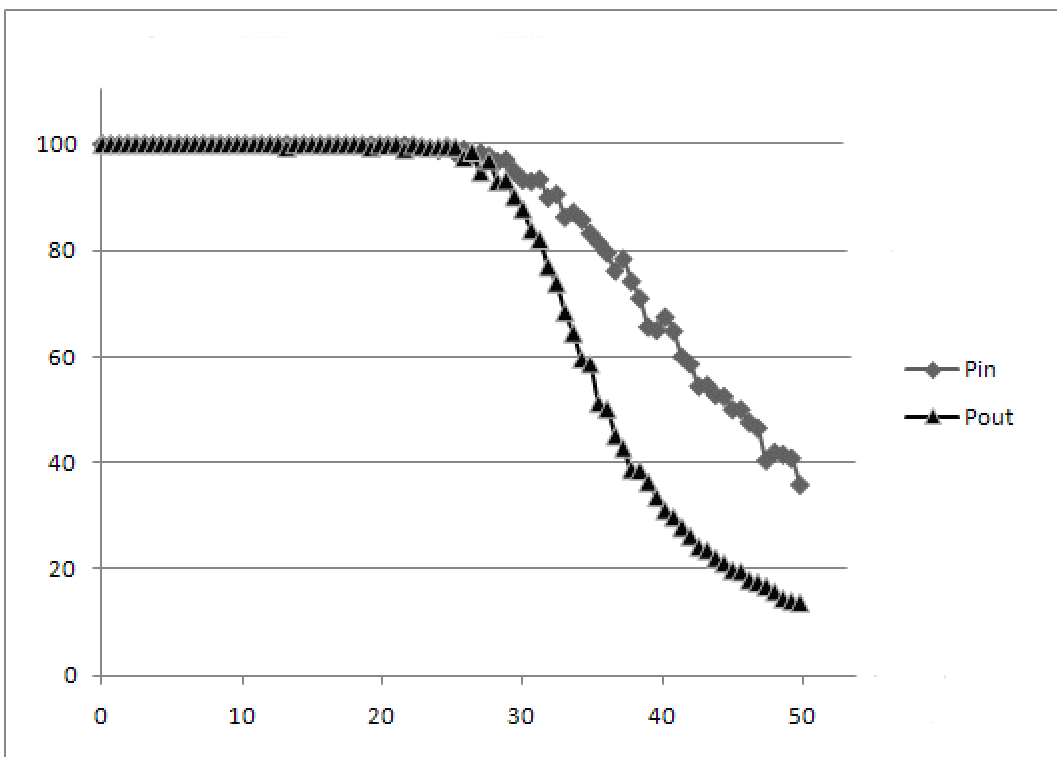
The effectiveness of community detection was tested against the varying randomization parameters of the EWS and HC models.
Key Findings:
- Phase Transition: There is a sharp drop-off in algorithm accuracy once the network moves too far from its small-world origins (as and increase).
- Clustering is Key: The success of community detection is directly proportional to the clustering coefficient. In "true" small-world networks, communities are remarkably easy to identify using local metrics.
Critical Analysis & Future Outlook
While the EWS and HC models provide a much-needed framework for community testing, the author acknowledges a limitation: these models do not natively produce power-law degree distributions (where a few "hubs" have most of the links).
However, the pedagogical and practical value is clear. By isolating hierarchical communities within a small-world framework, this work provides a "clean room" for testing algorithms before they are deployed on the chaotic data of the real Web. Future iterations that incorporate preferential attachment (for power-laws) alongside these hierarchical structures will likely become the gold standard for social network simulation.
Takeaway for Practitioners
If you are building community detection tools, the EWS model should be your first stop for benchmarking. It allows you to prove your algorithm's efficiency in a mathematically rigorous environment where the boundaries of "community" are precisely defined by .