
SmallBlue: Unlocking Collective Intelligence through Passive Social Network Analysis
Smallblue: Social network analysis for expertise search and collective intelligence
SmallBlue (also known as IBM Atlas) is a social network analysis platform designed to unlock organizational business intelligence by mapping "who knows what" and "who knows whom." It utilizes a client-side agent to passively analyze email and IM communications, building a live expertise and social graph of over 350,000 employees without requiring manual profile updates.
Executive Summary
TL;DR: SmallBlue is a sophisticated social networking platform developed by IBM that automates the discovery of expertise and social connections within a massive organization. By passively analyzing email and IM metadata (with privacy safeguards), it provides a dynamic, live map of "who knows what" and "who knows whom," effectively bypassing the failure points of manual employee profiles.
Background: Positioned as a pioneering work in "People Mining," SmallBlue (also known as IBM Atlas) serves as both a SOTA implementation of enterprise social network analysis (SNA) and a practical tool for maximizing the "Social Capital" of employees in large-scale corporate environments.
Problem & Motivation: The Failure of Manual Profiles
In large corporations, the most valuable information often resides in the "informal" roles and networks of employees. Traditional expertise-locator systems typically fail because:
- Maintenance Burden: Users rarely update their skills profiles.
- Lack of Context: Knowing who is an expert isn't enough; you need to know how to reach them.
- Incompleteness: Siloed documentation doesn't capture the fluid exchange of ideas in chats and emails.
The authors' insight was to move from active reporting to passive observation. By analyzing the natural flow of communication, they could build a real-time graph of expertise and social proximity.
Methodology: The Architecture of Expertise
The SmallBlue system is divided into a local client for data acquisition and a suite of web applications for visualization and search.
1. Privacy-Preserving Data Mining
The client analyzes outgoing emails and IMs locally. Instead of sending raw text, it sends stemmed term vectors. Crucially, the system never displays a direct "who-spoke-to-whom" log to other users; instead, it uses aggregated and inferred information to protect individual privacy while still calculating social proximity.
2. Quantifying Social Capital
SmallBlue introduces the concept of Personal Social Capital. This isn't just a list of friends; it's a measure of how many unique geographical and organizational contacts a person can introduce you to.
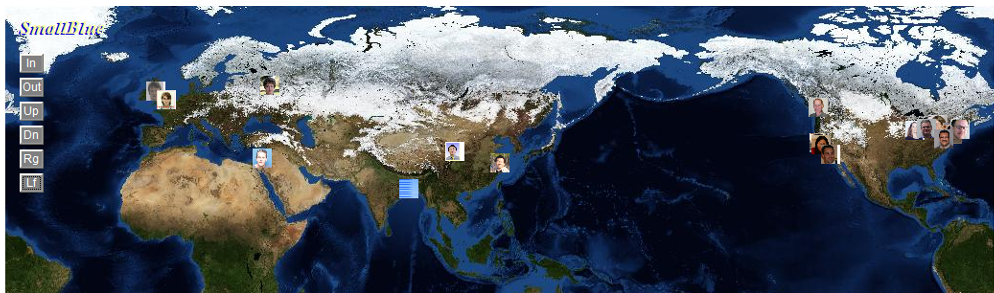 Figure 1: The SmallBlue Ego view, visualizing an individual's personal network and the social capital (bridging potential) of their contacts.
Experiments & Results: Mapping a Global Enterprise
SmallBlue was deployed across IBM, reaching a scale of 350,000 distinct recipients and 8 million communication entries.
Key Features and Performance:
- Expert Search (Find): Unlike a document search, "SmallBlue Find" returns a ranked list of people. The ranking is balanced between keyword relevance and social structure.
- Social Path Visualization (Reach): To solve the "cold start" problem of contacting an expert, the system displays the shortest social path (up to 6 degrees). If you need to talk to a "Second Life" expert, SmallBlue might tell you to "Ask Vicky," who is a mutual contact.
- Community Analysis (Net): This allows users to see the entire structural landscape of a topic.
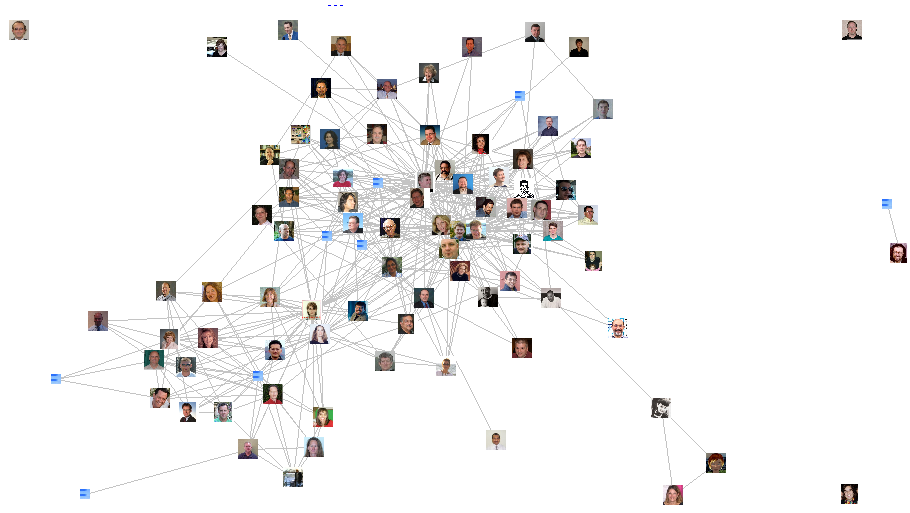 Figure 2: Clustering of experts in a specific domain (Second Life). The system identifies "Hubs" (central nodes) and "Bridges" (connectors between groups).
Critical Analysis & Conclusion
Takeaway
The genius of SmallBlue lies in its recognition that reachability is as important as expertise. It doesn't just find an expert; it finds a trustworthy path to that expert. By automating the data collection, it ensures the system remains a "living" representation of the company.
Limitations
- Consent & Adoption: The system relies on a "network effect"—it is only as good as the number of people who install the client.
- Privacy Perception: Despite strict technical safeguards, some users may remain hesitant to allow an agent to monitor their outbox.
- Contextual Nuance: Stemmed term vectors may lose the semantic nuance of complex technical problems compared to modern LLM-based embeddings.
Future Outlook
The concepts introduced in SmallBlue—social proximity ranking and passive expertise extraction—are more relevant than ever in the era of hybrid work. Future iterations could integrate with collaborative platforms like Slack or Teams, using vector embeddings to provide even more granular expertise matching.