
From Smart Cities to Social Cities: Re-engineering Technology for Community Bonding
From Smart Cities to Social Cities: Technology to Support Community Life
This paper introduces the concept of a "Digital Community Ecosystem" (DCE), a three-layered framework designed to shift the focus of Smart Cities from pure physical infrastructure to social cohesion. It proposes a "Social City" layer on top of existing Smart Grids and Smart City infrastructures to facilitate face-to-face interactions and community bonding.
TL;DR
The "Smart City" paradigm has long been criticized for focusing too much on "hard" infrastructure (grids, pipes, and sensors) while ignoring the "soft" fabric of human society. This paper proposes a Digital Community Ecosystem (DCE), a framework that adds a "Social City" layer to urban planning. The goal is to use technology not to isolate us behind screens, but to act as a catalyst for physical socialization and community life.
The Techno-Social Dilemma
We are living in an era where we have never been more connected digitally, yet never more isolated physically. Urban spaces are losing their function as social hubs because people are increasingly "alone together"—physically present in public but mentally occupied by private mobile devices.
The author argues that current Smart City models, driven by tech giants like IBM and Google, prioritize administrative efficiency (Smart Grids, Smart Traffic) but fail to address the basic human need for belonging. This creates a vacuum where technology disrupts community life rather than supporting it.
Methodology: The Digital Community Ecosystem (DCE)
To bridge this gap, the paper formalizes the Digital Community Ecosystem, structured into three essential layers:
- Smart Grid Layer: The foundation, focusing on energy production, consumption, and sustainability.
- Smart City Layer: The middle tier, comprising the ICT solutions we traditionally associate with smart cities—traffic management, healthcare, and public safety.
- Social City Layer: The crowning layer that focuses on Engagement. It provides the infrastructure needed to bond communities and foster social bonds.
Architecture of the DCE
The author uses a cyclical research method: designing an "in-the-wild" experiment, observing user behavior, and updating the DCE framework based on these real-world interactions.
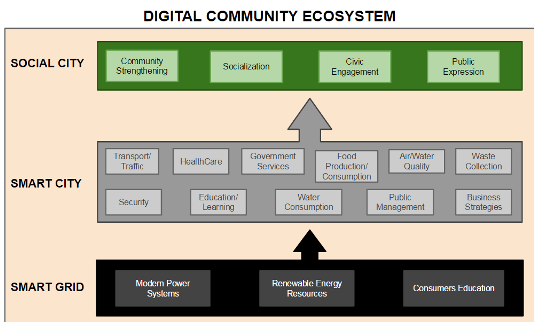 Figure 1: The three-layered Digital Community Ecosystem, highlighting the addition of the Social City layer.
Putting Theory into Practice: "In-the-Wild" Experiments
The research isn't just theoretical. The author details several experiments designed to test how technology can prompt socialization:
- The Table-Top Community Garden: Collaborative applications that allow people to interact through a shared digital/physical gardening task.
- Selfie Cafe & Public Displays: Utilizing public screens to encourage "passerbyers" to interact with one another, breaking the "ice" through interactive digital artifacts.
One critical insight from these experiments is the importance of tangible interfaces. The inclusion of physical objects in interactive systems helps users understand the technology faster and feel more comfortable engaging with strangers.
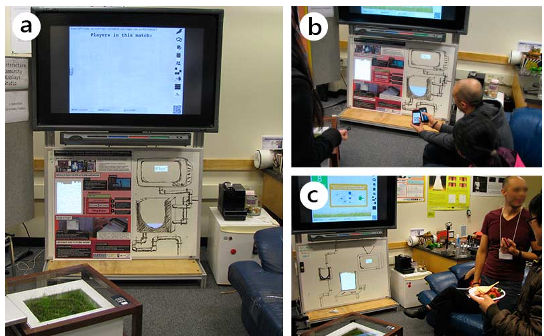 Figure 2: Prototype of a collaborative interface designed to encourage social interaction in urban environments.
Critical Analysis & Conclusion
The true value of this work lies in its shift of perspective. While most Smart City research focuses on optimizing the city, Bueno focuses on humanizing it.
Key Takeaways for Future Research:
- Holistic Integration: We cannot treat "Social Computing" and "Urban Computing" as separate silos. The social layer must sit directly on top of the physical infrastructure.
- The Challenge of Appropriation: A major hurdle identified is "appropriation"—ensuring that a community actually adopts and transforms these technologies into their own daily routines.
Limitations: As a Doctoral Consortium paper, the results are largely qualitative and exploratory. Future work would benefit from more rigorous, long-term quantitative metrics to measure specifically how these social layers impact community resilience and mental well-being over time.
In conclusion, the transition from Smart Cities to Social Cities is not just a technological upgrade—it is a necessary evolution to ensure that the cities of the future are places where community life can actually flourish.