
Smart Crowdsourcing: Eliminating the Middleman with Ethereum Smart Contracts
An Implement of Smart Contract Based Decentralized Online Crowdsourcing Mechanism
This paper presents a decentralized online crowdsourcing mechanism implemented via Ethereum smart contracts. It introduces specific task assignment and reward payment rules to ensure system truthfulness and cost minimization without relying on a central authority.
TL;DR
This research addresses the vulnerabilities of centralized crowdsourcing platforms by deploying a decentralized mechanism on the Ethereum blockchain. By combining Game Theory with Smart Contracts, the authors ensure that workers remain honest ("Truthfulness") while the system eliminates the risks of data leakage and high platform fees.
The Problem: The High Cost of Trust
Traditional crowdsourcing relies on a "Trusted Third Party" (TTP). While platforms like Uber or AMT are effective, they act as a single point of failure and extract significant transaction fees. Moreover, in online scenarios—where workers arrive and depart dynamically—preventing workers from "gaming the system" by reporting fake costs is mathematically complex and difficult to enforce without a robust incentive structure.
Methodology: Truthfulness in a Decentralized World
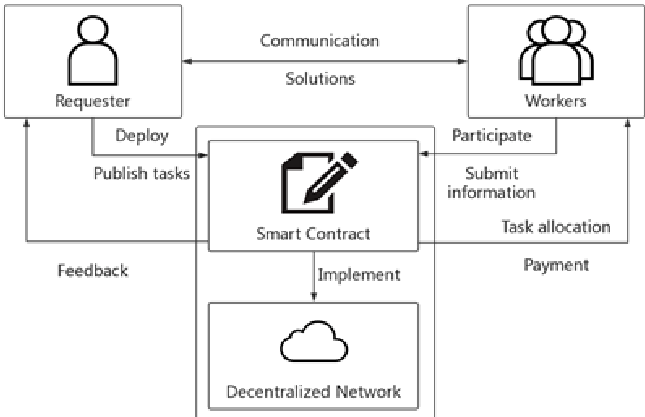
The authors propose a framework that transitions from a centralized model to a distributed network.
1. Task Assignment Logic
The mechanism segments the project into serial tasks. Workers submit a message representing arrival time, departure time, and cost. To maintain efficiency, the contract selects the worker with the minimum cost at each interval. If multiple workers bid the same, a "First-Come, First-Served" (FCFS) rule is applied via arrival tags.
2. The Reward Payment Rule (The "Why" it Works)
To prevent workers from inflating their costs (), the paper employs a Critical Value Payment. Instead of paying the worker their bid, they are paid the maximum price they could have bid while still winning the task. This makes the payoff independent of the worker's own reported cost, thereby incentivizing honesty.
System Implementation on Ethereum
The authors broke down the workflow into five smart contract functions:
- Task Publishing: Requester deposits Ether as reserve funds.
- Worker Quotation: Bids are filtered and stored in a transparent yet secure array.
- Task Assignment: Executed near the end of each time period based on the winning logic.
- Result Presentation: Results are broadcasted to the chain.
- Reward Payment: Critical values are calculated, and funds are released via
Algorithm 2.
Experimental Results
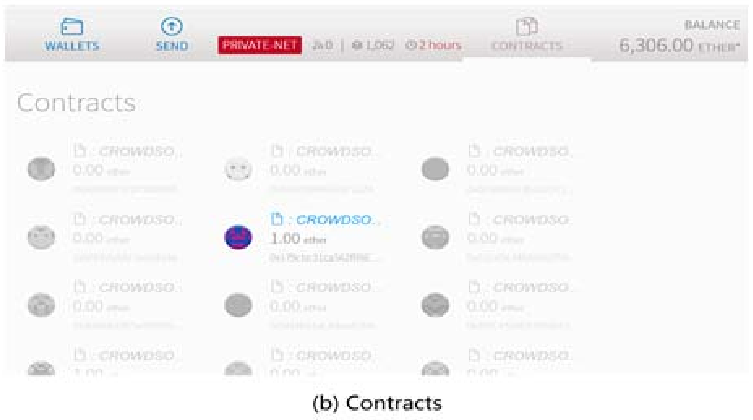
The authors tested the contract on a private Ethereum chain. The results confirmed that the Actual Transfers matched the theoretical Critical Value payments.
| Dataset | Winner Bid | Actual Transfer (10^8 Wei) |
|---|---|---|
| Set 1 | 8 / 10 / 9 | 12 / 12 / 12 |
| Set 2 | 9 / 7 | 10 / 8 |
The "Actual Transfer" being higher than the "Bid" is the essence of the truthful mechanism—it represents the critical value threshold that ensures workers do not benefit from lying.
Critical Insight & Future Outlook
While this paper successfully demonstrates a functional prototype, there is a fundamental "Blockchain Dilemma": Transparency. Because the ledger is public, workers might see previous bids and choose not to participate if they cannot compete, leading to low engagement.
Takeaway: Future iterations must integrate Privacy-Preserving Computation (like Enclave or ZKPs) to hide bids while still proving the correctness of the winner determination. This study serves as a vital stepping stone for shifting the crowdsourcing economy from "Platform-Loyalty" to "Algorithm-Trust."
Conclusion
By moving assignment and payment rules into immutable code, this research proves that we can build fair, efficient, and decentralized marketplaces for human intelligence.