
SNPM: Combatting Info-Leaks with Smart Contracts and Game Theory
Smart Contract-Driven Mechanism Design to Mitigate Information Diffusion in Social Networks
The paper proposes the Social Network Privacy Mechanism (SNPM), a decentralized framework combining game theory and blockchain to prevent unauthorized information diffusion. By utilizing smart contracts on a Directed Acyclic Graph (DAG) structure, it creates an incentive system where message owners reward nodes for holding information rather than forwarding it.
TL;DR
Information in social networks is like water—it's easy to stop at the first pipe, but almost impossible to control once it starts leaking through the cracks of "forwarding." This paper introduces the Social Network Privacy Mechanism (SNPM), which uses blockchain-backed smart contracts to pay users not to share your secrets. By aligning economic incentives with privacy goals, it turns common game theoretic principles into a programmable shield for sensitive data.
The "Forwarding" Problem: Why Privacy Policies Fail
Current privacy solutions are fundamentally broken because they are static. You can set your post to "Friends Only," but you cannot stop a "Friend" from taking a screenshot or forwarding the data to an "Enemy."
The authors argue that centralized servers (like Facebook) are black boxes that lack transparency. More importantly, they identify that information diffusion is an economic problem: an unauthorized user might "bribe" (socially or financially) a legitimate recipient to get the data. To solve this, we need a mechanism where the cost of silence is cheaper for the owner than the cost of a leak.
Methodology: High-Stakes Incentives on a DAG
The core of the paper lies in treating the social network as a Directed Acyclic Graph (DAG). In this model, information flows from a "Messenger" () to various "Agents."
The Bribe vs. Reward Logic
The authors define a recursive relationship between two forces:
- Bribe (): The total value an agent can offer to get the message (including values from their own descendants).
- Reward (): The amount the message owner is willing to pay to keep that agent from seeing/sharing the message.
Architecture Overview
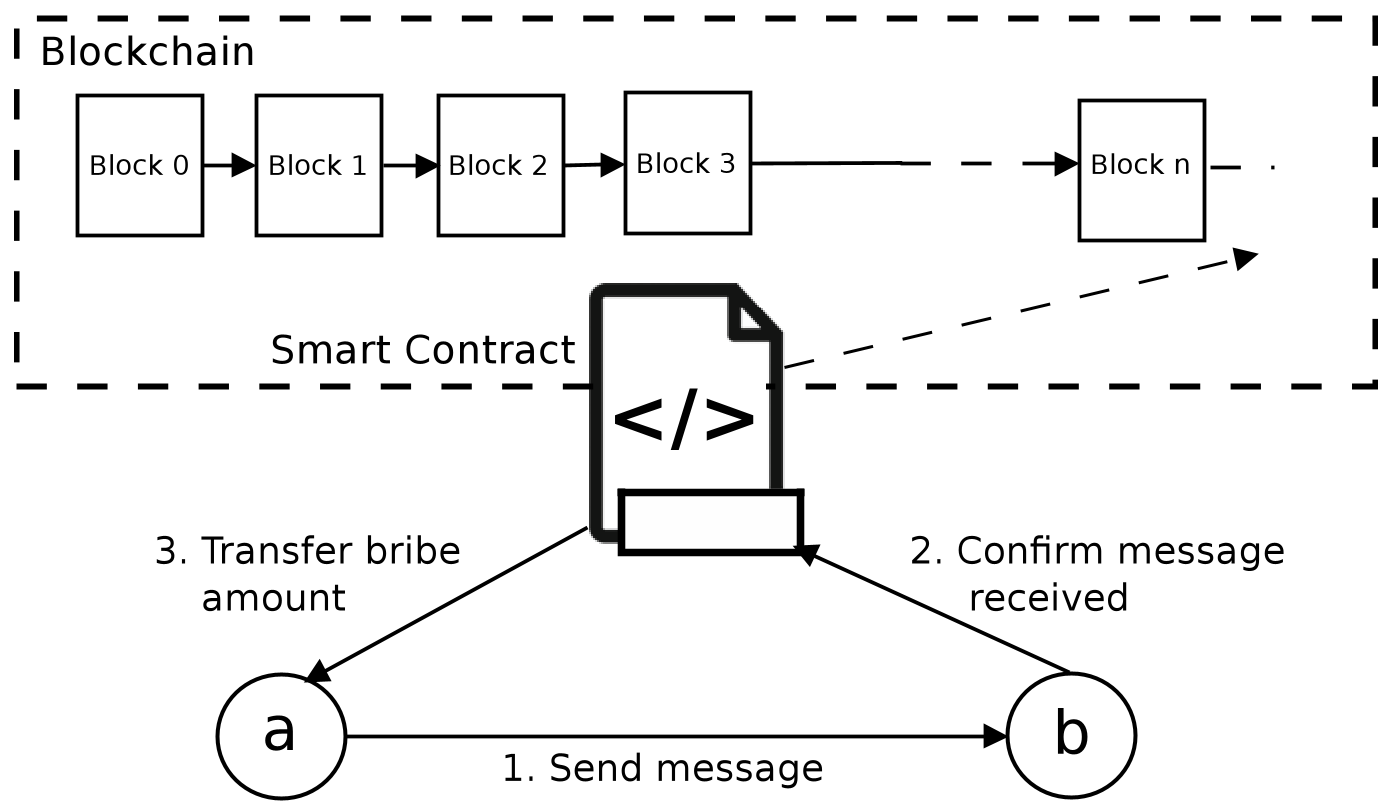
The mechanism triggers a Smart Contract to handle these valuations. If an agent’s potential bribe budget exceeds the owner's reward capacity (), the message is shared. Otherwise, the agent is incentivized to stay silent, receiving a reward that is mathematically guaranteed to be higher than the bribe they would have received.
Proving Fairness: The Three Pillars
A mechanism is only as good as its mathematical guarantees. The SNPM satisfies:
- Individual Rationality: No participant is "punished" or loses money for participating honestly.
- Incentive Compatibility (Truthfulness): The best strategy for any user is to report their true valuation of the data.
- Weakly Budget Balanced: The system doesn't require an external "money printer"; the owner's payments cover the rewards distributed, ensuring the system is self-sustaining.
Experimental Insight: Diffusion Control
The authors illustrate the mechanism's efficacy through a complex network flow example.
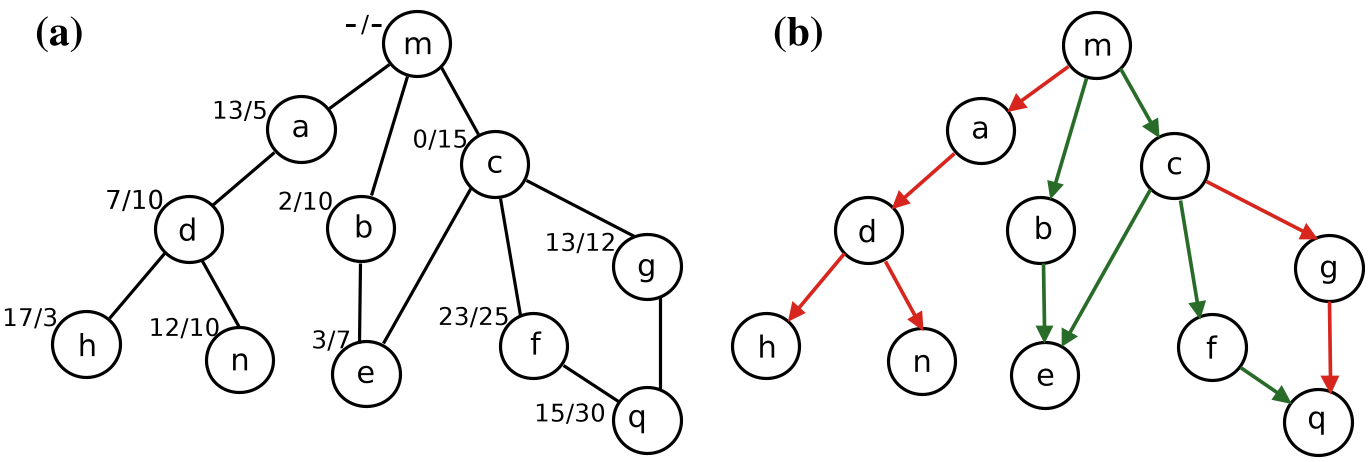
In the experiment (Figure 3), green arrows represent permitted information flow, while red arrows represent "forbidden" paths where the reward offered by the Messenger () was high enough to convince nodes (like node ) not to seek the bribe. This demonstrates that privacy can be "localized"—the owner doesn't need to bribe the whole world, only the key gateways in the graph.
Critical Analysis & Conclusion
The Takeaway
SNPM is a pioneer in "Economic Privacy." It acknowledges that you can't physically stop information from being copied, so it focuses on making it economically irrational to do so. By moving this to a blockchain, the "trust" moves from a corporation to immutable code.
Limitations & Future Work
- DAG Restriction: Real-world social networks are rarely DAGs; they have cycles. Applying this to periodic or cyclic graphs remains a "challenging extension."
- Scalability: Recursive calculations on-chain (like Ethereum) can become prohibitively expensive in terms of Gas fees as the network depth increases.
- Valuation Subjectivity: The system assumes users can accurately quantify their "valuation" of a message in monetary terms, which may not always align with human psychology.
Ultimately, this research opens a fascinating door: a future where your "Privacy Settings" are actually a set of smart contracts managing micro-incentives across your social circle.