
Smart e-Health Gateway: The "Fog" Brain Powering Ubiquitous Healthcare
Smart e-Health Gateway: Bringing intelligence to Internet-of-Things based ubiquitous healthcare systems
The paper introduces UT-GATE, a Smart e-Health Gateway that acts as an intelligent intermediary between medical sensor networks and cloud back-ends. It transforms the traditional "dumb" bridging point into an edge computing hub capable of real-time data processing, storage, and protocol translation.
TL;DR
As healthcare transitions from hospitals to homes, the "Gateway" in IoT is no longer just a mailbox for data packets. This paper presents UT-GATE, a Smart e-Health Gateway that brings intelligence to the edge. By handling data compression, filtering, and local decision-making, it solves the "triangle of pain" in healthcare IoT: Energy Efficiency, Reliability, and Latency.
1. The Strategic Pivot to the Edge
In the traditional IoT paradigm, sensors collect data and the cloud processes it. However, medical sensors (especially implants) are starved for power and memory. On the other hand, relying purely on the cloud is dangerous; a 2-second network lag or an internet outage could be catastrophic in a smart hospital scenario.
The authors identify a "Strategic Position": the Gateway. Unlike sensors, gateways are stationary and have steady power. Unlike the cloud, they are physically close to the patient. By injecting intelligence here—a concept recognized as Fog Computing—the system gains a "local brain" that operates even when the internet dies.
2. Methodology: Architecture of UT-GATE
The UT-GATE isn't just a router; it's a multi-functional embedded server. Its architecture is built to handle the chaos of heterogeneous IoT protocols.
Core Modules:
- Protocol Interoperability: It tunnels 6LoWPAN and translates non-IP Bluetooth/ZigBee signals into IPv4/IPv6.
- Local Data Processing: It runs digital filters (FIR/IIR) to clean "noisy" ECG/EEG signals before they ever reach the cloud.
- Smart Storage: Uses a local MySQL database with a "Federated Engine" to mirror cloud rules, allowing it to provide notifications even offline.
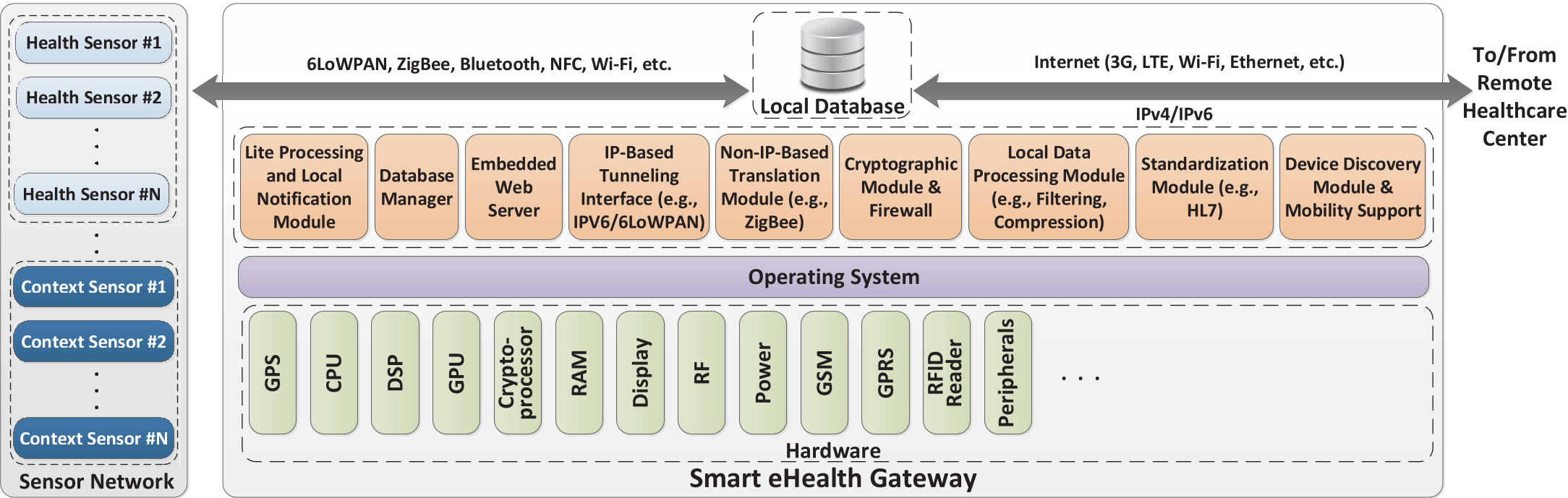 Figure 1: The Internal Logic of the Smart e-Health Gateway.
3. Breaking Performance Bottlenecks
One of the most impressive feats of this research is its approach to Real-time Data Compression.
Medical signals like ECG generate constant streams of data. Sending raw data 24/7 is a bandwidth nightmare. UT-GATE addresses this by:
- Accumulating samples: Grouping 30 samples to increase compression ratio.
- Lossless Compression (LZ4/LZO): Choosing speed over absolute density to ensure real-time delivery.
Key Results:
Experiments showed that for 50 nodes, the gateway handles compression in under 40ms. Given that the IEEE 1073 standard allows for a 500ms latency, UT-GATE operates with a massive safety margin, leaving plenty of room for re-transmitting lost packets.
 Table 1: Performance metrics showing LZ4/LZO compression efficiency vs. number of nodes.
4. Deep Insight: Why This Matters
The "Smartness" of the gateway provides three levels of defense:
- Network Intelligence: It acts as a WebSocket server, pushing real-time charts to a doctor's tablet with only 32ms of LAN latency.
- Data Integrity: It standardizes raw sensor data into HL7 (Health Level-7) formats locally, removing the metadata overhead from the tiny sensors.
- Safety Net: If the hospital's main fiber line is cut, the gateway continues to monitor, log, and trigger local alarms via its built-in notification module.
5. Critical Analysis & Future Outlook
While UT-GATE is a robust proof-of-concept, it faces a few challenges:
- Scalability of Management: As the number of sensors grows, managing the "Reconfigurability" of gateways manually becomes impossible. Future systems will need Zero-Touch Provisioning.
- Security Overhead: While it uses UFW and HTTPS, performing deep packet inspection on a dual-core ARM might hit limits if sophisticated encryption is required.
The Bottom Line: This paper is a foundational blueprint for modern Edge Healthcare. It proves that the gateway is the most critical asset in the IoT chain—moving it from a "dumb bridge" to a "smart sentinel."
Note: This blog summarizes the paper "Smart e-Health Gateway: Bringing Intelligence to Internet-of-Things Based Ubiquitous Healthcare Systems."