
The Clinic of the Future: Transforming Autism Therapy with Pervasive Computing
14461_A Smart Environment for Children with Autism.
This paper presents the long-term deployment of a multi-component smart environment at the Pasitos school clinic for children with autism. It introduces a suite of pervasive technologies—Mobis (AR), BxBalloons (Ambient Display), and exergames (SensoryPaint, FroggyBobby)—integrated via a unified sensing framework to augment traditional therapeutic interventions.
TL;DR
Researchers have successfully moved beyond the "living lab" prototype to deploy a permanent smart environment in a real-world autism clinic. By integrating Augmented Reality (AR), ambient displays, and motion-based exergames, they achieved a massive 10x increase in student attention spans and a 5x improvement in behavioral self-awareness, proving that pervasive technology can be a vital partner in special education.
Background: Beyond the Laboratory
For years, "Smart Environments" were confined to controlled residential labs like PlaceLab. While these provided great data, they lacked ecological validity—the ability to function in the messy, high-stakes atmosphere of a clinical school. The authors of this paper collaborated with the Pasitos school clinic in Tijuana, Mexico, to instrument a "Clinic of the Future" that accommodates 60 students aged 3 to 21.
Problem & Motivation: The Limits of Manual Care
Traditional autism therapy faces three major bottlenecks:
- Manual Record Keeping: Teachers spend too much time documenting and not enough time interacting.
- Engagement Fatigue: Repetitive cognitive trials often lead to student disengagement.
- Lack of Awareness: Children often struggle to perceive their own behavioral patterns or motor coordination in real-time.
The researchers' insight was to use Ambient Intelligence to turn the classroom itself into a feedback loop.
Methodology: The Four Pillars of the Smart Space
The smart environment was built on four interconnected prototypes, each targeting a specific developmental domain:
1. Mobis (Augmented Reality)
Using Android tablets and the Speeded-Up Robust Features (SURF) algorithm, Mobis allows teachers to "tag" physical objects with digital prompts. When a child views an object through the tablet "visor," they see cognitive goals superimposed on the physical world.
2. BxBalloons (Behavioral Awareness)
This ambient display uses a "hot air balloon" metaphor to represent classroom behavior.
- Input: Sound entropy (Mel-MBSES) detects yelling; Fitbits track "atypical" movements.
- Output: Balloons deflate if behavior is poor. This gamification creates a collective responsibility among students to stay focused.
3. SensoryPaint & FroggyBobby (Exergames)
These Kinect-based systems use HSV-model thresholding and depth sensing to track body movements. SensoryPaint allows "mirror therapy" where children paint on a projection using their whole bodies, while FroggyBobby focuses on coordination and motor repetition.
 Figure 1: The vision of the integrated Clinic of the Future.
Experiments & Results: Quantitative Breakthroughs
The deployment wasn't just a pilot; it was a long-term adoption. The quantitative shifts were statistically significant (via ANOVA):
- Attention Span (Mobis): Baseline observation showed 17:15 minutes of focus, which skyrocketed to 3:12:47 after deployment ().
- Behavioral Awareness (BxBalloons): The count of students self-correcting poor behavior rose from 31 to 180 instances ().
- Socialization: Teachers noted that exergames inherently encouraged "turn-taking" and collaboration—skills that are famously difficult to teach in autism therapy.
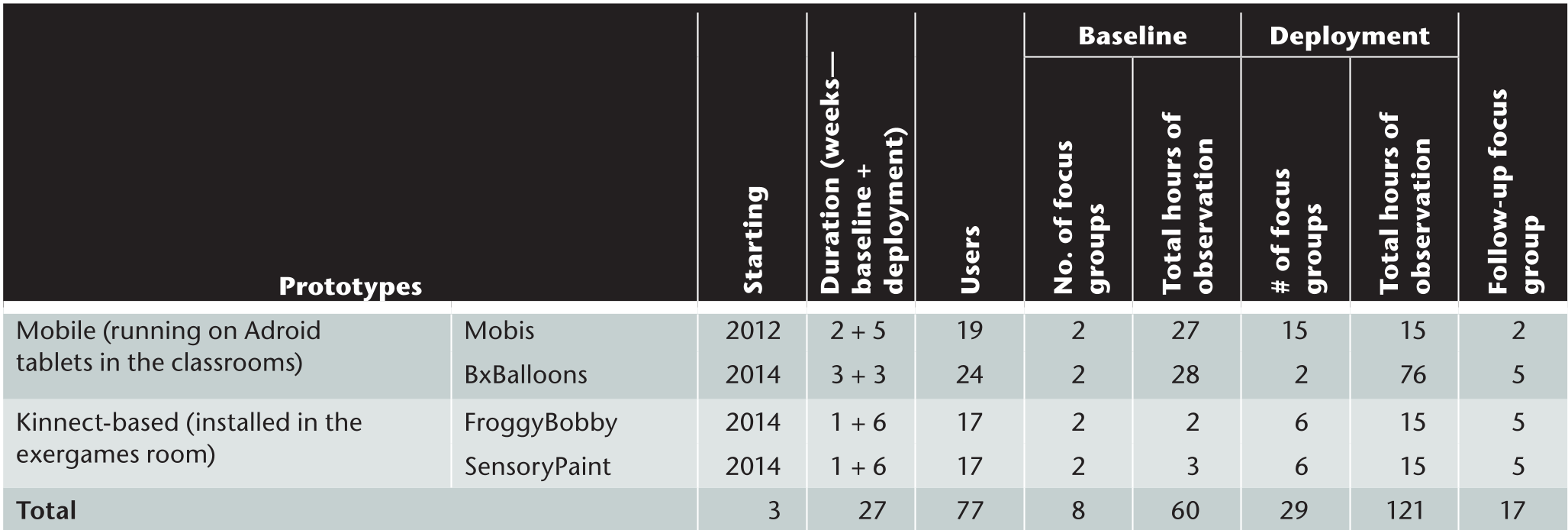 Table 1: Deployment statistics showing long-term usage across 77 users.
Critical Insight: Open-Ended vs. Task-Oriented
One of the most profound takeaways from the study is the flexibility-engagement trade-off.
- Task-Oriented systems (like FroggyBobby) were great for specific goals, but students disengaged once the "game" grew old.
- Open-Ended systems (like Mobis) allowed teachers to constantly invent new uses, leading to higher long-term adoption.
The researchers argue that for a smart environment to survive in the real world, it must be "hackable" by the caregivers themselves.
Conclusion & Future Outlook
The Pasitos school project proves that pervasive technology is moving from "gadgetry" to "infrastructure." The future of these environments likely lies in Embedded Systems (Internet of Things) and Brain-Computer Interfaces (BCI), where the environment can sense not just movement, but cognitive load and frustration levels, adjusting the therapeutic challenge in real-time.
Limitations: The study notes the "Novelty Effect" can skew early data, and the maintenance of heterogeneous hardware remains a burden for non-technical clinical staff.
Takeaway for the Industry: Designing for autism isn't about replacing teachers; it’s about providing them with a "digital magnet" that pulls students into engagement and automates the tedious burden of data collection.